12 V latching solenoid kickback damaging ADP2303 power supply – protection advice needed

Thread Starter

DJ_AA

Joined Aug 6, 2021
490
Hi,

I have encountered an issue where, when driving certain 12 V latching solenoids, my power supply appears to be burning out. I suspect this may be related to kickback current generated by the coil, and that additional protection may be required.

The coil is controlled by an H-bridge IC, which acts as the main driver, and I also have multiple SSRs connected to each solenoid. The H-bridge IC used is DRV8847PWPR and the SSR is CPC1019N. This arrangement has worked well with the previous solenoids, but the most recent solenoids have the specification shown below.

My power supply is based on the ADP2303 from Analog Devices, which appears to be the component being affected and damaged.

As I suspect this is due to inductive kickback, is there anything I can modify on my PCB to provide additional protection? Alternatively, can I add anything in series between the terminal block on the PCB and the solenoids to reduce the kickback effect?
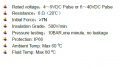
1770928353095.png
 

Thread Starter

DJ_AA

Joined Aug 6, 2021
490
@Ian0
No, can you recommend one?

Also, should I add a Zener diode on my power rail as protection?

I do not want to burn out any more PCB, so how can I test the effect of the diode without my PCB?
 

crutschow

Joined Mar 14, 2008
38,314
can you recommend one?
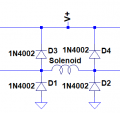
A 1N400x diode connected directly across the coil (cathode to plus side of coil).
should I add a Zener diode on my power rail as protection?
Don't think that's needed if you add the diode.
I do not want to burn out any more PCB, so how can I test the effect of the diode without my PCB?
Don't see how, since that's where the problem occurs.
 

panic mode

Joined Oct 10, 2011
4,864
that driver has built in diodes as shown in datasheet. so do not add diode, specially if you are using driver in full bridge mode because wrong connection will cause more problems. post your schematics.
 

Thread Starter

DJ_AA

Joined Aug 6, 2021
490
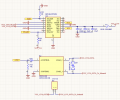
Please find the circuit below:

I have been using the DRV8847PWPR for some time to activate latching solenoids via SSRs, allowing a common H-bridge IC to control multiple SSRs. Please see the reference circuit. For the purpose of this post, I have shown only one SSR to avoid confusion.

If I power the solenoids using a bench-top power supply and alternate the polarity of the wires connected to the solenoid, a small spark can be seen at the point where power is applied. Am I correct in understanding that this is kickback current from the solenoid that does not affect the power supply but could affect my PCB?

1770988221264.png


It is also possible that my use of the DRV8847PWPR is incorrect. Please advise whether the following sequence is correct:

Current sequence:
  1. Set the H-bridge polarity.
  2. Activate the required SSR.
  3. Wait 1 second.
  4. Switch off the SSR and H-bridge.
Proposed alternative sequence:

  1. Set the H-bridge polarity.
  2. Activate the required SSR.
  3. Wait 1 second.
  4. Force both H-bridge output ports low.
  5. Wait 1 second.
  6. Switch off the SSR.


I am thinking that once the solenoids are powered, I am instantly disabling the SSR, which could cause the energy stored in the coil to increase the voltage. Perhaps I am mistaken.


Also, how would diode protection be used for a latching solenoid that requires the polarity to be swapped?
 

Thread Starter

DJ_AA

Joined Aug 6, 2021
490
My Solenoid is connected to the PCB using a long wire.

The V+, would that be 12V from the power rail or the output of the H-Bridge?

From your experience, could the way energy is dissipated from the coil cause such an issue? I have adjusted the timing slightly, but I am reluctant to test the solenoid again to avoid any potential damage to the PCB without TVS protection.
 

crutschow

Joined Mar 14, 2008
38,314
The V+, would that be 12V from the power rail or the output of the H-Bridge?
The V+ is the 12V supply.
The output of the H-bridge goes to the solenoid.
could the way energy is dissipated from the coil cause such an issue?
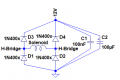
If the diodes are properly connected, including decoupling capacitors (100µF in parallel with 100nF) at the diode connections from the V+ to ground, then a small part of the inductive energy will be dissipated in the diodes, and the rest in the solenoid resistance.
The idea is to keep the solenoid inductive current localized to near the diodes at the bridge solenoid connections in the circuit, i.e. through the diodes and the capacitors.
Then no significant energy should be dumped into the circuit otherwise.

Revised circuit below:

1771007152384.png
 
Last edited:

Thread Starter

DJ_AA

Joined Aug 6, 2021
490
Ok, so this protection circuit happens on the PCB, rather than on the coil after a long wire. As my H-Bridge IC includes this protection

The question about the dissipated energy was related to my previous post about enabling the SSR when the H-Bridge goes low. For example

1. Set H-bridge outputs LOW (both low / brake / slow-decay).
2. Enable SSR (connect coil while voltage = 0).
3. Apply required H-bridge polarity to create the pulse.
4. Wait the required pulse time (e.g., 50–200 ms for latching).
5. Return H-bridge to LOW again (allow current decay).
6. Wait ~50–200 ms for energy to dissipate.
7. Disable SSR.

Is adding a snubber like the following recommended?
DAOKAI RC Snubber/Absorption Circuit Module,5 PCS Relay Contact Protection Circuit Electromagnetic Anti-Interference Module DC 5-400V Inductive Load Resistance Surge : Amazon.co.uk: DIY & Tools
 

Thread Starter

DJ_AA

Joined Aug 6, 2021
490
The V+ is the 12V supply.
The output of the H-bridge goes to the solenoid.
If the diodes are properly connected, including decoupling capacitors (100µF in parallel with 100nF) at the diode connections from the V+ to ground, then a small part of the inductive energy will be dissipated in the diodes, and the rest in the solenoid resistance.
The idea is to keep the solenoid inductive current localized to near the diodes at the bridge solenoid connections in the circuit, i.e. through the diodes and the capacitors.
Then no significant energy should be dumped into the circuit otherwise.

Revised circuit below:

View attachment 363423
This would be for a new PCB revision. I can add TVS on actual wire of the solenoid for now.

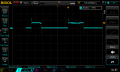
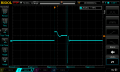
I carried out a small test to see what the solenoid could output using a scope. Please see attached,

On both tests, you will see a small drop in voltage because I limited the power supply current to 1 A. As a result, the voltage drops to about 7 V, but the solenoid still operates correctly.

Test 1: When the power supply is connected to the solenoid, I toggle the power button to apply and then remove the voltage. This looks a little cleaner than Test 2.

test1.png

Test 2: I simply touch the solenoid connection for a second or so. As you can see, there are spikes in the output. This goes back to my question in my previous post: what happens if I do not allow the solenoid to discharge via the H-bridge IC (forcing both outputs low while the solenoid is connected)? This test was done by hand, so there could be slight vibration causing a small issue or initial spike, which may be due to contact bounce.

test2.png
 

Thread Starter

DJ_AA

Joined Aug 6, 2021
490
Then is there decoupling directly on the chip pins using capacitors similar to what I show in post #9?
No, not on the output.
The output ports of the H-Bridge are also connected to a terminal block connector with a GND pin between them. Could adding a 10uF or 100nF between them be recommended
 
Last edited:
Top