Solenoid engine..arc on contacts

MisterBill2

Joined Jan 23, 2018
27,504
While the revered connected diode will do a very good job of reducing the arc it will also very much slow the collapse of the magnetic field. The result may be a change in the performance of the motor. And one more thing, the 1N4004 is still only a 1 amp diode! They vary in allowable reverse voltage spec from 50 volts for the 1N4000 to 600 volts for the 1N4006, or maybe the 1N4007. At any rate, it is a family of 1 amp diodes.
Another option, instead of diodes, would be light bulbs. 24 volt pilot light bulbs would probably both reduce the arcing and put on a good show.
 

AlbertHall

Joined Jun 4, 2014
12,625
While the revered connected diode will do a very good job of reducing the arc it will also very much slow the collapse of the magnetic field.
If the slow collapse is a problem then you can use a Zener diode in series with a 'normal' diode. This will allow a reverse voltage up to the zener voltage. This increased reverse voltage will reduce the current more quickly.

[EDIT] I hesitate to mention this and possibly add to the confusion but...
You can put just a zener diode across the contacts to achieve the same quicker collapse as above. N.B. This only works with a zener diode rated above the supply voltage.
 

BobTPH

Joined Jun 5, 2013
11,514
Sorry to disagree with Bob but the kickback voltage in something as inductive as solenoids will be several times the supply voltage due to inductance and the the rate of field collapse.
OP, the current is going to be small by the look of the solenoids and I would suggest using 1N4004 or 1N5404 diodes. These are rated at 400V and there is no cost penalty, these diodes cost pennies whether 50V or 1000V and will largely eliminate your problem. You need to connect them in reverse bias* , parallel with the switch contacts.
*You can read more on bias here: https://www.allaboutcircuits.com/te...chpt-3/introduction-to-diodes-and-rectifiers/
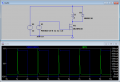
Tell me again why I need a 400V diode:

Blue is the voltage anode to cathode of the diode.
Green is the current through the diode, with the solenoid sized to draw 500mA

upload_2019-2-1_10-16-59.png
 

Attachments

MisterBill2

Joined Jan 23, 2018
27,504
The reason that a 400 volt reverse rated diode is needed is because the model in the post does not accurately reflect the reality in the hardware. The sparks at the contacts demonstrate that even better than I can explain it. The modeling software does not have an accurate model of a bouncy mechanical contact. In fact, the modeling program does not have a model of a really good mechanical contact, either.
 

AlbertHall

Joined Jun 4, 2014
12,625
The reason that a 400 volt reverse rated diode is needed is because the model in the post does not accurately reflect the reality in the hardware. The sparks at the contacts demonstrate that even better than I can explain it. The modeling software does not have an accurate model of a bouncy mechanical contact. In fact, the modeling program does not have a model of a really good mechanical contact, either.
Still wrong.
To get 400v across the diode in that circuit the drain would need to be at -388V or so and that can't happen as the drain source diode in the MOSFET will clamp that to a maximum of about 1V.
 

MisterBill2

Joined Jan 23, 2018
27,504
Still wrong.
To get 400v across the diode in that circuit the drain would need to be at -388V or so and that can't happen as the drain source diode in the MOSFET will clamp that to a maximum of about 1V.
There are no mosfets in the posted circuits. If mosfets were involved the arcing would probably not be a problem. Thus my statement that the mosfet circuit does not accurately reflect the actual hardware.
 

Tonyr1084

Joined Sep 24, 2015
9,744
@AlbertHall and others: Fictitious circumstance: Suppose you have a fictitious diode with a 1 volt reverse bias and you place it in series with a 12 volt battery in that reverse order: Will the resulting circuit have just one volt? If so - what happens to the other 11 volts?

My thinking on the breakdown voltage of a solenoid is potentially a lot higher than the initial charging voltage. As we know, coils build up their magnetic field over time - dependent in part on the voltage. When the voltage is removed the magnetic field collapses (in a perfect world) immediately, resulting in a much higher pulse of voltage. I see both sides of the argument, that "one" the breakdown voltage is significantly high, and "two" that the clamping diode will limit that voltage. Nevertheless, the collapse of the magnetic field is so swift that it presents a potential voltage at the diode, meaning that if the diode can't cope with that potential then it may break down and fail.

I also had a thought that in addition to a diode across the solenoid, having a snubber circuit of a resistor and capacitor across the contacts may further reduce the arcing. I don't KNOW this, but I think it will help. This is just my opinion. If anyone takes issue with my comments - I respect the difference of opinion or even difference in the level of understanding.
 

AlbertHall

Joined Jun 4, 2014
12,625
Nevertheless, the collapse of the magnetic field is so swift that it presents a potential voltage at the diode, meaning that if the diode can't cope with that potential then it may break down and fail.
When the switch/MOSFET/transistor opens the inductor will 'want' the current to continue flowing so, with the reverse diode, the current has a path to continue flowing. If the original current in the inductor was 1A then that 1A will flow in the diode and gradually decay. There is no big current or voltage spike.

Suppose you have a fictitious diode with a 1 volt reverse bias and you place it in series with a 12 volt battery in that reverse order
I don't understand the circuit you are describing. There are two possibilities:
1. You connect 12V across the diode in the reverse direction. You have 12V across the diode and negligible current.

2. You connect 12V across the diode in the forward direction. A large current will flow and either the diode will drag the 12V down to 1V ish, or the diode will release the magic smoke and go the breadboard in the sky. Which of those happens depends on the current rating of the diode and the internal resistance of the 12V source. This is not the circumstance in the system we are discussing - see the first part of my answer.
 

MisterBill2

Joined Jan 23, 2018
27,504
@AlbertHall and others: Fictitious circumstance: Suppose you have a fictitious diode with a 1 volt reverse bias and you place it in series with a 12 volt battery in that reverse order: Will the resulting circuit have just one volt? If so - what happens to the other 11 volts?

My thinking on the breakdown voltage of a solenoid is potentially a lot higher than the initial charging voltage. As we know, coils build up their magnetic field over time - dependent in part on the voltage. When the voltage is removed the magnetic field collapses (in a perfect world) immediately, resulting in a much higher pulse of voltage. I see both sides of the argument, that "one" the breakdown voltage is significantly high, and "two" that the clamping diode will limit that voltage. Nevertheless, the collapse of the magnetic field is so swift that it presents a potential voltage at the diode, meaning that if the diode can't cope with that potential then it may break down and fail.

I also had a thought that in addition to a diode across the solenoid, having a snubber circuit of a resistor and capacitor across the contacts may further reduce the arcing. I don't KNOW this, but I think it will help. This is just my opinion. If anyone takes issue with my comments - I respect the difference of opinion or even difference in the level of understanding.
Tony, You are quite correct about the snubber. That will also reduce the radiated interference from this motor.
 

MisterBill2

Joined Jan 23, 2018
27,504
And now I am wondering about the actual purpose of this motor, since it is clear that a fair amount of effort went into building it. Certainly it is an interesting device, demonstrating a number of principles, but it is not really a very efficient motor. So could the TS please give us a bit of the explanation of Why"?
 

Tonyr1084

Joined Sep 24, 2015
9,744
I think if I were to build this machine I'd set up the crank so that one piston is 90˚ from the other. I would use a forward voltage to pull a magnet into the solenoid. With 90˚ rotation the second solenoid would pull. With an additional 90˚ rotation I would apply a reverse voltage and make the solenoid PUSH the magnet out, and finally, with the final 90˚ rotation the second solenoid would likewise push the magnet out. Thus, making this effectively a four cylinder (or solenoid) engine. With just the two solenoids only pulling there is a period in-between each where there is only flywheel momentum keeping the machine moving. If the one solenoid was at top dead center when it was pulling the motor wouldn't know WHICH way to run unless someone gave it a spin. With the four cylinder configuration the motor will always run in one direction. If you reverse the battery polarity the motor would run in the other direction - each case, without need for anyone to spin the flywheel.

I don't think this is a practical device, other than to be similar to those kinetic machines that are merely objects of fascination.
 

BobTPH

Joined Jun 5, 2013
11,514
When the voltage is removed the magnetic field collapses (in a perfect world) immediately, resulting in a much higher pulse of voltage.
The field does not collapse if there is a path for the current to flow. In this case, the diode. Basically, when you remove the source of a current to an inductor, the voltage rises to the point where the current continues to flow. In this case, less than 1V.

Bob
 
Last edited:

MisterBill2

Joined Jan 23, 2018
27,504
The field does not collapse if there is a path for the current to flow. In this case, the diode. Basically, when you remove the source of a current to an inductor, the voltage rises to the point where the current continues to flow. In this case, less than 1V.

Bob
The field does collapse, but not instantly as long as the current flows. But since there are losses in the resistance the energy is dissipated and it does collapse eventually. Otherwise we would have perpetual motion. The diode will slow the collapse and so for maximum speed the timing will need to be adjusted to break the circuit sooner.
 

shortbus

Joined Sep 30, 2009
10,050
And now I am wondering about the actual purpose of this motor, since it is clear that a fair amount of effort went into building it.
Never saw one built like this one, but it is a type of 'model motor'. There have been plans for them since before I was a kid, because the first one I ever saw was in an old Popular Science type magazine that was in my grandpa's garage attic.
 

cork_ie

Joined Oct 8, 2011
428
It won't work across the contacts. It must be across the solenoid.
The voltage across the contact doesn't reverse during the spike, as the voltage across the solenoid does.
Diode across solenoid or contacts ?
Sorry to have confused you, of course it is diodes across the coil or a capacitor across the contacts. It was late last night when I posted that.
One down side of using freewheel diodes is that there will be a slower decay in the solenoids so they don't "snap" open and close as sharply as before and your engine may stop altogether. A capacitor across the contacts will reduce the sparking by a considerable amount if this becomes a problem ( see "snubber" ).
You could also try a standard diode and Zener in series across the coils to give an optimum decay time while still reducing the kickback voltage. This is what Ti recommend for their relays.
 

MisterBill2

Joined Jan 23, 2018
27,504
Sorry to have confused you, of course it is diodes across the coil or a capacitor across the contacts. It was late last night when I posted that.
One down side of using freewheel diodes is that there will be a slower decay in the solenoids so they don't "snap" open and close as sharply as before and your engine may stop altogether. A capacitor across the contacts will reduce the sparking by a considerable amount if this becomes a problem ( see "snubber" ).
You could also try a standard diode and Zener in series across the coils to give an optimum decay time while still reducing the kickback voltage. This is what Ti recommend for their relays.
I think it has been stated a few times that it will change how the thing works, and that a timing adjustment may be required.
 

cork_ie

Joined Oct 8, 2011
428
I think it has been stated a few times that it will change how the thing works, and that a timing adjustment may be required.
And I have suggested possible solutions that he can research, how bad is that ?
It will slow down too. I can't see his machine or how it works or what speed it runs at, just a picture.
I just advised of the possible downsides of using flywheel diodes and how the problems can be mitigated.
 

Thread Starter

DrewStupid

Joined Nov 28, 2018
64
I think if I were to build this machine I'd set up the crank so that one piston is 90˚ from the other. I would use a forward voltage to pull a magnet into the solenoid. With 90˚ rotation the second solenoid would pull. With an additional 90˚ rotation I would apply a reverse voltage and make the solenoid PUSH the magnet out, and finally, with the final 90˚ rotation the second solenoid would likewise push the magnet out. Thus, making this effectively a four cylinder (or solenoid) engine. With just the two solenoids only pulling there is a period in-between each where there is only flywheel momentum keeping the machine moving. If the one solenoid was at top dead center when it was pulling the motor wouldn't know WHICH way to run unless someone gave it a spin. With the four cylinder configuration the motor will always run in one direction. If you reverse the battery polarity the motor would run in the other direction - each case, without need for anyone to spin the flywheel.

I don't think this is a practical device, other than to be similar to those kinetic machines that are merely objects of fascination.
I built this just as an experiment. I train app electricians. Part of it is electronics. My resources is limited !
Cant detemine rpm. My guess is +-500rpm. <SNIP>

Moderators note : removed email to avoid spammers.
Personal details can be exchanged using PM.
 
Last edited by a moderator:

Thread Starter

DrewStupid

Joined Nov 28, 2018
64
I built this just as an experiment. I train app electricians. Part of it is electronics. My resources is limited !
Cant detemine rpm. My guess is +-500rpm. <SNIP>

Moderators note : removed email to avoid spammers.
Personal details can be exchanged using PM.
Sorry Sir ! Please don't expell me !
 

Thread Starter

DrewStupid

Joined Nov 28, 2018
64
I think if I were to build this machine I'd set up the crank so that one piston is 90˚ from the other. I would use a forward voltage to pull a magnet into the solenoid. With 90˚ rotation the second solenoid would pull. With an additional 90˚ rotation I would apply a reverse voltage and make the solenoid PUSH the magnet out, and finally, with the final 90˚ rotation the second solenoid would likewise push the magnet out. Thus, making this effectively a four cylinder (or solenoid) engine. With just the two solenoids only pulling there is a period in-between each where there is only flywheel momentum keeping the machine moving. If the one solenoid was at top dead center when it was pulling the motor wouldn't know WHICH way to run unless someone gave it a spin. With the four cylinder configuration the motor will always run in one direction. If you reverse the battery polarity the motor would run in the other direction - each case, without need for anyone to spin the flywheel.

I don't think this is a practical device, other than to be similar to those kinetic machines that are merely objects of fascination.
I think if I were to build this machine I'd set up the crank so that one piston is 90˚ from the other. I would use a forward voltage to pull a magnet into the solenoid. With 90˚ rotation the second solenoid would pull. With an additional 90˚ rotation I would apply a reverse voltage and make the solenoid PUSH the magnet out, and finally, with the final 90˚ rotation the second solenoid would likewise push the magnet out. Thus, making this effectively a four cylinder (or solenoid) engine. With just the two solenoids only pulling there is a period in-between each where there is only flywheel momentum keeping the machine moving. If the one solenoid was at top dead center when it was pulling the motor wouldn't know WHICH way to run unless someone gave it a spin. With the four cylinder configuration the motor will always run in one direction. If you reverse the battery polarity the motor would run in the other direction - each case, without need for anyone to spin the flywheel.

I don't think this is a practical device, other than to be similar to those kinetic machines that are merely objects of fascination.
Came up in my mind. How do suggest the mechanical side would work ? Changing the polarity. Two supplies? I like your idea. The crank will ceep the core in position ?
 
Top