Solenoid and water pump activation

Thread Starter

Kim Sleep

Joined Nov 6, 2014
402
Kim, Kim, Kim ... This is not a free homework service. Show us your solution to the problem and we will advice.

Update; You didn't say what this is for, but based on your profile it probably is not homework.

Also, think about what you are asking and how little information you have given us to work with.

Solenoid and pump currents / datasheets / websites; power source, etc. - ????

And, a timing diagram.

And - will the button always be released before the pump activates?

And - What is the guaranteed minimum time between when a cycle finishes and when the button is pressed again?

ak
The biggest problem I have with giving specific component specifications, is I frequently buy Surplus, or from Ali Express, and specific resistances, running/idle power consumption, etc,. etc., are not indicated.
 

crutschow

Joined Mar 14, 2008
38,564
Are you proposing using the R4-C4 reset pulse as an input lockout period?
No.
It has nothing to do with a lockout period.
I guess my explanation was not clear.

As I stated, the problem is that the reset pulse time as determined by R4C4 is too short to allow C2 to discharge through U1A's output resistance, and if C2 is not discharged, then the circuit doesn't reset.
I'm pretty sure that will be a problem with the real circuit, so that's why I increased the value of R4.
 

AnalogKid

Joined Aug 1, 2013
12,174
The reset pulse period and the C2 discharge period are not related.

The reset pulse resets the U1A-U1B flipflop, which latches pin 3 low so C2 can discharge through D2. Pin 3 stays low when the reset pulse terminates and pin 6 goes high, and the circuit just sits there in the inactive state. Thus, the reset pulse initiates the discharge period, but does not affect its length, No matter how narrow the reset pulse is (down to about 300 ns), pin 3 stays low until the next button press.

Or am I missing something - ?

All of the references are for the schematic in post #18.

ak
 
Last edited:

crutschow

Joined Mar 14, 2008
38,564
Or am I missing something - ?
Just an accurate explanation from me about a hidden gotcha in the reset logic.
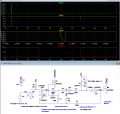
After examining the sim with the failure, I realized my description did not really show why the slow discharge of C2 is a problem.

The sim below shows that, due to the high current required to discharge C2 through U1a's output impedance, U1a's output does not get low enough during the short reset pulse to go below the input logic level of U1b and reset the latch. (see expanded U1a's output, third trace from the top)

Thus a longer reset pulse is needed so the output of U1a has time to discharge C2 below the logic level for latch reset.

The actual needed reset pulse time is, of course, determined by the actual output resistance of a real device.

Make sense?

1776798702739.png
 

AnalogKid

Joined Aug 1, 2013
12,174
I don't think I've run into this issue before, but I get it.

A number that is stuck in my head from way back is that the output resistance of a standard B-series CMOS gate is around 400 ohms. That feels a bit high, but that might be a 5 V number rather than a 12 V number. If that still is true, or an upper limit, then three time constants would be around 5 to 6 milliseconds. A 10 ms reset pulse should cover that.

ak
 

crutschow

Joined Mar 14, 2008
38,564
the output resistance of a standard B-series CMOS gate is around 400 ohms
My sim model shows a fixed 500Ω at any normal operating voltage.

An alternate solution is to a small resistor (e.g. 1kΩ) in series with the diode,, but that just adds a part, without any perceived advantage over stretching the reset pulse.
 
Last edited:

crutschow

Joined Mar 14, 2008
38,564
Small correction:
Just noticed that C3 has the wrong polarity.
The right side of C3 is always more positive than the left side (U1c output).
 

AnalogKid

Joined Aug 1, 2013
12,174
Just noticed that C3 has the wrong polarity.
oops.

In the original schematic, C3 was oriented correctly but it was a vertical decal rotated 90 degrees so the text was not right. I created a horizontal decal based on another part that decal has + to the left, and updated both schematics. I forgot to rotate it 180.

Fixed both schematics.

ak
 
Last edited:

Thread Starter

Kim Sleep

Joined Nov 6, 2014
402
oops.

In the original schematic, C3 was oriented correctly but it was a vertical decal rotated 90 degrees so the text was not right. I created a horizontal decal based on another part that decal has + to the left, and updated both schematics. I forgot to rotate it 180.

Fixed both schematics.

ak
Thank you so much for your help, which is always great
 

Thread Starter

Kim Sleep

Joined Nov 6, 2014
402
My sim model shows a fixed 500Ω at any normal operating voltage.

An alternate solution is to a small resistor (e.g. 1kΩ) in series with the diode,, but that just adds a part, without any perceived advantage over stretching the reset pulse.
Is this Diode D1?
 
Top