12v solenoid actuated by water flow

Thread Starter

DreamEater

Joined Jan 23, 2025
10
Hi,

I have a system that makes hot water, but when the water stops the heater shuts down, I'd like to keep the heater running as the flow can stop for a few seconds to a few minutes, maybe longer, up to an hour, but it takes too long to start up and get hot water running again.

I have been looking at water flow meters with a solenoid but I cannot find a way to control/read the flow to be able to actuate the solenoid.

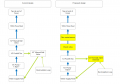
I have attached a image of how the system is currently and how I would like to run it.

Basically, I use the water for a bit, turn the tap off on the hose and then I manually close the hose reel ball valve (to keep pressure in the hose) and open the recirculation loop, this is the part I want to automate. I can't use wifi, nor can the tap at the end of the hose have anything on it.

I'm hoping that when the tap on the hose is closed the flow will stop or reduce enough to trigger the solenoid to open, I'm thinking a one way valve before the flow meter to keep the pressure in the hose as this is really important.
Screenshot 2025-01-23 174424.png
Could you help please?

Screenshot 2025-01-23 174424.png
 

Thread Starter

DreamEater

Joined Jan 23, 2025
10
OK.
You want the heater ON when the water is not flowing?
No not at all.

The pump is pumping to the hose reel, when the hose reel is turned off the water flow stops, the heater goes in to shutdown. But if i open the recirculation loop before the hose reel the heater will stay on, I need to automate the recirculation loop opening when flow stops to the hose reel
 

Thread Starter

DreamEater

Joined Jan 23, 2025
10
OK. Do you have the Solenoid valve and Flow sensor on hand?
No, they haven't been bought yet as I'm not certain how to make the flow meter talk to the solenoid.

Do you have any recommendations for meters and/or controllers?
Is the right way to do this with a flow meter?
 

MisterBill2

Joined Jan 23, 2018
27,474
OK, there is another way to monitor flow, which is a differential pressure switch shunting a check valve.
And now as I think about it, what sort of arrangement does the water heater have to sense when the flow stops?? If that switch is accessible, it could serve to trigger the re-circulation pump.

The big challenge is that the heater shut-down is a safety function, since probably there is enough heat to create steam.
 

GetDeviceInfo

Joined Jun 7, 2009
2,271
What is the volume of your recirculation loop? Could you sacrifice some pressure to dump over a pressure relief valve, inline with the recirc line.
 

MisterBill2

Joined Jan 23, 2018
27,474
REally, there is a much simpler scheme used in hydraulic systems all of the time. I am guessing that when the TS stops using the water flow, a valve is closed to stop the flow. So the pressure at the pump rises a bit. In a hydraulic system, when the flow stops and the pressure rises, a pressure relief valve opens and the pump flow is returned directly to the reservoir (tank). So al the TS needs is a relief valve that opens when the pressure rises because of closing the user valve. Adjustable pressure relief valves are a quite common sort of thing, and they should be available. The simplest possible scheme there can be. Why did I not think of it last time???
 

DC_Kid

Joined Feb 25, 2008
1,242
Post #17 is easiest way. That flow meter becomes your "flow meter-sensor", then just adjust the delay to near zero so that the loop opens as soon as you shut off the tap.

Place it as close to tap as possible, this way it can also work as protection against water line break or rupture. If you place it close to pump then it's possible the tap is off but the line breaks between tap and pump, in this case the loop will stay closed and water keep flowing out the break.

An alternative method is a clamp-on flow sensor. A tad more expensive but you don't have any inline device that may go bad in the future, and they do go bad, how fast depends on the sensor and the chemical composition of the water.
 

MisterBill2

Joined Jan 23, 2018
27,474
Really, I offer a tried and proven and very widely used scheme in post #18. Evidently nobody understands how it actually works. ALL of the other schemes depend on electrical power and quite a bit of circuitry and hardware.
Certainly a low pressure relief valve is a totally non-electronic method, and possibly it will be a challenge to come up with the right one. BUT it is vastly simpler and a lot more reliable.
 
Top