Soldering button diodes

Thread Starter

stryped

Joined Sep 17, 2023
134
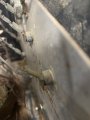
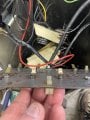
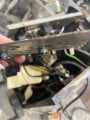
I have an old battery charger I am trying to resurrect that I mentioned on another thread. It has a metal plate with 8 button diodes that are soldered to the plate on one side, and have male spades soldered on the other. How difficult would it be to solder new diodes? I am assuming if they get to hot it will ruin the diode?
 

BobTPH

Joined Jun 5, 2013
11,463
Should be quite easy. You need a soldering iron designed for electronics, i.e about 25 or 30W, not the old soldering gun that heats a loop of copper. Do you know how to solder? It should only take a few seconds if heating to melt solder on those.
 

Tonyr1084

Joined Sep 24, 2015
9,744
The metal plate is likely Aluminum. And it's a heat sink. To solder anything to it would probably require a means of heating the plate as well as the solder joint. Wouldn't recommend a torch either. That'll be way too much local heat and could damage the diode.

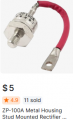
What I'd recommend is getting stud mounted diodes and drilling the necessary size hole so you can stud mount them along with a good layer of thermal paste to transfer the heat from the diode into the plate. Since, in that other thread, you damaged one I wouldn't replace them all, just the one that needs replacing.

Yesterday I started a thread about a stud mounted diode that I have in my drawer. It was an outcropping of your other thread. So I'm familiar with your challenge. No, I wouldn't try soldering a new diode in. I'd drill, bolt and thermal paste it in place. You didn't put in your profile where you live. No, not your mailing address, simply what country, township, state, etc. We don't know what things you have ready access to. Living in a hut in a forest, you're not going to find what you need very easily. In fact, living in a forest it's unlikely you'll even need a battery charger. But I think I said in the other thread that you need to fully diagnose the problem before you start buying parts. You could end up with a new machine for your power cord. I didn't say it that way before, but it holds true. You already have a broken selector switch. And now a broken diode. What else will break before you finally get it up and running? That's why I recommended buying new.

I have one of those big machines that is capable of starting a car. In the 18 years I've owned it I've rarely used it to charge a battery and even more rare has been the need to start a car. I linked you to a Harbor Freight battery reconditioning charger, one that reads the battery and does what is needed to de-sulfate the plates and make the battery work better. That one I use all the time. I have an elevator that I can set up. It has a 12 volt wench. I have an old battery standing by whenever I need to move a lot of materials upstairs or bring a project down stairs. That charger keeps the battery floating at around 13.4 volts.

If you find yourself NEEDING a battery charger that can start a car then you probably NEED a new battery. Stepping over dollars to pick up dimes doesn't make sense. Solve the real problem - the need for a charger.
 

Thread Starter

stryped

Joined Sep 17, 2023
134
The metal plate is likely Aluminum. And it's a heat sink. To solder anything to it would probably require a means of heating the plate as well as the solder joint. Wouldn't recommend a torch either. That'll be way too much local heat and could damage the diode.

What I'd recommend is getting stud mounted diodes and drilling the necessary size hole so you can stud mount them along with a good layer of thermal paste to transfer the heat from the diode into the plate. Since, in that other thread, you damaged one I wouldn't replace them all, just the one that needs replacing.

Yesterday I started a thread about a stud mounted diode that I have in my drawer. It was an outcropping of your other thread. So I'm familiar with your challenge. No, I wouldn't try soldering a new diode in. I'd drill, bolt and thermal paste it in place. You didn't put in your profile where you live. No, not your mailing address, simply what country, township, state, etc. We don't know what things you have ready access to. Living in a hut in a forest, you're not going to find what you need very easily. In fact, living in a forest it's unlikely you'll even need a battery charger. But I think I said in the other thread that you need to fully diagnose the problem before you start buying parts. You could end up with a new machine for your power cord. I didn't say it that way before, but it holds true. You already have a broken selector switch. And now a broken diode. What else will break before you finally get it up and running? That's why I recommended buying new.

I have one of those big machines that is capable of starting a car. In the 18 years I've owned it I've rarely used it to charge a battery and even more rare has been the need to start a car. I linked you to a Harbor Freight battery reconditioning charger, one that reads the battery and does what is needed to de-sulfate the plates and make the battery work better. That one I use all the time. I have an elevator that I can set up. It has a 12 volt wench. I have an old battery standing by whenever I need to move a lot of materials upstairs or bring a project down stairs. That charger keeps the battery floating at around 13.4 volts.

If you find yourself NEEDING a battery charger that can start a car then you probably NEED a new battery. Stepping over dollars to pick up dimes doesn't make sense. Solve the real problem - the need for a charger.
I live in the country in Kentucky. I have several cars, 4 wheelers, and a 1940’s era tractor that’s sits outside and is almost impossible to start in the winter.
That plate is definitely steel.
I would prefer the stud diodes as you said, however I would need 8 of them and they are much higher in cost. I even looked on Amazon, however the ones that came in a pack of 10 only had 5 forward and 5 reverse. Not kit I could find had 10 of the same type.
I found the button on a battery repair site for 20 bucks for 10 of them.
 

Thread Starter

stryped

Joined Sep 17, 2023
134
Should be quite easy. You need a soldering iron designed for electronics, i.e about 25 or 30W, not the old soldering gun that heats a loop of copper. Do you know how to solder? It should only take a few seconds if heating to melt solder on those.
This is soldering the metal of the diode to a thick metal plate. I actually think you would have to use silver solder.
 

Attachments

panic mode

Joined Oct 10, 2011
4,864
for one off, DIY project, it is likely that you do not have right tools for the soldering job on a large metal plate. this is the biggest pitfall in trying to rebuild that unit. so suggestion was offered as a workaround to not need heat at all. after all that is exactly what the original question was:

How difficult would it be to solder new diodes? I am assuming if they get to hot it will ruin the diode?

before one can determine number and size of the substitutes, one need to take a look at the actual circuit. single bridge is 4 diodes. depending on what you have there, it may as well be just a bridge or two that does the trick. and they are available for different currents. i was just rescuing large hobby CNC and repair was done with such 50A bridge. besides this is not the only form factor. the whole point was to consider another product form factor to avoid soldering to a large plate and damaging the diodes. and there is tons of options, including single diodes.
 

LesJones

Joined Jan 8, 2017
4,511
Do not even considder SOLDERING new diodes to the plate. Just remove the old ones using a propan torch (Or a VERY large soldering iron, A few hundres watts.) directed on the back of the plate directly behind the diode that you are removing.
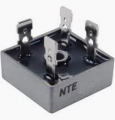
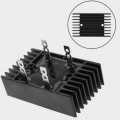
Using four 50 amp bridge rectifiers seems a cheaper otion than stud diodes even though half the diodes in the four bridges will not be used. One possible model of briidge rectifier that you could probably use the KBPC5006 . I found one supplyer selling these at £1.88 +VAT. Using an aluminium heat sink about 4mm thick would be better than the steel heat sink.
Les.
 

panic mode

Joined Oct 10, 2011
4,864
judging by the wire size (AWG6) this circuit is likely some 50A.
and this or this is cheap. with 10pcs, you can use each bridge as a substitute for a single diode (and still have spares).
connect AC terminals together as an anode. use + terminal as a cathode. this way two diodes in a bridge are paralleled and sharing load...

and talk about ease of repair if you ever need to replace one. compare that to diode soldered to a metal sheet.
 

Tonyr1084

Joined Sep 24, 2015
9,744
OK, going to say it yet again: Buying new is a better option than repairing what you have. Unless you have scrap parts laying around you're going to throw good money after bad. If you replace one diode - what's next to fail? As I said before, I have a similar machine. My timer no longer works. But given the amount of times I've used it - more so to help neighbors get started - the cost of fixing what's old versus the cost of a new unit needs to be considered.

As for the tractor, having a second battery that can be plugged into the tractor will be quicker and easier than running a cord out there just to start the engine. Same can be highly useful for starting cars with weakened batteries. The biggest concern for starting an engine with a bad battery is the strain it puts on the alternator. Yeas ago I built an old alternator onto a frame with a gasoline motor that ONLY spun the alternator. Thought I could use that to charge a battery in an emergency but to this date I've never used it. Instead, I have batteries that are on a charger almost all the time. When I want to set up my elevator - I have 12V with lots of capacity. I could just as easily wheel that out to a car with a dead battery and start it just using jumper cables.

Buying new means you have a useful product for some time. Fixing OLD can mean spending a little bit of money a whole bunch of times to fix those little problems that will crop up. In the end - you can do as you wish. I am of the opinion you'd be better off buying new. In the long run it will be cheaper. And always reliable. You never know when the OLD machine is going to crop up with an inconvenient gremlin just when you need it the most. A readily charged battery can avoid that problem.
 

LesJones

Joined Jan 8, 2017
4,511
You don't need 8 bridge rectifiers. You only need 4. Each bridge rectifier consists of 4 diodes. You can only use 2 of the diodes in each bridge because of the way they are internally connected. Do not even consider just replacing some of the existing diodes. Replace them all. If you can find stud diodes that cost half or less than the price of a bridge rectifier then use them.

Les.
 

Thread Starter

stryped

Joined Sep 17, 2023
134
judging by the wire size (AWG6) this circuit is likely some 50A.
and this or this is cheap. with 10pcs, you can use each bridge as a substitute for a single diode (and still have spares).
connect AC terminals together as an anode. use + terminal as a cathode. this way two diodes in a bridge are paralleled and sharing load...

and talk about ease of repair if you ever need to replace one. compare that to diode soldered to a metal sheet.
Each of my 8 terminals go to an individual diode on the metal plate. I could connect one of these to one ac input on the bridge rectifier but what would go on the 2nd ac input?
 

Thread Starter

stryped

Joined Sep 17, 2023
134
judging by the wire size (AWG6) this circuit is likely some 50A.
and this or this is cheap. with 10pcs, you can use each bridge as a substitute for a single diode (and still have spares).
connect AC terminals together as an anode. use + terminal as a cathode. this way two diodes in a bridge are paralleled and sharing load...

and talk about ease of repair if you ever need to replace one. compare that to diode soldered to a metal sheet.
each bridge rectifier has 2 ac inputs and 2 dc out puts. I understand one of the metal lines would go into 1 bridge rectifiers ac input and the dc+ would go to the charger positive lead. However what would go on the 2nd ac input on each bridge rectifier and what would go to the dc negative output on each bridge rectifier in your scenario?
 
Top