Solar to LM7805 to Powerbank

Thread Starter

alecksha

Joined Jan 27, 2015
7
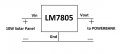
Hi everyone i got this school project which will be needed on march for my final project, im just new to electronics. here is the picture my concern is if sunlight is stable will it charge my powerbank continuously? please do give some advise or do and don't on the picture thank you
 

Attachments

pwdixon

Joined Oct 11, 2012
488
Rather depends on the voltage from the solar panel and what the current is going into the power bank, you might find that the regulator gets hot if the solar panel outputs much more than 7V or 8V.
 

Thread Starter

alecksha

Joined Jan 27, 2015
7
here is the solar panels specs.

10W Polycrystalline Solar Panel
Cells per module: 36pcs
Maximum System Voltage: 800V
Test Condition: 1000W/M² AM 1.5 Global, 25 °C Cell Temperature
Maximum Power (Pmax): 10W
Tolerance: 5%
Voltage at Pmax (Vmp): 18.0V
Current at Pmax (Imp): 0.555A
Open-circuit voltage (Voc): 21.6V
Short circuit current (Isc): 0.621A

some of my classmate says i have to put heat sink for regulator since the panel says its 18v i hope my solar panel wont burn my regulator. thank you for the fast reply
 

wayneh

Joined Sep 9, 2010
18,133
Voltage at Pmax (Vmp): 18.0V
Current at Pmax (Imp): 0.555A
You want your system to operate well at full (max) power conditions, and the 7805 would not be able to handle that much. It would be dropping 13V at 0.5A, requiring it to dissipate 6.5W. It will go poof.

Perhaps worse than that, your panel is cranking out 9W and you are burning off and wasting most of that.

Forget the 7805 and look into a DC-DC converter. These wonderful things can convert your power to the lower voltage while losing only ~15% of the power your panel is making. They are cheap and ready-made from many sellers on e-bay. Get one rated for well over your max conditions of open-circuit voltage and short-circuit current, so that nothing your panel puts out can blow it.
 

Bernard

Joined Aug 7, 2008
5,784
You have given only half of the system-- need specs on power bank. Nice advantage of buck converter is that output V is regulated & adjustable. When all ic connected, adjust buck converter, BC,output so as to load SP V to about 15.75 V ( 75% of OC V ) which will give near max. power.
 
Last edited:

AnalogKid

Joined Aug 1, 2013
12,238
some of my classmate says i have to put heat sink for regulator since the panel says its 18v i hope my solar panel wont burn my regulator. thank you for the fast reply
The TO-220 package without a heatsink will overheat with more than about 1 W, so you *will* need a heatsink. If there is no fan and you are relying on radiation and still-air convection, find one about the size of a golf ball.

ak
 

Evil Lurker

Joined Aug 25, 2011
116
I believe the OP is inferring to use a 7805 to regulate the charging voltage of the solar panel. This is incorrect on so many levels.

Solar panels charge batteries in two states based upon the luminous intensity at which they are being exposed and ohms law. With a battery that is depleted but otherwise in good condition it will have very little resistance to accepting a charge and in this state the solar panel is said to be operating in constant current mode. As long as the current output from the solar panel is less than the maximum permissible charging rate of the power bank then no sort of regulation is needed during this phase. When the battery voltage is approaching the level where it is almost at full charge the internal resistance of the cell will increase, charging current will drop, and the voltage provided by the solar cell will rise accordingly. It is around this point where charging shifts from a constant current mode to a constant voltage mode to ensure that the batteries do not get overcharged. The way to go about this is not with a linear voltage regulator that controls the charging voltage but rather to use a shunt regulator that dumps excess power to ground. The difference between the two is that with a linear regulator it would operating all the time and wasting massive amounts of power coming from the panel, but with a shunt regulator it only works when the battery voltage reaches a certain level. The device is known as a TL-431 (many variants exist with similar names) adjustable shunt regulator. And since your panel is likely to exceed the current of the shunt regulator you will need to rig up a pass transistor to the TL-431 to handle the extra power.
 

MrChips

Joined Oct 2, 2009
35,018
As Evil says, you do not necessarily need a voltage regulator to charge a battery.
What you need is a voltage monitor to check when the battery is fully charge and then switch to a float charge.
 

Thread Starter

alecksha

Joined Jan 27, 2015
7
The TO-220 package without a heatsink will overheat with more than about 1 W, so you *will* need a heatsink. If there is no fan and you are relying on radiation and still-air convection, find one about the size of a golf ball.

ak
thank you i already got a a heatsink its more than a size of a golf ball i got it from an old computer processor with add on fan with 5v power
 

Thread Starter

alecksha

Joined Jan 27, 2015
7
@ Evil Lurker thank you sorry im not good at electronics but ive been reading your post it does mean i need some switching device that shuts the regulator feeding my powerbank as soon it is full charge btw sir im using Powerbank 8800mAh it has a charge protection and led indicator on full charge and it automatically trip off power after full charge i hope that alright thank you sir
 

Thread Starter

alecksha

Joined Jan 27, 2015
7
You have given only half of the system-- need specs on power bank. Nice advantage of buck converter is that output V is regulated & adjustable. When all ic connected, adjust buck converter, BC,output so as to load SP V to about 15.75 V ( 75% of OC V ) which will give near max. power.
Powerbank specs
Type: 8800mAh Mobile Power Bank
Available Colors: Gold/Silver/Green/Black/ Blue/Yellow
Material: ABS Plastic
Dimensions: 110mmm x 28mm x 80mm (L x W x H)
Packaging Dimensions: 112mm x 31mm x 215mm (L x W x H)
Charging cable: 300mm(L) Micro USB
Net Weight: 215g
Gross Weight: 251g
Capacity: 8800mAh
Charging indicator: 4 Blue light (running)
Full charge Indicator: 4 Blue Light (Stable/Auto trip off on full charge)
Input Voltage: DC 5V / 1000mAh
Output Voltage: “ USB1: DC 5V / 1000mAh “ USB2: DC 5V / 2100mAh
Battery: Lithium-ion
Charging time: 8-10 hours
Battery usage time: 5 Hours

thank you so much sorry for the late reply
 

Thread Starter

alecksha

Joined Jan 27, 2015
7
You want your system to operate well at full (max) power conditions, and the 7805 would not be able to handle that much. It would be dropping 13V at 0.5A, requiring it to dissipate 6.5W. It will go poof.

Perhaps worse than that, your panel is cranking out 9W and you are burning off and wasting most of that.

Forget the 7805 and look into a DC-DC converter. These wonderful things can convert your power to the lower voltage while losing only ~15% of the power your panel is making. They are cheap and ready-made from many sellers on e-bay. Get one rated for well over your max conditions of open-circuit voltage and short-circuit current, so that nothing your panel puts out can blow it.
thanks sir but its not possible for us to use ready made converter since its a school project also i need to put them piece by piece in a place so that i can tell them what this part is use for.
 

wayneh

Joined Sep 9, 2010
18,133
The 7805 will work. It just has two major shortfalls: 1) Poor efficiency and 2) Limited capacity due to heat.

But if you just want 100mA at 5V from your panel and don't care about the efficiency, the 7805 will be just fine. You can add a power transistor to help handle the current and heat, so that your load can draw more total current. This cannot solve the efficiency issue.
 
Top