Solar Generation and facility consumption

Thread Starter

dbetts

Joined Jan 4, 2017
3
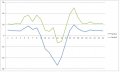
Hello, first post here so apologies if I've chosen the wrong forum. I manage a small business facility that has recently installed solar. The primary service is 1200A 208V 3PH, the solar has the maximum capacity to supply about 100kw. When we purchased the solar system I also had them install a Wattnode device with three 1200A CT's on the main service so I could get data on facility consumption. All of the data from the Utility meter, solar inverters, and the Wattnode are available to me to download in Excel format, but not real-time. I have compared the data from the Utility meter to my Wattnode data for about 3 months, and it is consistently different. For example, I ran a 24 hour data set comparison and the Utility (red line) was about 10kwh more than my Wattnode data (blue line). See graph. On this particular day, the solar was out-producing my consumption so you see the graph cross 0 to the negative (power back to the grid). We have ran multiple calibration tests on all data collection equipment and it passes. But I still have this offset in what my facility data says and what the Utility meter says. Multiple ideas have been discussed - power factor, VARs vs Watts, phase imbalance, harmonics, etc - but none seem to be a definitive answer. Maybe it's a simple math error but I don't think so. Bottom line is the solar is producing what was planned, the facility usage is generally the same as the historical data shows, but my Utility bill has only accounted for a small cost offset. Certainly not enough to pay for the system as planned.

I'd appreciate any help I can get. Thanks
Nov29-2016-24hrComparison.jpg


Moderators Note:
Please don't show the Email on forum, it will bring the spammer robot to our forum and you, now the Email was deleted.
 

wayneh

Joined Sep 9, 2010
18,090
... the Utility (red line) was about 10kwh more than my Wattnode data (blue line). See graph.
Do you mean the utility company reports the green line?

Let's first be clear what we are looking at. The x-axis is time, in hours of the day (or test interval). The y-axis is what exactly, kW instantaneous sampled once per hour, cumulative kWh of the previous hour, what?

In the flat-ish sections of the chart, can we assume that's basically where it's dark and your solar is not contributing?

How are you transforming your data to get from the CT measurements to kW? It looks like, in the dark, your measurement is about half what the utility calculates.
 

tcmtech

Joined Nov 4, 2013
2,867
What's the margin of error for each measuring device on both systems and how does that compare to the percentage of error in your overall readings and power use/return numbers from both systems? Any device that is used fore measurement purposes has a +- tolerance factor that goes with it.

If you have a 10 KWH per day variance on a system that running an average load of 100 KW per hour (~2400 KWH per day total) that s pretty small power measurement discrepancy that falls well within the design tolerance of +- 1% or better. However if its a 10 KWH variance on a 100 KWH power transfer obviously one measurement system was not calibrated using the same reference points as the other at the same time or it is not using the same monitoring and calculating criteria.

Also is that ~50 cent to a dollar or so a day power value worth the fuss to begin with? o_O:rolleyes:
 

Thread Starter

dbetts

Joined Jan 4, 2017
3
Thanks for the quick replies. Screenshot must have lost something in the upload, yes the top line (red or green apparently) is the utility report and the bottom (blue) line is my Wattnode data. The horizontal axis is hours, data is sampled at the top of each hour. Vertical axis is kwh, as in kwh consumed (positive, or produced negative) since last sample. Hours 1-8 and 18-24 represent dark hours, 12 represents noon. According to testing using an utility grade Eagle data logger, my accuracy is better than 2% done by the Utility EE and my solar EE (who can't seem to explain it either). The calculation within the Wattnode came preprogrammed, but I called them anyway and they verified by remoting into it the settings were correct. In this particular month we typically consume about 9000 kwh, or about 300 kwh per day average but our load varies greatly. On this particular day, Wattnode says we consumed about 200 kwh and the solar system reported we produced about 200 kwh, so for the day we should have been roughly net zero from the utility. While the Utility data did show some production back on to the grid (at noon, top line into below 0 area), they said we actually consumed about 260 kwh for the day. So with a rate of about .0125 per kwh that's about $3.25 per day or about $100 per month. And that was somewhat of a light work day to begin with, the differences seem to increase as the load increases. One thing to note is the Utility detected significant phase imbalance at our facility. While we are three phase the majority of our load is single phase, and depending upon what is running they indicated sometimes I was sending power back t the grid on one line and consuming power on the other two. They said the meter wiould figure it all out but I'm skeptical.
 

tcmtech

Joined Nov 4, 2013
2,867
I see now. I would be tempted to agree that the wide phase imbalance may be screwing things.

I have worked around power systems electrical and electronics systems in one way or another most of my life and I personally have reasons to not trust the all solid state no moving parts digital monitoring and metering tech.

I'll trust a known to be accurate and calibrated old fashioned spinning disk based power flow and usage monitoring system first.

The calculation within the Wattnode came preprogrammed, but I called them anyway and they verified by remoting into it the settings were correct.
How could they remote into it and verify it was correct without having had physically attached and operating independent reference systems in place? You could have a shorted turn on one of the current transformers creating huge reading skew on one phase and their software would never know.o_O

The only thing they could confirm that their remote data values were the same as whatever its display values you saw on site showed. The real accuracy and validity to the actual electrical power it ws monitoring and thought it saw and was reporting was totally irrelevant and likely could be made to show anything just by a few software setting adjustments. :oops:

To me the baseline reference the digital unit should be set up to match is whatever the utility company systems say. They are the ones who determine what your electrical bill or payments are. Accurate or not they are the one who sets the standard of measurement your financial gain/loss is determined from.
 

tcmtech

Joined Nov 4, 2013
2,867
I tend to agree but there is such a thing as a bad meter. I'm pretty sure @#12 has shared just such a horror story with us here.
I agree but if the utility company has been involved and they have confirmed their meter is accurate I have to say they are who sets the standards.

Then there's this part,

but my Utility bill has only accounted for a small cost offset. Certainly not enough to pay for the system as planned.
Which as I have come to understand the typical as sold solar power co gen systems rarely ever pay for themselves in any realistic time frame even f they are running at optimal performance and conditions.

20 year payback to break even on a 20 year service life in ideal working conditions were numbers I always read about on the solar co gen sales pitches and saw as being unrealistic unless you were the guy making the money off the sale, installation and upkeep of the system for those 20 years. :rolleyes:
 

#12

Joined Nov 30, 2010
18,224
there is such a thing as a bad meter.
I had a mechanical meter and the rotor never stopped, even when the main breaker was off and I waited for 10 minutes.
After scamming the electric company into giving me a different meter, the problem was solved.
they verified by remoting into it the settings were correct.
What?:eek:
That means the electric company can scam any or every customer by telling the meters to change their settings!
I think I need a new tin foil hat.:mad:
 

Thread Starter

dbetts

Joined Jan 4, 2017
3
Thanks everyone! For better or worse, all of the metering on this entire system is electronic. The utility meter, and even the Eagle meter and the power analyzer we used to determine the phase imbalance, were simply processors running a piece of software. When I say "remote in" the experts on these devices can gain access and verify all of the software settings are correct for the application. Possibly the definition of correct is still up for debate, but it is what I have to work with. To get the data the software combines the outputs of three inverters, the Wattnode, the Utility meter and serves it to websites where I go get it.

One detail that keeps bugging me is the way the Utility installed their CT's. On my equipment, each CT is installed in a specific current flow direction and the leads individually hook up to the Wattnode with polarity very important. If the flow reverses thru any individual CT the polarity of the 0-300 mv signal flips on the Wattnode terminals. In the Utility's cabinet, they bonded all leads of one side of their three CT's together to a common wire to the meter, and then one additional wire to the meter on the other terminal for each CT. In my simple mind I think of this wiring like any other circuit, if I bond one side of all the CT circuits together and any one of the CT flips polarity, it simply going to bleed off that (line) signal thru the other two (neutral) signals and the meter sees nothing. Only when all three CT's flip polarity does the meter see the reverse signal and record power returning to the grid. I tried this idea with the Utility EE and got nowhere, he said that's the way we always hook them up. I simply don't have the background to argue the issue effectively. One consideration is that if this was true, when I'm under full production back to the grid (all three phases) the lines on the graph at that point would meet. And they don't. So maybe it doesn't make a difference after all.
 

wayneh

Joined Sep 9, 2010
18,090
One detail that keeps bugging me is the way the Utility installed their CT's.
I think that's the heart of the matter, if you're measuring something differently than they are. From their point of view, I suppose they want to measure net current to ground for each phase. That makes sense. I'm not sure I understand what your CTs are measuring, but apparently not the same thing.
 
Top