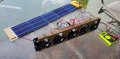
Solar array to power fan array

MisterBill2

Joined Jan 23, 2018
27,504
Short circuit current is not very useful in most instances, and the only possible value is as a diagnostic tool. So why bother? The goal was to run the fans, and so that is what I suggest trying. You can read the current and the voltage and see how well the fans spin. The proof is in the results.
 

Thread Starter

AndrewR

Joined Sep 10, 2018
9
sorry I meant direct from panel. This is the measure from the cell array without the booster

direct from panel: 2.7v .9 amps - 2.43 watts
into v booster 1: 11.9v .8 amps - 9.52 watts
into v booster 2: 27.3v .79 amps -21.6 watts

I figured there would be some loss and that the booster would trade current for voltage but I don't see much change at all in the amperage. So either I am measuring wrong or the volt booster is adding power going form 2.43 watts without to max 21.6 watts.

As far as the the cell amperage. I backed into it at the rated .5 volts 4.89 watts. Amperage was never actually provided.

I did hook up to the fan array. With all 5 nothing turned. I could get 1 going slowly or 2 going about the same speed maybe a little slower and I had to tap start 1 of the fans. This was at 10 volts which was what the fans seems to be pulling when plugged into dc power brick when I tested the fans. I also tested with a single fan rated at 12v .18amp. It also started but spun very slow. Not what to make of it. I must be measuring amps wrong. Am I using the correct setting on the multimeter?
 

oz93666

Joined Sep 7, 2010
742
Well done , that looks a very neat job you've done soldering on the buss wire ... I would advise you to get it encapsulated quick before the cat jumps on it and breaks it into a thousand pieces ....

As for lack of current ... the ammeter and the thin connecting leads do have a significant resistance which will greatly reduce the current at such low voltages ...

Don't worry those cells will deliver 8 amps in strong direct sunlight ...

I would buy some liquid encapsulant and see how many panels this will allow you to build ... keep making them till all the encapsulant is used up ... more voltage makes things easier , and more cells mean the fans will run on cloudy days.

I would make another row of 5 cells , put the two rows side by side , this will make a reasonable sized 2x5 panel ... importantly the two wires coming out of the finished panel will be in the same location hence no need for the long connecting wires that you presently have .
 
Last edited:

MisterBill2

Joined Jan 23, 2018
27,504
I had forgotten to consider those clip leads! I had a set of them once and they were made of very thin wire and the connections at the clips were very poor. Each lead was over ten ohms resistance, so they were not even good as meter leads. So I suggest that you connect the fans and then measure the voltage from end to end of the clip leads. My guess is that is where the power is lost. The clip leads that I had were like three strands of #36 wire, thinner than the leads on a dollar set of earphones.
But you do need to be careful about the leads to the solar arrays because stiff wire can result in broken off connection tabs.
 

Thread Starter

AndrewR

Joined Sep 10, 2018
9
Huzzah. You 2 were correct. I switched the alligator clamps over to soldered 16 gauge wire and right out the gate got 5.8 amps direct from the panel. I was expecting 8 but I assume the drop is likely due to my amateur construction.(Oz appreciate the compliment on my soldering but there are a few gaps in the contact and yea I cracked 1 panel a bit). I would think these cell are capable of 8 with proper construction.

So I plugged into the fan and the all got up to speed in full sunlight. With a cloud overhead 2 started up but not the other 3. Once full sun hit them they all got going and keep spinning even with cloud cover(slowly but never stop). They don't seem to spin quite as fast as they do when plugged into my PC power supply but close. I assume if the current bumps up from 5.8 to 8 I would get full speed. Correct me if I'm wrong. It would be 21.6 watts.

I may try to make a slightly cleaner panel to achieve the full 8 amps but my goal isn't to manufacture panels. I'm just trying to get the concept down. Also I don't have much more room to play with to get a 2x5 array going. do you not this the 1x5 is sufficient for just the 5 fans?

I have a couple more question if you guys wouldn't mind.
Will the varying current to the fans wont effect life span?
The booster is set to ~12v and produces that when no load. When I add the load I test the voltage at ~7.8v is this expected?
Id still be interested in adding a battery and solar charge controller down the line. Would either of you know of a board that would fit my needs to replace the booster?
 

Attachments

MisterBill2

Joined Jan 23, 2018
27,504
Running the fans a bit slower with a lower voltage will increase the fan life a bit, and so that is OK. Yes, those clip leads are quite something, sort of like cheap fuses in that they don't let enough power through to do much damage, or anything useful, either. I knew that the cells had to be able to produce more current than you were getting.
When you assemble the panels be sure to anchor the terminations so that you can avoid damaging any of the connections.
 

oz93666

Joined Sep 7, 2010
742
I assume if the current bumps up from 5.8 to 8 I would get full speed. Correct me if I'm wrong. It would be 21.6 watts.
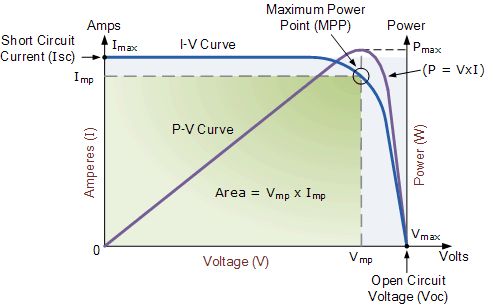
You can reasonably expect to get 4W from each cell if the load is perfectly matched to the line of cells ... You can see from the graph if the cells are short circuited the current is max but the power you get out is zero , open circuit power out is zero .... To get the max power out the voltage across the cell should be about 0.48V , you have five so that's 2.4V ... So when your 5 cells not connected to load the voltage will be about 2.75.... when you connect the load if voltage drops to 2.4 then you know the load is matched perfectly and you are getting the most you can from the cells .... It will never be perfect , if voltage with load is 2V then you get perhaps 85% full power .... that's just in full sunlight to keep getting max posible power in all light conditions requires complex circuitry ,it's call MPPT Maximum power point tracking.


5
 

MisterBill2

Joined Jan 23, 2018
27,504
My question is which will be the more efficient and deliver the most power to the fans: connecting directly, knowing that probably it is not at the peak power point, or running through the voltage booster device. It can not boost the power, it can only change the voltage, and it is never 100% efficient. One easy experiment will be to try it with different numbers of fans, and look at the voltage and speed for each number. It might be that the system is more efficient with fewer fans, and possibly the air flow may be greater, or not. If you don't have all the numbers you would need to experiment. But this is an easy experiment to try, different numbers of fans.
 

oz93666

Joined Sep 7, 2010
742
My question is which will be the more efficient and deliver the most power to the fans: connecting directly, knowing that probably it is not at the peak power point, or running through the voltage booster device. It can not boost the power, it can only change the voltage, and it is never 100% efficient. One easy experiment will be to try it with different numbers of fans, and look at the voltage and speed for each number. It might be that the system is more efficient with fewer fans, and possibly the air flow may be greater, or not. If you don't have all the numbers you would need to experiment. But this is an easy experiment to try, different numbers of fans.
I think an important question is which system design is going to continue to work , year after year with no problems ... I've lost count of the number of solar regulators I've had which have bitten the dust , damp gets in , geckos crawl inside big items and get fried (I live in Thailand).. and electronics does have a limited life , even if well protected ....and of course there's the added cost ...

Solar panels are very cheap now and are proven to run over 25 years with no problems .... if I was to do a similar project I would buy a 20W 18V(open circuit) panel and plug it directly into the bank of fans . the fans would see between 15V in strong sun , and 8V on very cloudy days ...

The big unknown is fan life ... they're only $3 each ,design the housing so that any ones which break can be easily replaced.
 
Last edited:
Top