Solar array to power fan array

Thread Starter

AndrewR

Joined Sep 10, 2018
9
Hello I'm looking to put together a fan array power by solar cells. I have the main components and the wattage should be good but but don't have the circuitry to manage power flow and voltage variation from the sun.

Load:
5 120mm fans all the same. 12v, 0.3 amp for 3.6 watts. Total 18 watts
Solar array:
5 156mm solar cells. 0.5v, 9.78 amps for 4.89 watts. wired in series for total 2.5 volts and 24.45 watts

I've been looking into solar charge controllers paired with a small battery to handle power dips and surges and keep the fans running but don't know how they handle voltage. I'd be fine with the fans turning on and off as the required power is available. As small a battery as reasonable is desired as I don't need fans running solely off battery just as power regulator. I would also consider capacitors if that would be a better option. Any thoughts or advice is appreciated.

Thanks,
Andrew
 

oz93666

Joined Sep 7, 2010
742
Reading between the lines it sounds like you have some raw "6x6" cells ....

... these are the best quality around but only produce 8A ... These must be encapsulated ...otherwise they will not last long > Have you soldered on the buss wire yet ???

Sounds like the fans are computer types , brushless , these can operate over a wide voltage range , the 12V one I have spins slowly on 3V

Rather than waste money on electronics it would be better to spend it on more cells and you can just run the fans directly.

Give more details I can save you a lot of wasted time ... encapsulation is not easy , don't buy these cells if you haven't already .
 

wayneh

Joined Sep 9, 2010
18,088
Hello I'm looking to put together a fan array power by solar cells. I have the main components and the wattage should be good but but don't have the circuitry to manage power flow and voltage variation from the sun.

Load:
5 120mm fans all the same. 12v, 0.3 amp for 3.6 watts. Total 18 watts
Solar array:
5 156mm solar cells. 0.5v, 9.78 amps for 4.89 watts. wired in series for total 2.5 volts and 24.45 watts

I've been looking into solar charge controllers paired with a small battery to handle power dips and surges and keep the fans running but don't know how they handle voltage. I'd be fine with the fans turning on and off as the required power is available. As small a battery as reasonable is desired as I don't need fans running solely off battery just as power regulator. I would also consider capacitors if that would be a better option. Any thoughts or advice is appreciated.

Thanks,
Andrew
You're going to need a DC-DC boost converter with a 12V output. These are relatively cheap on eBay these days. Just be sure to get one rated for currents and power well above your needs. The online specs should be taken with a grain of salt. There's a lot of exaggeration out there.

One issue that plagues every such system is that fans typically require more current to start spinning than to continue spinning once started. So you can get into a frustrating situation where there is enough sun to run the fans but not enough to start the fans. There are various solutions to this problem and they all involve storing up energy to provide a brief burst of power to get the fans moving.

The suggestion to solve many performance issues by simply adding more cells is a good one. With enough cells, you have only one problem to solve - how to handle an overpower situation. There are various solutions to this problem as well. A current shunt is probably the simplest solution and I can provide an example if you need it.

Have you decided whether to arrange the fans in parallel or in series, or some combination?
 

Thread Starter

AndrewR

Joined Sep 10, 2018
9
Hey thanks for the response. Looks like a couple thing to touch on here. Ill answer the questions first.

I have ordered them but have not received them yet. They are only about a $1 a piece and I got 40 so not a huge commitment to play around and learn from. That being the case I have not soldered the bus yet. You do have the correct cells. The ones I order were supposed to be 4.89 watts but wont know for sure until I hook them up. 5 cells at 4 watts would get me to 20 watts total which should still be enough. You are also correct on the computer fans. I assumed they would run at lower voltage producing lower RPM but I was looking to get maximum air flow.

I haven't encapsulated yet either hopefully I can figure it out though. one problem at a time. =)

Now assuming I want to get to the max airflow at the 12v. I would need some sort of voltage regulator. Also if I want prevent wasted energy I would need solar charge controller and battery. I'm no expert so if I'm wrong on any of this please correct me.

Plan A Just to get the voltage correct no battery, I was thinking a DC boost converter. Something like this
https://www.amazon.com/dp/B01N9ZVXTR/ref=sspa_dk_detail_0?psc=1&pd_rd_i=B01N9ZVXTR

Ideally I would be looking for a charge controller with a battery to maximize run time and efficiency. Something like this
https://www.amazon.com/Programmable...words=solar+charge+controller#customerReviews
I'm not sure if the voltages would be correct on that though.

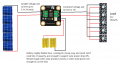
I put together a diagram. Hopefully this explains the desired layout better.

Anything thoughts and assistance is greatly appreciated.
 

Attachments

wayneh

Joined Sep 9, 2010
18,088
Hey thanks for the response. Looks like a couple thing to touch on here. Ill answer the questions first.

I have ordered them but have not received them yet. They are only about a $1 a piece and I got 40 so not a huge commitment to play around and learn from. That being the case I have not soldered the bus yet. You do have the correct cells. The ones I order were supposed to be 4.89 watts but wont know for sure until I hook them up. 5 cells at 4 watts would get me to 20 watts total which should still be enough. You are also correct on the computer fans. I assumed they would run at lower voltage producing lower RPM but I was looking to get maximum air flow.

I haven't encapsulated yet either hopefully I can figure it out though. one problem at a time. =)

Now assuming I want to get to the max airflow at the 12v. I would need some sort of voltage regulator. Also if I want prevent wasted energy I would need solar charge controller and battery. I'm no expert so if I'm wrong on any of this please correct me.

Plan A Just to get the voltage correct no battery, I was thinking a DC boost converter. Something like this
https://www.amazon.com/dp/B01N9ZVXTR/ref=sspa_dk_detail_0?psc=1&pd_rd_i=B01N9ZVXTR

Ideally I would be looking for a charge controller with a battery to maximize run time and efficiency. Something like this
https://www.amazon.com/Programmable...words=solar+charge+controller#customerReviews
I'm not sure if the voltages would be correct on that though.

I put together a diagram. Hopefully this explains the desired layout better.

Anything thoughts and assistance is greatly appreciated.
Looks right. You have to be sure to configure your system to match the sweet spot of the converter/controller you get. If your battery, fan load and solar array are all well within specifications, you should be fine. In a big installation you could invest more effort to squeeze out every ounce of efficiency, but it's probably not worth the effort for this small project.
 

oz93666

Joined Sep 7, 2010
742
I haven't encapsulated yet either hopefully I can figure it out though. one problem at a time. =)
I don't think you've quiet understood what your getting into with this ... DIY solar panels is a trap for the unwary ... It's not possible to create panels more cheaply than you can buy them ready made ... 95% of DIYers won't even succeed in making a decent panel.

Still ... it's a good education , I hope you've got a deep pocket , if you want advice from someone who's already been there, just ask.
 

Thread Starter

AndrewR

Joined Sep 10, 2018
9
Thanks again for all the help.

While the loads and supply look good I was wondering if anyone has thoughts on if there is chip to control charge and load and input voltages and currents? Also is there is a specific battery I should use? I was thinking 4 Nimh for a voltage of 4.8.

As for DIY solar panels. Becoming a solar panel manufacturer isn't the goal, if someone already made what I needed I would buy it for sure but to the best of my research I cant get a 6"x30" solar panel producing 20+ watts. If you know a place please let me know. I'm fairly confident I can construct 1 or 2 working units to prove the concept. As I get into it I will post updates and let you know any road blocks I hit. My main concern is getting the circuitry to work correct.
 

oz93666

Joined Sep 7, 2010
742
NiMh is old battery technology ...Think lithium ,look out for scrap laptop batteries most of the cells in these have years of life left .

I'm not sure why you want a panel with such low voltage??? you definitely will not need all those amps ... the fan I have listed at 0.3A 12V only draws 0.18A at 12 V .... 10W is about right for 5 fans

This is a perfect panel ..... https://www.ebay.co.uk/itm/10W-18V-...884901?hash=item2aaf03bfa5:g:VfMAAOSwkxtbSbla ......

only $15 inc delivery open circuit voltage is 18V your fans will see about 12V .if you find ,because of location this is not enough power ,buy another and put in parallel ..

Lead acid is very forgiving , can be wired to the above panel with nothing in between , look out for a car battery which can no longer crank an engine so has been scrapped ,this will store plenty of power for your needs ....

Realistically you may need a 20 or 25W panel if charging battery too ... every type of panel imaginable on eBay

The ideal set up would be an old lead acid battery being charged directly from a 25W , 18 V (open circuit) panel .... fans connected to the battery ... no troublesome electronics of any kind which can playup .... the battery doesn't care about being overcharged at a few amps , it just electrolyzes the water .... keep it topped up.
 
Last edited:

MisterBill2

Joined Jan 23, 2018
27,186
Post #2 was right! Keep in mind that the fans will run at a lot less than 12 volts, and draw less current also. So unless you need a constant voltage for something else a serious controller is not needed.
 

oz93666

Joined Sep 7, 2010
742
I became curious about what voltages my fan would run at ...this one ...

A computer fan ... $2 from eBay inc postage 120 x120mm ...On the yellow label it says "12V 0.3A"

At 8 Volts it consumed 0.09 A .................. at 11.2 V ...0.12A .................15.2V ....0.16 A ........... 18.8V ...0.2A

It sounded fine running at 18.8V and was of course pushing the air a lot faster .
 

MisterBill2

Joined Jan 23, 2018
27,186
OK, if you are going to use those fans you may be all set. And an interesting option, if you have either 4 fans or six fans, is to be able to switch and either run all of them off the supply voltage in parallel, or in two sets in series. Then at 18 volts the fans would only be running on 9 volts, well within their ratings, assuring maximum fan life. If that option sounds interesting I can provide a description of the switching circuit.
 

Thread Starter

AndrewR

Joined Sep 10, 2018
9
Great info all, thank you so much.

The 2 panels mentioned
https://www.ebay.co.uk/itm/10W-18V-...884901?hash=item2aaf03bfa5:g:VfMAAOSwkxtbSbla
and
https://www.harborfreight.com/25-watt-solar-panel-63940.html
look good on voltage but are a bit wider than I need. I need to fit the panel on a 7"x 36" surface. This is why the 5 cells at 6x6 works well. The voltage on most cells that I have seen is at the 0.5 volt for some reason I am unaware of.

For the Nimh battery I'm not particular I just know they are cheap and easily available. Ill look into the Lithium Ion and lithium polymer. Most look to be at the 3.7 volt. (this is for an attic fan. Any concerns on attic heat and lithium batteries?)

Good info on the fans. Should I expect the rated airflow of the fan to be reached at the rated voltage ~12v?

I may end up running these solely of the solar but I am going to try the circuitry angle first for maximum efficiency. I was thinking this just unsure of the voltages in, out and from the battery.
https://www.mouser.com/ProductDetai...jJf-ahw1CejSaXgW8F8bkqNyyWtPS84EaAosnEALw_wcB
 

MisterBill2

Joined Jan 23, 2018
27,186
Solar powered attic vent fans do make a lot of sense, since the power will be greatest while the solar heat load is the greatest. Avoiding batteries will be a big benefit because of vastly improving the reliability while cutting the cost a lot. The added benefit is avoiding the hazard of a failing battery back igniting a fire in the attic.
 

oz93666

Joined Sep 7, 2010
742
Good info on the fans. Should I expect the rated airflow of the fan to be reached at the rated voltage ~12v?
I may end up running these solely of the solar but I am going to try the circuitry angle first for maximum efficiency. I was thinking this just unsure of the voltages in, out and from the battery.
I agree with Bill2 ... no need for batteries on this project ...

You need to test out the fans you have ... the one I have listed as 12V 0.3A only starts to work well at higher voltage , at 26V it is still only drawing 0.27A ... you need to buy a multimeter and test your fans out at varying voltages....

My opinion is you are jumping the gun with the solar cells ... you are assuming you can make a panel ... In reality you will probably not be able to , this is a skilled job requiring much experience and expensive equipment ...

If your fans are like mine they will work perfectly just wired directly to an 18V panel , around 20W
 

MisterBill2

Joined Jan 23, 2018
27,186
OZ is right about the fans. What I have seen is that there is a huge realm of quality and performance variations among fans that look similar and would all mount in the same place. I don't know what part of the world you are in, but if you are able to try different models of fans you may find one that satisfies your requirements much better than the others. As for building your own array, the cost effectiveness will depend a lot on the cost of the materials you use. I could build one for just the cost of the solar cells, while many others would need to purchase every single item. The big deal part is sealing out water and moisture, and often, insects and rodents. They all will permanently damage solar cells. And when you solder on the wires be sure to follow the makers directions and do not apply too much heat.
 

Thread Starter

AndrewR

Joined Sep 10, 2018
9
Thanks again. The cells should arrive this weekend so we will see how able I am to put together a working panel. I have also ordered fans to test it out. I will keep you posted.
 

Thread Starter

AndrewR

Joined Sep 10, 2018
9
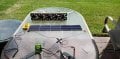
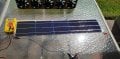
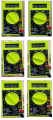
ok got the cells and soldered them up but I seem to have a misunderstanding of something. Ive included pic of the set up and the multi meter readings. What I am missing is how voltage and amps should work. Here are the readings

direct into the panel: 2.7v .9 amps - 2.43 watts
into v booster 1: 11.9v .8 amps - 9.52 watts
into v booster 2: 27.3v .79 amps -21.6 watts

can this be accurate? why is there no boost in current and why is current so low out of the panel? I was expecting 8 to 9 amps. Im being stupid somehow just not sure how. Any thought would be appreciated.
 

Attachments

MisterBill2

Joined Jan 23, 2018
27,186
The only power comes from the photocells, the "boosters" trade voltage for current, or current for voltage.
At all times, power out is less than power in, because of some losses.
What I don't understand is "direct into panel" Do you mean the fan panel? and just where is the current being measured?Out of the solar cell array or out of that booster? And where is the load connected, since I do not see the fan array connected to anything.
 

wayneh

Joined Sep 9, 2010
18,088
Solar cell specs for current typically quote the short circuit current, not what you’ll see when operating into a load with a voltage drop. And they tend to be “optimistic“, to be kind. If your meter has a shunt able to measure 10A, it should be able to act as short circuit and allow you to get close to the rated current as long as you have full direct sunlight.
 
Top