SMPS with UC3845

Thread Starter

agsuresh

Joined Dec 28, 2023
66
Just to clarify a few points here:
1. the voltage rating of a cro probe is not determined by the attenuation factor. A100x is usually higher rated than a 10x but a relative rating is not useful when confronted with a circuit that has a specific high voltage you want to measure. At that point, you need the actual rating.
2. I am not sure our OP is at the point of making a conscious decision about the continuity of the tx currents. Being a fixed frequency flyback it will start discontinuous but may move into continuous mode at higher loads. It is better if it does work this way.
3. the vast majority of flyback converters DO NOT work in discontinuous mode. Traditionally, a great many used a current mode control but there were still plenty of voltage mode control flybacks around too. I wonder if you are confusing the mode of control with the operating mode of the converter?
4. Discontinuous current mode will not guarrantee no reverse recovery in the rectifier diode. That PN junction still needs to adapt to the reverse bias and it takes effort to expand that depletion region.
5. The TVS is a good idea for getting this off the ground but be sure it is sized to suit. I have assumed 230VAC power so a 400V TVS would be about right maybe. Check data sheets (carefully).
6. There is no continuous loss from the resistor in the snubber. In a low loss snubber (one with R, C and D) the function of R changes from a damping factor control element, ie sympathetic to the resonance of the snubber C and tx leakage inductance, to a cap discharge function. There should not be any continuous resistor current unless the current is too small. Lode the diode and go traditional RC snubber. Good honest snubber. :)
7. The problem with the input current measurement, especially a converter with a simple rectifier / peak detector input stage and very light load is that the input current is not just small,but it is also quite wide band. The waveform will be a little, very short pulse of current near the middle of the peak of the mains waveform. (This is where crest factor comes in.) So the measurement device needs to be sensitive and have a reasonably wide bandwidth to have any hope of accuracy. To check the quality of your readings, I would suggest a waveform or spectrum capture and manual calculation from the capture. Messy and painful but honest method.
I am using the RCD snubber. Thank you.
 

Thread Starter

agsuresh

Joined Dec 28, 2023
66
Just be careful and don't kill yourself, ok? ;)
If you post back regularly with progress reports then we can all know you are still alive as well as get progress reports.
Thank you. BTW I am not knew to electronics. I stepped into electronics at the age of 12 (now 65) , worked with very high tech equipment (Radars, sonars etc), never had a chance to look into actual making of SMPS , Moved to Business & technical Software , designed very complicated softwares for various industries , now took a step back from those and stepped back into electronics , particularly micro-controller programming and designing. so It was just natural to peep again into Switching circuits. I just love it.
 
Thank you. BTW I am not knew to electronics. I stepped into electronics at the age of 12 (now 65) , worked with very high tech equipment (Radars, sonars etc), never had a chance to look into actual making of SMPS , Moved to Business & technical Software , designed very complicated softwares for various industries , now took a step back from those and stepped back into electronics , particularly micro-controller programming and designing. so It was just natural to peep again into Switching circuits. I just love it.
Wow. Welcome back to real hardware!
When you were unfamiliar with a cro I assumed... incorrectly.
My apologies if my previous responses were inappropriate.
 

Thread Starter

agsuresh

Joined Dec 28, 2023
66
Wow. Welcome back to real hardware!
When you were unfamiliar with a cro I assumed... incorrectly.
My apologies if my previous responses were inappropriate.
Absolutely No. You are very nice & concerned. Back then, it was impossible to see a CRO. I vaguely remember taking a peek a big box with a round 4 or 5 inches and lots of control. Now they are in plenty. At the cost of a decent multimeter, one can get a chinese handheld mso + multimeter. Yes, my experience with CRO is nill and cons when dealing high voltage + mains connected.

members here has helped me a great lot in not just smps but CRO too. thanks to them all.

I am still working on it on the side as I had to finish a couple of other projects MC based and to get CRO.

Thank you.
 

Thread Starter

agsuresh

Joined Dec 28, 2023
66
Hai,
I am back !

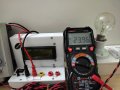
I have attached a couple of images from the smps I am made and testing.

Here are some of the values.
Current drawn on AC line of 220v
without load 0.30 mA
With load 0.72 mA

Frequency : 48khs optimized for the transformer

DC out
Without load : 23.48 V -24v
With load 24v 10w filament bulb : 19.60v

DC out is not regulated yet

DC Bulk capacitor
303v
with switching On : 255v
with load connected 229v

Primary inductance : 356.65 without air gap. (tested with a self made inductance meter using arduino uno - gives reasonably correct value with known fixed inductors). No ringing still.

Do you think these needs to further optimized ?
or are they good.
 

Attachments

Hai,
I am back !

I have attached a couple of images from the smps I am made and testing.

Here are some of the values.
Current drawn on AC line of 220v
without load 0.30 mA
With load 0.72 mA

Frequency : 48khs optimized for the transformer

DC out
Without load : 23.48 V -24v
With load 24v 10w filament bulb : 19.60v

DC out is not regulated yet

DC Bulk capacitor
303v
with switching On : 255v
with load connected 229v

Primary inductance : 356.65 without air gap. (tested with a self made inductance meter using arduino uno - gives reasonably correct value with known fixed inductors). No ringing still.

Do you think these needs to further optimized ?
or are they good.
The primary waveform(? is it primary or secondary?) either way, it is very clean. Is it under load for this waveform capture?
As for load regulation, No load at all is not a very fair test. Try 10% of full load as the minimum load and repeat. No load at all can leave the output detecting the peak of the ringing. 10% is typically enough to absorb that energy and 10% is also a typical minimum load value specification for an SMPS.
I see you are enjoying the CRO! :)
The even order harmonics may be a bit of a worry. They can only happen if their is asymmetry in the waveform. And 12dB down from the fundamental is still pretty high. It might be an artifact of the ripple on the DC primary which is a bit big. Have you checked the ripple current rating of the cap against the ripple current of the primary?
The waveforms are looking good!
 

Thread Starter

agsuresh

Joined Dec 28, 2023
66
The primary waveform(? is it primary or secondary?) either way, it is very clean. Is it under load for this waveform capture?
As for load regulation, No load at all is not a very fair test. Try 10% of full load as the minimum load and repeat. No load at all can leave the output detecting the peak of the ringing. 10% is typically enough to absorb that energy and 10% is also a typical minimum load value specification for an SMPS.
I see you are enjoying the CRO! :)
The even order harmonics may be a bit of a worry. They can only happen if their is asymmetry in the waveform. And 12dB down from the fundamental is still pretty high. It might be an artifact of the ripple on the DC primary which is a bit big. Have you checked the ripple current rating of the cap against the ripple current of the primary?
The waveforms are looking good!
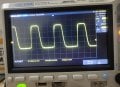
//The primary waveform(? is it primary or secondary?)// Waveform at the output pin of UC3845 before the4.7R resistor connected to the gate pin .
//Is it under load for this waveform capture?// I have checked the waveform under load. It is not different. It is very steady.

//As for load regulation, No load at all is not a very fair test. Try 10% of full load as the minimum load and repeat. No load at all can leave the output detecting the peak of the ringing. 10% is typically enough to absorb that energy and 10% is also a typical minimum load value specification for an SMPS.// OK. I only wound a single 25 AWG wire for testing. It is rated @ 0.45A. Hence tested with a 10w bulb.

I see you are enjoying the CRO! . Sure.

//The even order harmonics may be a bit of a worry. They can only happen if their is asymmetry in the waveform. And 12dB down from the fundamental is still pretty high. It might be an artifact of the ripple on the DC primary which is a bit big. Have you checked the ripple current rating of the cap against the ripple current of the primary?//

This I think is due to several factors. I am using a bread board for the IC with other components on a zero board connected with wires. The power supply for the IC is now fed using a DC Converter LM2596. These might be inducing the harmonics. Once the ferrite core is finalized, I can make a PCB for the whole unit and test for harmonics. I haven't tested the harmonics induced by the converter. I should do this to confirm. Thanks for pointing that harmonics is on the higher side.

What do you think about the DC voltage drop on the BULK capacitor. Is it is fair. I think it is slightly higher. Mosfet gets warm even without load.
 
//The primary waveform(? is it primary or secondary?)// Waveform at the output pin of UC3845 before the4.7R resistor connected to the gate pin .
//Is it under load for this waveform capture?// I have checked the waveform under load. It is not different. It is very steady.

//As for load regulation, No load at all is not a very fair test. Try 10% of full load as the minimum load and repeat. No load at all can leave the output detecting the peak of the ringing. 10% is typically enough to absorb that energy and 10% is also a typical minimum load value specification for an SMPS.// OK. I only wound a single 25 AWG wire for testing. It is rated @ 0.45A. Hence tested with a 10w bulb.

I see you are enjoying the CRO! . Sure.

//The even order harmonics may be a bit of a worry. They can only happen if their is asymmetry in the waveform. And 12dB down from the fundamental is still pretty high. It might be an artifact of the ripple on the DC primary which is a bit big. Have you checked the ripple current rating of the cap against the ripple current of the primary?//

This I think is due to several factors. I am using a bread board for the IC with other components on a zero board connected with wires. The power supply for the IC is now fed using a DC Converter LM2596. These might be inducing the harmonics. Once the ferrite core is finalized, I can make a PCB for the whole unit and test for harmonics. I haven't tested the harmonics induced by the converter. I should do this to confirm. Thanks for pointing that harmonics is on the higher side.

What do you think about the DC voltage drop on the BULK capacitor. Is it is fair. I think it is slightly higher. Mosfet gets warm even without load.
I think the cap value might be too small, the ripple voltage is too big II think and the ripple current is almost definitely too high. Mosfet getting hot can be so many things. It may be related to the fact that a fkyback without closed loop regulation should not have a reasonable output voltage.
The basic principle is this,when the mosfet is on the transformer current should rise linearly and for discontinuous mode it will start from zero and in continuous mode it will start from a non zero value. In both cases there will be a delta I (the difference between the final and initial currents in each primary cycle. That difference represents an energy= 1/2*Lp*(If^2 - Ii^2) where If is the final current and Ii is the initial current (probably zero in this case). That energy must be transferred to the secondary otherwise the transformer core will saturate and your mosfet will go bang. If there is no load on the output but all of the energy is transferred then the secondary voltage will just keep rising until something gives (or goes bang in other words).
Primary side cycle by cycle current limiting may be helping to stop it going bang due to excessive primary current but what stops the output voltage going crazy???
This may be incredible luck with a combination of core saturation, your snubber circuit and current limiting combining to perform a miracle. I can't think how else this might be happening.
In any event,does anything other than the mosfet get hot under no load?
With the transformer,I think you said it was a reclaimed core from another PSU? If the other PSU was also a flyback then the core will be gapped. If you take the two core halves and hold a straight edge,like a ruler across the two outer legs and passing over the centre leg,can you see a gap at the centre leg. It may only be a fraction of a millimetre. Check both halves.If they are not gapped then do you remember if,when you took the transformer apart,was there anything like pieces of tape on any of the core faces(either on both outerlegs orjust the centreleg).Imean the faces that touch together when youassemble the core into the bobbin.
If you probe the waveform from the shunt resistor, that should reveal a lot about what is going on.
 

Thread Starter

agsuresh

Joined Dec 28, 2023
66
I think the cap value might be too small, the ripple voltage is too big II think and the ripple current is almost definitely too high. Mosfet getting hot can be so many things. It may be related to the fact that a fkyback without closed loop regulation should not have a reasonable output voltage.
The basic principle is this,when the mosfet is on the transformer current should rise linearly and for discontinuous mode it will start from zero and in continuous mode it will start from a non zero value. In both cases there will be a delta I (the difference between the final and initial currents in each primary cycle. That difference represents an energy= 1/2*Lp*(If^2 - Ii^2) where If is the final current and Ii is the initial current (probably zero in this case). That energy must be transferred to the secondary otherwise the transformer core will saturate and your mosfet will go bang. If there is no load on the output but all of the energy is transferred then the secondary voltage will just keep rising until something gives (or goes bang in other words).
Primary side cycle by cycle current limiting may be helping to stop it going bang due to excessive primary current but what stops the output voltage going crazy???
This may be incredible luck with a combination of core saturation, your snubber circuit and current limiting combining to perform a miracle. I can't think how else this might be happening.
In any event,does anything other than the mosfet get hot under no load?
With the transformer,I think you said it was a reclaimed core from another PSU? If the other PSU was also a flyback then the core will be gapped. If you take the two core halves and hold a straight edge,like a ruler across the two outer legs and passing over the centre leg,can you see a gap at the centre leg. It may only be a fraction of a millimetre. Check both halves.If they are not gapped then do you remember if,when you took the transformer apart,was there anything like pieces of tape on any of the core faces(either on both outerlegs orjust the centreleg).Imean the faces that touch together when youassemble the core into the bobbin.
If you probe the waveform from the shunt resistor, that should reveal a lot about what is going on.
Thank you very much.
//I think the cap value might be too small, the ripple voltage is too big// I have used a 47mfd/450v capacitor.

//In any event,does anything other than the mosfet get hot under no load?// The 47K resistor in the RCD gets slightly hot.

//With the transformer,I think you said it was a reclaimed core from another PSU?// No . I hand wound it by myself.

//If you probe the waveform from the shunt resistor, that should reveal a lot about what is going on// I did not understand this. How to connect Shunt resistor ?

//Primary side cycle by cycle current limiting may be helping to stop it going bang due to excessive primary current but what stops the output voltage going crazy???// I have put a 33K resistor across the output capacitor (1000mfd 63v). This was more for discharging the capacitor fast before each test, so that I can get a reliable output voltage. Otherwise I had to discharge it. each time .
 
Thank you very much.
//I think the cap value might be too small, the ripple voltage is too big// I have used a 47mfd/450v capacitor.

//In any event,does anything other than the mosfet get hot under no load?// The 47K resistor in the RCD gets slightly hot.

//With the transformer,I think you said it was a reclaimed core from another PSU?// No . I hand wound it by myself.

//If you probe the waveform from the shunt resistor, that should reveal a lot about what is going on// I did not understand this. How to connect Shunt resistor ?

//Primary side cycle by cycle current limiting may be helping to stop it going bang due to excessive primary current but what stops the output voltage going crazy???// I have put a 33K resistor across the output capacitor (1000mfd 63v). This was more for discharging the capacitor fast before each test, so that I can get a reliable output voltage. Otherwise I had to discharge it. each time .
You have a 47000uF450Vcap in the primary???
So the tx core is not reclaimed? Ok, so can you tell me what the core material, gap and geometry are please. Also the primary and secondary turns and briefly describe how you have provided the creepage and clearance distances (thin sheet, solid material, tape barriers or offset windings for example). With this information I can review the basics of the design for clues as to what is happening in the power stage.
The shunt resistor is the current sensing resistor, connected from mosfet source to ground. Probe at the mosfet source end of the resistor (preferably do not probe at the mosfet source as the signal can be dirtier at that point). The waveform should be a ramp with a peak value under a maximum of 1.1V (for the UC3845). If it looks more like an exponential, or the early part of an exponential function then the core is approaching saturation.
 

Thread Starter

agsuresh

Joined Dec 28, 2023
66
You have a 47000uF450Vcap in the primary???
So the tx core is not reclaimed? Ok, so can you tell me what the core material, gap and geometry are please. Also the primary and secondary turns and briefly describe how you have provided the creepage and clearance distances (thin sheet, solid material, tape barriers or offset windings for example). With this information I can review the basics of the design for clues as to what is happening in the power stage.
The shunt resistor is the current sensing resistor, connected from mosfet source to ground. Probe at the mosfet source end of the resistor (preferably do not probe at the mosfet source as the signal can be dirtier at that point). The waveform should be a ramp with a peak value under a maximum of 1.1V (for the UC3845). If it looks more like an exponential, or the early part of an exponential function then the core is approaching saturation.
You have a 47000uF450Vcap in the primary??? pls read 47uF / 450 v

I changed the snubber diode from IN4007 to FR107 a fast switching diode. This helped a lot. Now it works better at 67khz. Mosfet does not get hot. BTW i changed the power supply to a transformer based supply to reduce any harmonics induced by the buck conveter.

The transformer details are
core details
EE core 25/10/6
Material unknown
Primary winding 85 turns 30 guage
Secondary 10 turns 25 guage
 
You have a 47000uF450Vcap in the primary??? pls read 47uF / 450 v

I changed the snubber diode from IN4007 to FR107 a fast switching diode. This helped a lot. Now it works better at 67khz. Mosfet does not get hot. BTW i changed the power supply to a transformer based supply to reduce any harmonics induced by the buck conveter.

The transformer details are
core details
EE core 25/10/6
Material unknown
Primary winding 85 turns 30 guage
Secondary 10 turns 25 guage
The 1N4007 at 50kHz is pretty much a slightly resistive piece of wire. The mosfet is discharging the snubber cap directly. I still recommend taking the diode out though. The RC will need recalculating but the result is usually better at these power levels. The FR107 or SF4007 or UF4007 definitely a better pick.
I don't understand how it is that you do not know what the core material is. And if you do not know that, how can you be sure it is not gapped? The gap may be very very small.
If you could get a capture of the current waveform as I mentioned before, it would make this a whole lot easier to help you. It will help you as well of course to get to know that waveform.
I could work backwards from your inductance and the core geometry to see if a gap is likely, but really, how difficult are you going to make it for the people trying to helping you?
At first glance, your primary turns look too few and secondary (maybe) too many.The ratio, does not seem right but this is first glance only. That waveform will tell me a lot about what is going on. Just be careful taking the measurement and check previous emails re isolation tx.
 

Thread Starter

agsuresh

Joined Dec 28, 2023
66
The 1N4007 at 50kHz is pretty much a slightly resistive piece of wire. The mosfet is discharging the snubber cap directly. I still recommend taking the diode out though. The RC will need recalculating but the result is usually better at these power levels. The FR107 or SF4007 or UF4007 definitely a better pick.
I don't understand how it is that you do not know what the core material is. And if you do not know that, how can you be sure it is not gapped? The gap may be very very small.
If you could get a capture of the current waveform as I mentioned before, it would make this a whole lot easier to help you. It will help you as well of course to get to know that waveform.
I could work backwards from your inductance and the core geometry to see if a gap is likely, but really, how difficult are you going to make it for the people trying to helping you?
At first glance, your primary turns look too few and secondary (maybe) too many.The ratio, does not seem right but this is first glance only. That waveform will tell me a lot about what is going on. Just be careful taking the measurement and check previous emails re isolation tx.
//I don't understand how it is that you do not know what the core material is.// The retail sellers here doesn't have any idea and they just don't care. They sell what they get.
As far I have seen , the core is not gapped.

//If you could get a capture of the current waveform as I mentioned before, it would make this a whole lot easier to help you. It will help you as well of course to get to know that waveform.// I am off my lab for the next couple of days. I shall post the wave form as soon as I get back.

//I could work backwards from your inductance and the core geometry to see if a gap is likely, but really, how difficult are you going to make it for the people trying to helping you? // I can't thank you enough. You have been a great help.

Pls excuse me. using scope is pretty new to me. So I am extremely careful / a little bit scared to use it any where near the switching area. I don't want to damage it. It would be extremely difficult to get it serviced. For experienced users like you, it might be everyday's game. So pls bear with me.


//At first glance, your primary turns look too few and secondary (maybe) too many// I had tried several turn , as per calculations for flyback and from power.com too.

I shall post the waveform when I get back. Thank you very much for all the help.
 
//I don't understand how it is that you do not know what the core material is.// The retail sellers here doesn't have any idea and they just don't care. They sell what they get.
As far I have seen , the core is not gapped.

//If you could get a capture of the current waveform as I mentioned before, it would make this a whole lot easier to help you. It will help you as well of course to get to know that waveform.// I am off my lab for the next couple of days. I shall post the wave form as soon as I get back.

//I could work backwards from your inductance and the core geometry to see if a gap is likely, but really, how difficult are you going to make it for the people trying to helping you? // I can't thank you enough. You have been a great help.

Pls excuse me. using scope is pretty new to me. So I am extremely careful / a little bit scared to use it any where near the switching area. I don't want to damage it. It would be extremely difficult to get it serviced. For experienced users like you, it might be everyday's game. So pls bear with me.


//At first glance, your primary turns look too few and secondary (maybe) too many// I had tried several turn , as per calculations for flyback and from power.com too.

I shall post the waveform when I get back. Thank you very much for all the help.
You will be ok capturing the waveform,just remember to think about what you re connecting to what,what currents might flow "to and from" where, consider the frequencies involved too. An isolation tx does very little isolating if the fundamental frequencies get up into the100kHz plus range (harmonics compound the problem of course) and read those other posts again about the isolation tx. If in doubt, stop, think and live.
Best single piece of advice when working with higher voltages: if in doubt, stop!
 

Thread Starter

agsuresh

Joined Dec 28, 2023
66
You will be ok capturing the waveform,just remember to think about what you re connecting to what,what currents might flow "to and from" where, consider the frequencies involved too. An isolation tx does very little isolating if the fundamental frequencies get up into the100kHz plus range (harmonics compound the problem of course) and read those other posts again about the isolation tx. If in doubt, stop, think and live.
Best single piece of advice when working with higher voltages: if in doubt, stop!
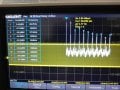
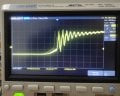
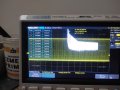
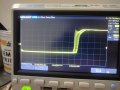
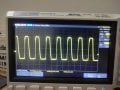
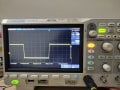
I wound three turns of 20AWG wire along with other secondary winding and connected the scope to this winding. I am posting the images of the scope readings. The actual frequency is 61khz. However when I wound the additional turns had to increase the freq and so the readings from transformerOUT shows higher frequency, which I reduced after removing the this additional winding , back to 61KHz.

pls take a look at them and give your comments.
 

Attachments

I wound three turns of 20AWG wire along with other secondary winding and connected the scope to this winding. I am posting the images of the scope readings. The actual frequency is 61khz. However when I wound the additional turns had to increase the freq and so the readings from transformerOUT shows higher frequency, which I reduced after removing the this additional winding , back to 61KHz.

pls take a look at them and give your comments.
Some interesting points to note:
The pin 6 waveform has very small even order harmonics compared to the transformer output. A close up of the pin 6 waveform would have been good to check that the 3845 output drive is not losing control (output transistor spending too much time in linear region = bad).
There is a lot of ringing on the transformer output signal but an unloaded secondary winding is not a reliable measure of anything noise wise in the primary and the real secondary windings. A load resistor on this extra winding will help but the result is still not reliable as an indicator of anything on the real windings. Why did you not probe the secondary directly?
The rise and fall times look a bit slow (and noisy). If the switch (primary side mosfet) is still getting warm,try increasing the gate resistor. I think you said it was 47R. If so,try taking it up to 100R. A value up to 220R should be ok but at that value the switch losses may be dominated by slow switching speed. Also, be very very sure that the gate resistor is as close as possible to the actual gate lead of the mosfet and that the connection of the gnd pin of the 3845 and the gnd end of the shunt resistor is short and heavy gauge wire, preferably even a Cu plate or Cu braid / ribbon.
That you needed to change the frequency because of an extra 3 turn winding is a problem. That should not be the case.It suggests that there is something (possibly resonant) going on in the transformer. Can you answer the questions I asked before please? As I said, everybody who is trying to help you do not have enough information to do that effectively. What I said above is really only my opinion based on likely cause and effect and experience rather than better deductions based on better information. If you can't or are not sure how to get the other information I have asked for, let us know so we can guide you. It is possible to get that information and the information is kinda important for us to understand what is going on with your psu.
I want to help you, but the missing details are making it very difficult still.
In order for me to extract anything more from these waveforms you need to tell me what the test conditions are.
 
Top