Then the photodiode is used as a photocell producing only a positive output voltage at twice the mains frequency.
I think an incandescent light bulb heats quickly but cools slowly resulting in the peak detection of each halfwave of the sinewave.
Ok, let me explain: There is an old type of measuring device with moving coil (imagine transformer with moving secondary which is moving around exes) so at the secondary you have AC voltage as I said and there is no DC component of course. That system is working and I must not anyhow disturb it by some load, so, again, as I said the idea is to use opamp as the first stage to buffer it. After that I have to transfer that information to remote controller who is using 4-20mA input signal, I have already AD694 circuit finished to work with input voltage 0-5V (i.e. it converts 0-5V to 4-20mA) that is linear conversion by the way, So the problem is just to convert AC input 0-30mV p-p (I agree with you) to 0-5VDC - of course that should be done as much precise (I do not some special %) - I hope it is clear now.
There is an old type of measuring device with moving coil (imagine transformer with moving secondary which is moving around exes) so at the secondary you have AC voltage
A coil that is moving around a permanent magnet or an electromagnet generates an AC voltage.
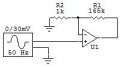
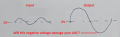
The AC voltage will be single-ended or differential between both of its wires. If it is single-ended then one end of the coil will have a DC reference voltage which might be 0VDC. If the reference is 0VDC then the output of the coil will be +15mV to -15mV p-p. Then the output of the very simple non-inverting opamp will be +2.5V to -2.5V p-p and it will need a dual-polarity power supply.
The input impedance of the non-inverting opamp amplifier in the LM324 is exactly the same as an additional buffer using another of the opamps so the buffer is not needed. Many opamps that are newer than the old LM324 have much higher input impedance.
Using the LM324 for the input stage would be bad, as its range of offset error approaches half the input signal. A single-supply design is possible using an instumentation amplifier on the input, but with filtering, and maybe a peak sampler, becomes a complicated multi-stage design I would not do for free. (No, not looking for any money or job here. Just that there are too few good younger analog designers out there for me to take food from one by competing for free.)
This forum is for free advice and design suggestions, as I'm sure most posters cannot afford to hire an engineer for that task, which would likely involve a high fee.
So, if you don't feel it's proper to do a free design here that's your prerogative, but I will continue to do so.
This forum is for free advice and design suggestions, as I'm sure most posters cannot afford to hire an engineer for that task, which would likely involve a high fee.
So, if you don't feel it's proper to do a free design here that's your prerogative, but I will continue to do so.
If it is for a 4-20mA circuit (as the OP stated) it is for industrial, i.e. commericial, i.e moneymaking, use. Free advice and suggestions I will continue to provide as well, but this is a novice whose goal is beyond simple advice and suggestions.
By all means do contribute here to the extent you feel comfortable with!
If it is for a 4-20mA circuit (as the OP stated) it is for industrial, i.e. commericial, i.e moneymaking, use. Free advice and suggestions I will continue to provide as well, but this is a novice whose goal is beyond simple advice and suggestions.
By all means do contribute here to the extent you feel comfortable with!
Thank you for your advice but 4-20mA is suitable for many reasons, This is not intended to any industrial or commercial usage, I just want diy simple circuit to have remote display of old analog device with 0-30mV p-pknowledge as I already have one small voltage to 4-20mA converter circuit and my idea was to use it for that purpose. I do not have much knowledge in opamp circuit but I am going to try to make a test circuit and see what is happening.
4-20mA seems nice and simple, trust me current loop systems are not. At one end of that cable is power, at the other end everything you do must be isolated and run on 50mW or less. Which end gets the power? Power supply noise can be an issue, and usually 24V or so is needed for the loop. If the sensor end isn't isolated, then the load end needs to be. What's your load ("remote display")? Less than 50mW? As mentioned earlier the 30mV p-p is about the same as a dynamic microphone. That signal level works well with a differential input microphone amplifier, allowing the use of a long 2-conductor shielded cable to reach from the source to where the electronics can be easily maintained. If you want simple don't try to put the electronics at the source, where it could hard to work on. Cable the signal to your bench, and experiment there where it is easy to have the multiple power supplies you will need.
4-20mA seems nice and simple, trust me current loop systems are not. At one end of that cable is power, at the other end everything you do must be isolated and run on 50mW or less. Which end gets the power? Power supply noise can be an issue, and usually 24V or so is needed for the loop. If the sensor end isn't isolated, then the load end needs to be. What's your load ("remote display")? Less than 50mW? As mentioned earlier the 30mV p-p is about the same as a dynamic microphone. That signal level works well with a differential input microphone amplifier, allowing the use of a long 2-conductor shielded cable to reach from the source to where the electronics can be easily maintained. If you want simple don't try to put the electronics at the source, where it could hard to work on. Cable the signal to your bench, and experiment there where it is easy to have the multiple power supplies you will need.
Yes, I must experiment. All electronics and power supply (24VDC) will be at the load end in my case, where the display is located so if I use diff.input amplifier the noise should be canceled, buffer is not needed of course, I will try in that way to work on the problem - at start I didn't think about the noise but really that can be the problem thanks for all warnings - hope that's the right way ....
A differential amplifier does not cancel noise produced by its inputs.
A modern audio opamp produces much less noise than an old "general purpose" LM324 opamp.
A differential amplifier does not cancel noise produced by its inputs.
A modern audio opamp produces much less noise than an old "general purpose" LM324 opamp.
It is my understanding that the purpose of a differential amplifier is to cancel common-mode noise presented to its inputs. A properly shielded cable and input filtering significantly reduces the pickup of non common-mode noise that might otherwise reach the differential amplifier inputs. Virtually all amplifiers (and resistors) add both noise and distortion, some are better, some are merely good, and the LM324 is a"jellybean" low performance amplifier for sure.
Common mode noise is hum and static picked up by a poorly shielded input cable. Opamp input noise is produced randomly (then it cannot be cancelled) by each input transistor. The LM324 general purpose opamp has so much rumble and hiss noise that it is not used for audio and its amount of noise is not even shown on its datasheet. Audio opamps have their low amount of noise listed on their datasheets. Your gain is high then the output of a lousy old LM324 will have lots of noise.
The low performance of an LM324 and LM358 are because it is the first opamp designed to use a very low power supply current causing noise, poor high frequency slew rate and crossover distortion.
Ok, let me explain: There is an old type of measuring device with moving coil (imagine transformer with moving secondary which is moving around exes) so at the secondary you have AC voltage as I said and there is no DC component of course. That system is working and I must not anyhow disturb it by some load, so, again, as I said the idea is to use opamp as the first stage to buffer it. After that I have to transfer that information to remote controller who is using 4-20mA input signal, I have already AD694 circuit finished to work with input voltage 0-5V (i.e. it converts 0-5V to 4-20mA) that is linear conversion by the way, So the problem is just to convert AC input 0-30mV p-p (I agree with you) to 0-5VDC - of course that should be done as much precise (I do not some special %) - I hope it is clear now.
So your device produces a floating AC voltage around 30 mV ?
The circuit in this video can convert the voltage into a single-ended 0-5 volt signal, just replace the current transformer with your coil. (remove the 1 ohm burden resistor)
You may need to adjust the gain down a bit.
I keep telling you that your input will be +15mV to -15mV p-p and then the output will be +2.5V to -2.5v p-p.
Its input will not be 0V to +30mV and its output will not be 0V to +5V.
It is shown in the video:
I keep telling you that your input will be +15mV to -15mV p-p and then the output will be +2.5V to -2.5v p-p.
Its input will not be 0V to +30mV and its output will not be 0V to +5V.
It is shown in the video:
So your device produces a floating AC voltage around 30 mV ?
The circuit in this video can convert the voltage into a single-ended 0-5 volt signal, just replace the current transformer with your coil. (remove the 1 ohm burden resistor)
You may need to adjust the gain down a bit.
I see the schematics looks fine, just one thing is not clear to me. The output of peak detector will keep the voltage high - if the input goes low, capacitor will still keep the higher voltage as peek detector does. Who discharge the capacitor to measure lower voltage then ?

 Facebook
 Google
 GitHub
 Linkedin