Sine wave oscillator help

Thread Starter

KLillie

Joined May 31, 2014
138
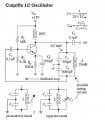
I would like to make a sine wave oscillator. So far I've only tried a colpitt with a transistor and with little success. Can any inductor be used or does it have to be a ferrite core wire wound? I'm trying to make one like the image posted. Also is the RFC needed? Again does this have to be a wire wound jobby or can it be coated? what inductive value can it be; high/low? As long as the transistor is not in cut-off or sat. shouldn't this circuit just oscillate @ some frequency?!!! Frustrated. Also, I tried a lot of different values for the resistors in my spice program and it didn't seem to matter much. (I realize spice is an ideal environment). How the circuit automates the the feedback gain (and my ignorance of this) may be my problem. Looking forward to comments to come.


 

Attachments

Last edited:

to3metalcan

Joined Jul 20, 2014
263
Are you interested in RF frequencies or audio-range? Your circuit uses an RFC as a collector load because this produces high gain at radio frequencies...it produces essentially NO gain at lower frequencies, regardless of the other components. I'm guessing Jony's circuit is RF, too, given the common-base stage, though it might work at lower frequencies.

If you're looking for quick, more-or-less guaranteed results, google "op-amp phase shift oscillator." Not the lowest component count, but it's easy to build and understand.
 

Thread Starter

KLillie

Joined May 31, 2014
138
Thanks Jony I may try this, though I don't have those transistors and may have two PNP's to my name. I would like to shoot for .5 to 1Mhz range. Does anybody have an answer on the inductors? I see a lot of circuit schematics on the internet, but not many oscillators built.
@to3metalcan-What produces high gain at radio frequencies, the circuit I posted? I'm not sure I understand. I know my capacitors and inductor have a reactance, but isn't that normally small? And that they have an impedance, but don't they mostly counter balance? Thanks for the help I hope more people respond. I will take any info/advice I can get. I may try an op-amp phase shift oscillator, but I want the final circuit to be simple and small.
 

Thread Starter

KLillie

Joined May 31, 2014
138
I have not tried to make the circuits suggested above yet. Still waiting for a response on inductor type. Thanks
 

BeerBelly

Joined Dec 16, 2013
30
Do you have any inductors in your parts box?
Inductors with a ferrite core will give a higher output and be smaller in size for a given value. A 470pf capacitor and a 47uh inductor will put you very close to 1mhz. You should be able to detect this signal with a AM broadcast band radio.
 

to3metalcan

Joined Jul 20, 2014
263
In the initial circuit you posted, there are at least two inductors...one is parallel with the capacitor and determines the tank frequency. The other is labeled "RFC" and is used as a load in the transistor amplifier. At audio-range or lower, you would use a resistor in this position. You're using a Radio Frequency Choke because its impedance (and hence the voltage gain of the stage) goes UP with respect to frequency...the stage starts from theoretically no gain at DC (where the inductor appears to be just a wire) through negligable gain at audio frequencies, and then to high impedance and high gain at radio frequencies and above (though in reality, at some point stray capacitance will start to undermine the effect.) The subsequent inductors and capacitors serve as a passive narrow-band filter...the only frequency that will make it through (the sine wave) is the one where both the inductor(s) and capacitor(s) have the same reactance. This is one of those times when quality of parts matters...if the inductors or caps have undesirable series resistance, if the inductor has stray capacitance or the cap has stray inductance, or if the layout of the board introduces any of those things, the circuit may not get off the ground. The process is a bit more forgiving than that, in practice, but those are things to watch out for. The initial choke in the gain stage doesn't necessarily need to be a certain value, just enough Henries to have a relatively high reactance (and thus ensure gain) at your frequency of interest.
 
Top