Sine Wave filter for a VFD

JohnSan

Joined Sep 15, 2018
127
Well, DOL (Direct On Line) has been around for longer than most people on here.
It's difficult to believe anyone 'electrical', that has had any experience with AC motors, has never heard of it.

Sorry to hear it confused some people.

When using a VFD (Variable Frequency Drive) or VFI (Variable Frequency Inverter), to supply an AC (Alternating Current) motor, energy can be saved in multiple ways.
For a single, low or fractional HP (Horse Power) motor, it's unlikely to be a significant saving.

Remember, the inverter output operates on a VF (Voltage - Frequency) curve when varying speed.

A 60Hz (Hertz) 240V (Volt) motor, running at half speed would have around 120V across it.
PWM (Pulse Width Modulated) , sine filtered or not.
If the current has also dropped by half, the power is now a quarter of its rating.
(The cooling air flow will have reduced, if it's self ventilating, and depending on the motor, may or may not be a problem ).

With a VFD, the power factor is always 1.0 so motor PF (Power Factor) losses are significantly zero.

If the motor is subject to frequent starts, the VFD controls the starting current, so no 10x motor rated current experienced, unlike DOL starting.
It won't slowly ramp up the current, it limits it to a preset multiple of the motor rated FLC (Full Load Current) and giving at least motor rated torque from zero speed.

If it has multiple windings, it is important to use the most appropriate for the speed range it will be used in. Obviously,

Using dampers on a ducting system to regulate flow, is not the way to go, particularly if being updated.

See attachment for further info on energy savings.
 

Attachments

MisterBill2

Joined Jan 23, 2018
27,700
NOPE, never came across "Direct On Line", it must be local slang some place. The common term for that would be "Across The Line", which is more accurate and descriptive, while "direct on" sort of implies a temporary scheme, or maybe even DC.
And I just read an article in building management mag about how important duct pressure was to being able to provide the correct air flow to each area of a building. So it is clear that there are different points of view.
Certainly there are many places where a VS drive can offer a real benefit, but probably driving a PSC motor is not really one of theem.
 

Thread Starter

glcohen

Joined Feb 4, 2018
14
Well, DOL (Direct On Line) has been around for longer than most people on here.
It's difficult to believe anyone 'electrical', that has had any experience with AC motors, has never heard of it.

Sorry to hear it confused some people.

When using a VFD (Variable Frequency Drive) or VFI (Variable Frequency Inverter), to supply an AC (Alternating Current) motor, energy can be saved in multiple ways.
For a single, low or fractional HP (Horse Power) motor, it's unlikely to be a significant saving.

Remember, the inverter output operates on a VF (Voltage - Frequency) curve when varying speed.

A 60Hz (Hertz) 240V (Volt) motor, running at half speed would have around 120V across it.
PWM (Pulse Width Modulated) , sine filtered or not.
If the current has also dropped by half, the power is now a quarter of its rating.
(The cooling air flow will have reduced, if it's self ventilating, and depending on the motor, may or may not be a problem ).

With a VFD, the power factor is always 1.0 so motor PF (Power Factor) losses are significantly zero.

If the motor is subject to frequent starts, the VFD controls the starting current, so no 10x motor rated current experienced, unlike DOL starting.
It won't slowly ramp up the current, it limits it to a preset multiple of the motor rated FLC (Full Load Current) and giving at least motor rated torque from zero speed.

If it has multiple windings, it is important to use the most appropriate for the speed range it will be used in. Obviously,

Using dampers on a ducting system to regulate flow, is not the way to go, particularly if being updated.

See attachment for further info on energy savings.
Many thanks for your information and the paper. I realize now the importance of ensuring that the motor is rated for use with a VFD - usually be having type F insulation but also including features that protect the bearings.
 

MisterBill2

Joined Jan 23, 2018
27,700
Not "confusing" but certainly an uncommon term. So I am asking what area of the world has it been so very commonly used for so many years? It could even be within one industry. Certainly there are a lot of terms limited to mostly one industry.
 

Thread Starter

glcohen

Joined Feb 4, 2018
14
45 years ago at the research lab of a medical school in south Louisiana there was a problem with lab techs closing off AC vents instead of raising the thermostat setting. The solution involved not replacing the failed AC system components during the July and August. Experience can be a brutal teacher but some folks will not learn any other way.

An induction motor running at 26 Hz is going to get very warm. And if it is an actual 60 Hz 3 speed motor the lowest speed would be about 850 RPM. So a better scheme will be to connect the lowest speed tap, and if there is a need for greater speed in some conditions, the a scheme to switch speed taps when more speed is needed. That can totally avoid the VSD package and probably save even more electricity.
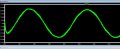
I have two failures of single phase 230v 50Hz 1/2Hp motors being driven by an Invertek Optidrive E1 size 2 in a fan coil; one after 18 years and the other after 8 months! To try to prevent a repeat I have used part of a three phase Mitsubishi suppression filter that I thought was a sine wave device but on closer examination seems to be a dv/dt filer. I enclose a jpg of its schematic. I have connected the incoming L and N to U and V and the outgoing to X and Y. This puts a series R/C filter across the output following the inductor. I enclose 'scope traces of before and after which shows considerable improvement. However, I now wonder if a better sine wave could be produced by changes to the circuit. I would be very grateful for further advice. Incidentally I have not been able to find anyone selling a proper single phase sine wave filter.
I now have better pictures for the VFD oscilloscope output (I was wrongly using ac coupling for the probe) and I am also enclosing the LTspice predicted output (and the LTspice asc file) which for reasons I do not understand is too optimistic about the results from the filter. The file "cleaned high res 1.txt" was made is what the oscilloscope sees as the VFD output.
 

Attachments

MisterBill2

Joined Jan 23, 2018
27,700
One motor lasting 18 years and the next only lasting 8 months.
So now the big question is WHAT CHANGED???
When relatively more rapid problems start to arise there is often a reason that may not seem related. That could be seemingly non-related, such as some adjustment change in the cooling system, or a duct modification, or a belt change, or possibly some improvement to increase efficiency somewhere in the system. It might even be a component failure in the drive itself suddenly changed the output waveform.
 

Thread Starter

glcohen

Joined Feb 4, 2018
14
Except that nothing changed ! And the VFD output waveform looks OK. Hopefully the improved waveform with adding the filter will be sufficient.
 

Pyrex

Joined Feb 16, 2022
510
I do not understand why it is believed that the problem is in a bad form of VFD voltage?
Any motor has its own internal inductance. When the motor is fed from the VFD, the current through the motor windings is sinusoidal thanks to that inductance. Current heats the motor windings, not voltage.

Another question is why the engine broke down so quickly? Because the engine was poorly made.Such is the most likely reason
 

Thread Starter

glcohen

Joined Feb 4, 2018
14
I do not understand why it is believed that the problem is in a bad form of VFD voltage?
Any motor has its own internal inductance. When the motor is fed from the VFD, the current through the motor windings is sinusoidal thanks to that inductance. Current heats the motor windings, not voltage.

Another question is why the engine broke down so quickly? Because the engine was poorly made.Such is the most likely reason
It seems to be widely recognised that the VFD output has voltage spikes that can stress the insulation of the motor and that the insulation to the usual B specification is not adequate.
 

MaxHeadRoom

Joined Jul 18, 2013
30,699
It seems to be widely recognised that the VFD output has voltage spikes that can stress the insulation of the motor and that the insulation to the usual B specification is not adequate.
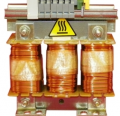
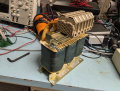
I have usually fitted 3ph inductor chokes between VFD and motor, especially on older, non-VFD rated versions .
Never had a n issue.
 

MisterBill2

Joined Jan 23, 2018
27,700
There is an understanding that some VFDs have outputs that include spikes and transients. Certainly quality levels vary widely. The reality is that not all products are good quality, in fact some are pure junk. and some others are less well designed. with much less safety margin provided.
 

JohnSan

Joined Sep 15, 2018
127
It's not the VFD that 'creates' the spikes, it's the motor & cabling.
The VFD output is fast rising & falling edges.

Both the motor and cabling have inductance, resistance and capacitance.
The fast rising / falling edge of a square wave will cause ringing.
That's the voltage 'spike' an old motor often doesn't like.
If it is an inverter rated motor, its insulation is inverter rated motor for this reason.

The inverter could produce a square wave with a slower edge, but that will cause its output devices to generate a lot of heat.
As far as I have experienced, that is never done.
For an older motor, either an output line reactor is used, or terminating resistors fitted at the motor terminals.

(Bear in mind - if testing or measuring the actual transient voltages the motor experiences, will only be seen at the motor terminals. It also needs to be the actual motor and actual installed cabling).

See a typical Rockwell example:-
 

Attachments

Last edited:

tonyStewart

Joined May 8, 2012
238
I would expect a VFD to have user input variables for constant V/f and constant acceleration of f from min to max with a sine lookup table to depending on inertia and rated load usage.

It should include all the protections such as OCP, UVP, OVP,
 
Top