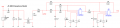
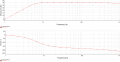
Simulation of compact Geophone SM-6

Thread Starter

lhagva99

Joined Feb 1, 2023
24
Hello @ericgibbs
I have modified the component values as below.
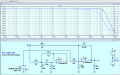
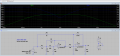
The response of first stage v1 (output of U1) gives very nice plot, but output of second stage vo (output of U2) is distorted.
In my opinion U2 is just an differential amplifier, so it should not affect response.
I think something is wrong with my simulation, please check.

Best regards,
Lhagva
1738336970109.png
 

Attachments

ericgibbs

Joined Jan 29, 2010
21,466
hi i99,
Checking the BW of the 2nd stage OPA shows a good response up to 2MHz.
There is a problem in the filter component values, I will check it out.

Update: @lhagva99

The design of the circuit requires rework, there is a large phase difference in the signals at the two inputs of the final OPA


EEG57_ 2636.png
 
Last edited:

0ri0n

Joined Jan 7, 2025
177
The paper shows flat phase of 90 degree from 1Hz to 50Hz.
Please recommend how to improve phase shift.
Unfortunately I have no idea how to make the phase flat everywhere or what magic was used in the paper to make that happen. You could remove the lowpass filter which impacts the phase shift at higher frequencies but doesn't have much effect on the low end of the spectrum. In the paper the measurements were done on a real albeit different geophone and not simulated with the help of a model.

My initial approach to expanding the bandwidth was passive, heavy damping of the geophone with a simple Zobel network at the expense of gain/sensitivity, followed by a low noise preamp to build the input signal back up. The phase shift is not and can not be flat everywhere either but imo is acceptable.

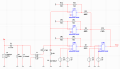
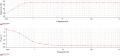
Geophone_v0_Schematic.png

Geophone_v0_Phase.png
 
Last edited:

Thread Starter

lhagva99

Joined Feb 1, 2023
24
Hello @ericgibbs

Thank you again for your kind assistance and the new circuit suggestion.

Do you think our geophone model in LTSpice performs well? I have simulated the model using the .wav files you provided, and it looks good. However, in terms of complexity, including phase shift and gain response, how well is it working?

Which software did you use for the above simulation?

Best regards,
Lhagva
 

Thread Starter

lhagva99

Joined Feb 1, 2023
24
The circuit in the mentioned paper is not able to extend the bandwidth of the geophone. Yes, you could compensate the winding resistance of the transformer with some negative input resistance (< -375 Ohm) but as the resistive component of the geophone impedance at it's natural frequency is many times larger than the winding resistance it has no effect in moving the lower frequency corner down.

I tried the method described in the following paper to increase the bandwidth down to about 1 Hz, keep the amplitude response flat and also limit the upper frequency corner to below 200 Hz.

https://www.mdpi.com/1424-8220/23/6/3082

View attachment 340945

View attachment 340946
Hello @0ri0n
I have reviewed the paper thoroughly.
As it described in the page #9, we must set 1/(R1C2) = 2*gamma1*omega0, where gamma1 is target damping ratio, omega0 is natural frequency. So I set R1=18 Ohm and R2=18 kOhm.
Also for R3, it must be equal to R3 = 2R1/3, so I set to 12 Ohm.
If we keep this setting, can we adjust second stage to have attenuation of around -5dB at somepoint around 0.5Hz, and -3dB at 0.8Hz, same as what you did in previous work.
Let us forget about phase shift at this stage.

Best regards,
Lhagva
1738428671079.png
 

Attachments

Last edited:

0ri0n

Joined Jan 7, 2025
177
The response of first stage v1 (output of U1) gives very nice plot, but output of second stage vo (output of U2) is distorted.
In my opinion U2 is just an differential amplifier, so it should not affect response.
The "distorted" frequency response is deliberate. The filtered frequency spectrum from the active BP-filter is subtracted from the unaltered spectrum which results in a rather broad frequency notch at the natural frequency of the geophone for the purpose of flattening the overall (incl. the geophone) frequency repsonse and extending the bandwidth.


As it described in the page #9, we must set 1/(R1C2) = 2*gamma1*omega0, where gamma1 is target damping ratio, omega0 is natural frequency. So I set R1=18 Ohm and R2=18 kOhm.
Also for R3, it must be equal to R3 = 2R1/3, so I set to 12 Ohm.
If we keep this setting, can we adjust second stage to have attenuation of around -5dB at somepoint around 0.5Hz, and -3dB at 0.8Hz, same as what you did in previous work.
Let us forget about phase shift at this stage.
The component values don't seem to be quite right yet as the frequency response is far from flat and the bandwidth extension is minor.

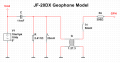
Below the model I created for the JF-20DX geophone studied in the MDPI paper originally posted in #18. Check if the overall phase shift is, like you mentioned, really flat everywhere in case the geophone is followed by the preamp published in the paper.


JF-20DX_Model.png
 
Last edited:

Thread Starter

lhagva99

Joined Feb 1, 2023
24
The "distorted" frequency response is deliberate. The filtered frequency spectrum from the active BP-filter is subtracted from the unaltered spectrum which results in a rather broad frequency notch at the natural frequency of the geophone for the purpose of flattening the overall (incl. the geophone) frequency repsonse and extending the bandwidth.


The component values don't seem to be quite right yet as the frequency response is far from flat and the bandwidth extension is minor.

Below the model I created for the JF-20DX geophone studied in the MDPI paper originally posted in #18. Check if the overall phase shift is, like you mentioned, really flat everywhere in case the geophone is followed by the preamp published in the paper.


View attachment 341987
Hello @0ri0n
Thank you again for your comment and model for JF-20DX geophone.
Could you please tell me how to calculate a value for the L (L=1/k, where k is Coil Spring Constant) and R (R=1/d, d=Damping Coefficient)?
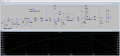
I did simulation with LTspice, using JF-20DX model and values in the paper, response is as below.
I feel to get flat phase response from 10Hz to 100Hz is unpossible, I will try to correct with Digital Signal Processing.
What do you think about amplitude response? Please tell me countermeasure to flatten it, let me play little more on that.
Anyway I think I will create a real circuit board with your values.

Best regards,
Lhagva

1738839618176.png
 

Attachments

Last edited:

0ri0n

Joined Jan 7, 2025
177
Hi lhagva99,

Could you please tell me how to calculate a value for the L (L=1/k, where k is Coil Spring Constant) and R (R=1/d, d=Damping Coefficient)?

I have attached some papers that show how to calculate equivalent component values for the linear, lumped model. Also shown is how good the tested geophones, among them the SM-6, agree with the linear model used for simulation.

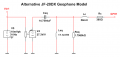
If you are working with coupled inductors as a transformer, delete L (23mH) and simply use 23mH : 17.1417H in the transformer. Below an alternative but identical model for the JF-20DX geophone that uses a voltage controlled voltage source with appropriate gain instead of a transformer. Leq/Ceq/Req represent the mechanical and Lc/Rc the electrical system of the geophone. What is missing is the capacitance of the coil (in parallel to Lc+Rc) which is not given in the datasheet.

JF-20DX_Model_v2.png

I feel to get flat phase response from 10Hz to 100Hz is unpossible, I will try to correct with Digital Signal Processing.

I don't see how a perfectly flat phase response would be possible in an analog circuit that has a natural high pass response.

I did simulation with LTspice, using JF-20DX model and values in the paper, response is as below.
What do you think about amplitude response? Please tell me countermeasure to flatten it, let me play little more on that.

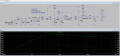
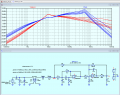
I adjusted somewhat the components to flatten the amplitude response and in the process I even gained some additional bandwidth compared to straightforward resistive damping. Gain rolls of smoothly above 200 Hz due to the coil inductance (50 mH) and the resistive load. Phase response is well behaved but making it flat everywhere is imo unrealistic. Maybe someone else comes around with an idea how to do that.

JF-20DX_Preamp.png


JF-20DX_AC-Sweep.png
 

Attachments

Top