Simulation 12V Powersupply

Thread Starter

Rensieboy223

Joined Feb 3, 2024
88
Hello guys,

I build a powersupply for my relais on my PCB for 12V/3A.
I want to simulate it how good it works but don't know how, can someone help me simulate it?

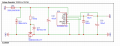
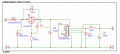
The powersupply:
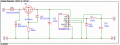
1742050578663.png

Greets,

Rens
 

LowQCab

Joined Nov 6, 2012
5,101
Your Input-Voltage is stated as being "12V to 24V".
At 12-Volts of Input, you are not likely to get a full ~12-Volts at the Output,
there will be a certain amount of Voltage-Loss in the Circuit.

Your Input-Power-Supply must be capable of supplying more than 3-Amps at 24-Volts.

There will be an unpredictable amount of Electrical-Noise generated by the Buck-Converter,
this may, or may not, create various problems for the Circuit being supplied.
Additional Filtering may be required on the Output of the Buck-Regulator.

A Schematic-Diagram of the Voltage-Input-Source, and the Circuit being powered,
may bring-up many more questions that need to be answered.

We are only seeing a small part of a "System" that must all work together to provide what You expect.
.
.
.
 

ericgibbs

Joined Jan 29, 2010
21,439
Hi R223,
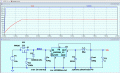
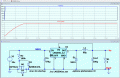
This is what LTSpice shows.
Note that the Q3 PMOS, WST4041 has an internal forward biassed diode [D3] in that configuration.
The circuit requires a redesign.
E
Update: 5v version corrected to 12v version.

EG57_ 2733.gif
 
Last edited:

LowQCab

Joined Nov 6, 2012
5,101
The Buck-Converter in the original Schematic seems to be rated for a 12-Volt Output,
but the above Schematic from Eric shows a 5-Volt rated part.

A quick search for a Spec-Sheet only turned-up Asian-Language versions.
.
.
.
 

Thread Starter

Rensieboy223

Joined Feb 3, 2024
88
Hi R223,
This is what LTSpice shows.
Note that the Q3 PMOS, WST4041 has an internal forward biassed diode [D3] in that configuration.
The circuit requires a redesign.
Thanks E,

What for type of redesign does my circuit require? Can you be a bit more specific?
To give some more background information:
This circuit will power the coils for switching 12V relais on my PCB, it will also power a small coolingfan.
The relais will be controlled with input from a raspberry PI 5, also the powersupply are boat batteries who operate on 12V or 24V.


Greets,

Rens
 
Last edited:

ericgibbs

Joined Jan 29, 2010
21,439
Hi Rens,
Relook at the PMOS, what are you expecting the circuit to do?
I suspect with the 12v Zener you were trying to drop the 24v down to 12V, before the regulator
But the internal diode shorts out the PMOS

Will the LM2596 give a 12 Vout with a 12V input ???

E

Update: Note the LM has a24V input on my simulation, due to forward biassed internal diode
 
Last edited:

Thread Starter

Rensieboy223

Joined Feb 3, 2024
88
Hi Rens,
Relook at the PMOS, what are you expecting the circuit to do?
I suspect with the 12v Zener you were trying to drop the 24v down to 12V, before the regulator
But the internal diode shorts out the PMOS

Will the LM2596 give a 12 Vout with a 12V input ???

E

Update: Note the LM has a24V input on my simulation, due to forward biassed internal diode
Hello E,

I think you mean that the Mosfet won't work with this setupt because of the 12V voltage enables current to always to flow to the powersupply through the foward biased diode. Is a different P-Mosfet the option or should i go N-Mosfet?

Yes the zener was meant to limit the voltage to the pmos for it not to burn out.
What do you suggest how to redesign the circuit?

Greets,

Rens
 
Last edited:

ericgibbs

Joined Jan 29, 2010
21,439
Hi Rens,
A typical application of a MOS FET in series with a voltage regulator is to reduce the voltage applied to the voltage regulator [ LM2596] so that it operates within its specified power rating.
The problem is that the PMOS you are using has an internal bypass diode, which effectively shorts the PMOS, so that you will get the full 24V input on the LM2596 input.
So check the LM2596 datasheet and ensure that you keep within specification..

I would only use a 24V to 12V step down regulator, when the boat's supply is 24V and have a direct connection to the boats' battery for a boat supply of 12V.... always fused near the battery for safety.

A point to consider is if a boat 24V battery system is being recharged with an onboard generator, the actual; battery voltage could be as high as 28V

E
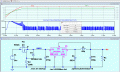
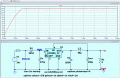
Added a plot for 24V Input,, 12Vout at 3amps, note the LM2596 Watts [ lower plot]EG57_ 2737.gif
 

Thread Starter

Rensieboy223

Joined Feb 3, 2024
88
Hi Rens,
A typical application of a MOS FET in series with a voltage regulator is to reduce the voltage applied to the voltage regulator [ LM2596] so that it operates within its specified power rating.
The problem is that the PMOS you are using has an internal bypass diode, which effectively shorts the PMOS, so that you will get the full 24V input on the LM2596 input.
So check the LM2596 datasheet and ensure that you keep within specification..

I would only use a 24V to 12V step down regulator, when the boat's supply is 24V and have a direct connection to the boats' battery for a boat supply of 12V.... always fused near the battery for safety.

A point to consider is if a boat 24V battery system is being recharged with an onboard generator, the actual; battery voltage could be as high as 28V
Hello E,

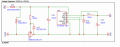
Yes you're completely right, I have changed my setup now to N-channel mosfet so this can't happen anymore, does it look okay now? 1742317364832.png

The input for the XL2596S-12E1 is 4.5 to 40V. So the 28V spike when charging shouldn't be a problem.
Also the relais already turn on at 10V it says in the datasheet, so if the voltage is little below 12V it not a big deal for this setup, but your setup is better. Can I make a second 12V input circuit with also the N-channel mosfet as reverse polarity protection and connect to the output of the 24V-12V powersupply shown above here?

Are there any mistakes in this design now which i haven't noticed?

Greets,

Rens
 

ericgibbs

Joined Jan 29, 2010
21,439
Hi Rens,
I would recommend not using a floating ground on your project, it would mean all the equipment connected to 12V would require the ground to be floating.

E
EG57_ 2749.gif
 

Thread Starter

Rensieboy223

Joined Feb 3, 2024
88
Hi Rens,
I would recommend not using a floating ground on your project, it would mean all the equipment connected to 12V would require the ground to be floating.

E
Hello E,

Can i fix this to pull a track with 10K resistor from the system GND to PGND to ensure good grounding?
Or do you have a better suggestion?

Greets,

Rens
 

ericgibbs

Joined Jan 29, 2010
21,439
Hi R,
Did you understand, post #9, you are exceeding the power rating of the LM regulator.

E

Update:

What is the specification of the 12V relays coils you need to drive???
 

Thread Starter

Rensieboy223

Joined Feb 3, 2024
88
Hi R,
Did you understand, post #9, you are exceeding the power rating of the LM regulator.

E

Update:
What is the specification of the 12V relays coils you need to drive???
Hello E,

No, i don't understand, I'm using the XL2596S as shown in the schematic who can handle up to 40V input.
I redesigned the schematic as shown below, the leakage current is very low so don't mind that, and extra reverse polarity protection with the SS54.
What do you think:
1742448613183.png

Greets

Rens
 

ericgibbs

Joined Jan 29, 2010
21,439
Hi R,
The MOS FET is not required if all you are asking is reverse voltage protection, a simple power diode is what is usually used..
E
EG57_ 2760.gif
 

ericgibbs

Joined Jan 29, 2010
21,439
Morning Rens,
The MOS as wired in your circuit will not reduce dissipation.

The extra diode wired in parallel with the MOS internal diode has a minor effect, the LM2596 still has close to the full 24V on its input.

A simple diode is all that is required for reverse voltage protection.
E
 

Thread Starter

Rensieboy223

Joined Feb 3, 2024
88
Morning Rens,
The MOS as wired in your circuit will not reduce dissipation.

The extra diode wired in parallel with the MOS internal diode has a minor effect, the LM2596 still has close to the full 24V on its input.

A simple diode is all that is required for reverse voltage protection.
E
He E,

Okay, thanks, but the diode in the Mosfet has already a function for blocking the Reverse voltage right? So the extra diode in parallell is not useful?

I see many high power circuits where a mosfet is used instead of a diode for reverse voltage protection, that's what the Mosfet in my circuit was supposed to do.

Greets,

Rens
 
Top