You seem to be leaning towards a 555 timer configuration circuit.
Is that because you have a concern about the timing accuracy of the simple circuit I posted?
Yes.
R1 and R2 are for simulation purposes to represent the resistors in the resistor network in the vehicle, as I mentioned in my post.
Perhaps that was not clear.
The scheme can use some 5 second pulse generator and that will step a CD4017 counter that will operate sections of a CD4066 quad analog switch to supply the correct resistances. and then one of the last counts will diable the 4017 counting until the power is switched off, at which point it will restart. And the pulses can be from a 555 or from a CD4013 configured as a dual flop-shot with a 5 or six second on time..
No not really, just looking at what will be the easiest to assemble on veroboard.
Also I think we have our wires crossed about where the resistors R1 and R2 are in the circuit. I'll try to explain.
Take a simple 2 resistor voltage divider, one fixed at the top and either R1 or R2 connected below it. The centre point of the divider (the output) has a wire connected to it and goes down the steering column to the computer so it can monitor the voltage. To simulate the the pressing of the steering wheel buttons I have to connect either R1 or R2 to this wire and ground. Hope it makes sense.
Also I'm wondering what would happen to the timer accuracy if the power is removed from the circuit and applied before the caps discharge. Llike turning the car OFF and starting it back up.
No, I understand.
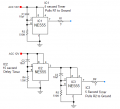
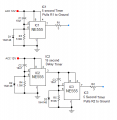
R1 and R2 in my circuit are the R1 and R2 resistors you mentioned in your first post (see revised circuit below).
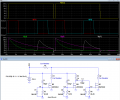
Added diodes to ground (D1, D2, D3) provide a near instant reset (below):
Note that the 555 circuit also has this reset problem.
Thanks very much looks great. I think I would be happier to switch R1 & R2 to ground via a relay, just to keep it completely isolated. Don't want anything to go wrong and chance doing something wrong to the car's computer.
Have you contacted the manufacturers of the vehicle to ask why these buttons are configured as to require the driver to operate them before driving? Are they safety interlocks of some kind?
E
Isolated from what?
The MOSFET connects to the resistor and vehicle ground, and the MOSFET gate is isolated from its source and drain (no current can flow through the gate), so there's nothing to isolate.
I think the only problem using the mosfets is when they begin to turn OFF. The voltage at the divider will start to increase and may or may not cause an issue.
The 555 or relay provides a definitive ON-OFF state.
It wasn't clear to me.
Are you referring to the fact that the MOSFET doesn't instantly change from ON to OFF but takes about 300ms?
I suppose that could be a problem if the system responds rapidly enough to see the intermittent voltage as a different button press.
No not really, just looking at what will be the easiest to assemble on veroboard.
Also I think we have our wires crossed about where the resistors R1 and R2 are in the circuit. I'll try to explain.
Take a simple 2 resistor voltage divider, one fixed at the top and either R1 or R2 connected below it. The centre point of the divider (the output) has a wire connected to it and goes down the steering column to the computer so it can monitor the voltage. To simulate the the pressing of the steering wheel buttons I have to connect either R1 or R2 to this wire and ground. Hope it makes sense.
Also I'm wondering what would happen to the timer accuracy if the power is removed from the circuit and applied before the caps discharge. Llike turning the car OFF and starting it back up.

 Facebook
 Google
 GitHub
 Linkedin