Yes, but Zeners have a poor voltage tolerance.
That's why I uses the programmable TL431 reference in my circuit, which looks like a high accuracy Zener.
Why do you want to use a Zener?
So, you have lots of parasitic loads and you want to add more ? ? ? ANY circuit that compares the voltage is going to draw some current. At least as far as I know. Perhaps a better solution is to keep the vehicle(s) on a constant charge and let the engineers who designed all those parasites figure out how they are going to operate.
Yes, but Zeners have a poor voltage tolerance.
That's why I uses the programmable TL431 reference in my circuit, which looks like a high accuracy Zener.
Why do you want to use a Zener?
By poor voltage tolerance you mean the rated voltage of the zener is not spot on?
The reason for a zener is simplicity, and I already have a bunch of 13V zeners. It will not have as sharp turn on-off as TL431 I think, that might be a problem that will take more components to fix than using TL431 to begin with?
So, you have lots of parasitic loads and you want to add more ? ? ? ANY circuit that compares the voltage is going to draw some current. At least as far as I know. Perhaps a better solution is to keep the vehicle(s) on a constant charge and let the engineers who designed all those parasites figure out how they are going to operate.
The idea is that what my circuit(s) uses when idle will be offset by the savings it will provide by not allowing anything run from the battery. Since I'm not the only user of the vehicle, other drivers are not as cognizant as to the depth of discharge of the lead acid battery, and use various accessories while the vehicle is off not judiciously.
The reason for a zener is simplicity, and I already have a bunch of 13V zeners. It will not have as sharp turn on-off as TL431 I think, that might be a problem that will take more components to fix than using TL431 to begin with?
Not sure that a Zener circuit would be significantly simpler.
Don't offhand see how to use a 13V Zener in a circuit simpler than the one with the TL431, to give a 13V power cutoff.
A zener diode is relatively hungry, with poor initial value tolerance. Thanks to laptops and cell phones in the 90's, there are lotsa very low power reference and comparator components, sometimes in the same chip. Back when, Linear Technology and Maxim battled for years, with new parts introduced every month. I prefer LT parts to M, and LT (now a part of Analog Devices) has a great parametric search engine.
While there are many variations on the theme, they all will have a reference voltage of some type, a variable voltage input, a comparison function, and a power transistor. Getting this down below 0.1 mA static current in the off state is very doable. Another way to describe what you want is an undervoltage lockout circuit.
In an old project, I use a National Semiconductor LM611, Here are some more modern parts.
Below is the LTspice simulation of a comparator circuit using a low-cost, programmable TL431 voltage reference as a comparator to turn a MOSFET on when the battery is above 13.5V and off when it drops below 13V.
Thank you crutschow! I made this circuit and it works as you planned. I am planning car battery heater, which should activate when battery is charging, either by alternator or separate battery charger. With this circuit I can connect it directly to battery and heater automatically turns on and off without any attention. I made this with IRF9540 (Rds 0,117 ohm) and it seems to handle 2A current, but not more without heatsink. I try again with IRF4905 with Rds 0,02ohm, if it makes a difference. If not, then I use just 12V relay. I will also have +20°C bimetal thermostat for safety and to heat only when necessary.
Heating elements are 2 pieces of 12V 12W silicone pads and then I will insulate battery with foamed plastic etc.
Here in Finland we had below -30°C last month and even with quite new AGM battery I had problems, because it will not take (charge) any current when it's cold.
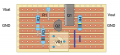
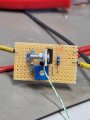
Circuit on stripboard
Testing:
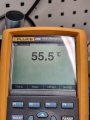
Temperature at 2A
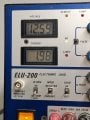
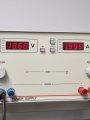
Artificial load, voltage drop mostly because of wires and test clips
I adjusted it to turn on at approx. 13,6 volts and it turns of at 13,1V
I have repaired just such a device long ago, for a client. Thee purpose of the device was to power their portable music system that was plugged in to the lighter socket when the engine started. It did not use the battery voltage because that voltage is unreliable when the headlights were on and the engine idling.
The circuit detected the low level alternator whine frequency which is only present when the engine is running. It used an LM324 quad op-amp, coupled to the positive lighter connection with a capacitor. There were two stages of AC coupled gain, , which fed a stage that was a rectifier so that a DC voltage was produced when the engine was running. THAT fed the last stage that drove a transistor switch that supplied the 1`2 volts to the module outlet connector. With the engine not running the only current draw was the resting current of the LM324 quad op-amp, which is not much. Very reliable circuit, but not soldered very well.
So using that scheme is my suggestion.

 Facebook
 Google
 GitHub
 Linkedin