simple BJT audio amp experiment (need help)

I was able to get acoustic feedback by using a small power transformer to get the voltage gain.

I connected the speaker/microphone to the 12 volt winding of a small power transformer and then drove an emitter follower from the 120 volt winding, which then drove the second speaker. The supply voltage was 3 volts and the emitter follower quiescent current was about 50 mA.

The speakers had to be no more than 1/2 inch apart to get the acoustic feedback, so it would appear that I'm not getting as much power gain as the common emitter stage provides.
 

Wendy

Joined Mar 24, 2008
23,798
Something similar a 600Ω/8Ω transformer? That was cheating! :D There is a reason they existed, and were pretty universal in the age of the transistor radio.
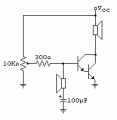
Impedance matching is always an issue in electronics, but it is usually taught after basic theory.

From now on, when showing biasing schemes, I'm going to use this one, since it is universal. Simplifies the math a lot too.


Electrician, did I understand you got squeal with just one transistor and no transformer? I'm using a 1" speaker and a 3" speaker, I suspect cone surface area matters.

Side note, in http://www.allaboutcircuits.com/vol_6/chpt_3/12.html they use a transformer as a method of isolating and increasing the sensitivity of headphones for later experiments. I had to build one of these for use in some of my experiments, though I'm not fond of the gadget myself.
 

Attachments

Last edited:

Thread Starter

count_volta

Joined Feb 4, 2009
435
Yes it was kinda cheating LOL. Everyone knows that transformers amplify the heck out of signals. You can make a small voltage into thousands of volts easy, but if everyone used transformers as amplifiers our devices would once again be big and heavy, instead of fitting into our pockets. ;)

I read about the Darlington on wiki. Correct me if I'm wrong anywhere. As far as I understand its equivalent to a regular NPN BJT but with gain β1*β2. Also it has a higher VBE turn on voltage. 1.3V or so right?

Also VCE sat is higher, 0.7V. What does that say about VCB? For a regular BJT active mode is defined as VCB must be greater than -0.4V. Is this still true for a Darlington, since I see VCE sat has changed. Forgive me I forgot what the heck VCE sat is. LOL. I remember that active mode means VCB is greater than -0.4V.

Bill I have a question about your circuits with the Darlington. I want to try building them and see what happens, but first I need to know the need for certain things and how certain things are connected. First of course I need to know if my assumptions about Darlingtons above are correct?

These circuits of course.


First of all the potentiometer/var resistors, the way they are drawn is slightly confusing. Can you please redraw them as regular resistors and just say variable resistor above it? For example I have no clue how the 300Ω is connected to the 10KΩ. The symbols are confusing. I never seen them before.

Also why and what did you change between trials 1 and 2? Has to do with the pot again. Lastly what is the purpose of the capacitor in the last circuit? As a high pass filter to block DC? Why would you need to do that here?

Thank you very much. Eagerly awaiting your reply. :D
 

Wendy

Joined Mar 24, 2008
23,798
Actually transformers don't amplify, but I'm being picky. It is important though to choose your words in regards to any technical field, you can get into fierce technical discussions only to discover you were arguing apples and oranges. Transformers are the original impedance matchers, that is why some are not referred to by their windings or voltage, but by their ohmage.

As to the Darlington transistor, you are right on all fronts. Some of it I didn't really understand until I was on AAC, specifically the saturation drop is a fixed (or semifixed) voltage. On a conventional transistor it can be quite low (less than 0.1V, occasionally as high as 0.2V). The Sziklai pair has the same saturation problem, but only drops .6V BE, and it also looks like one transistor.

The capacitor allows a low impedance path for the AC (ie, audio), while being invisible to the DC, so the transistor's bias is not affected.

Post #120 I covered this, but since pictures are worth a thousand words...


By using a pot I don't have to calculate the exact resistors needed, I just adjust for a specific collector current.

You know, I have no idea what the longest thread on AAC is, but I bet this one is giving it a run for it's money.
 

Thread Starter

count_volta

Joined Feb 4, 2009
435
As to the Darlington transistor, you are right on all fronts. Some of it I didn't really understand until I was on AAC, specifically the saturation drop is a fixed (or semifixed) voltage. On a conventional transistor it can be quite low (less than 0.1V, occasionally as high as 0.2V). The Sziklai pair has the same saturation problem, but only drops .6V BE, and it also looks like one transistor.
So what does it say about VCB? Is active mode for a Darlington still defined as VCB> -0.4V?

The capacitor allows a low impedance path for the AC (ie, audio), while being invisible to the DC, so the transistor's bias is not affected.
So it is a high pass filter right?


Post #120 I covered this, but since pictures are worth a thousand words...


By using a pot I don't have to calculate the exact resistors needed, I just adjust for a specific collector current.
Whoa why is that true? The resistors are like they are in parallel and the source is halved? Why?


You know, I have no idea what the longest thread on AAC is, but I bet this one is giving it a run for it's money.
Is that a good thing? :D I think many different people are interested in this thread. Has nobody ever asked a detailed question about a BJT amp here before or what? LOL.
 

Wendy

Joined Mar 24, 2008
23,798
I think it is the practical experiment that is the difference. Just an opinion. I'm thinking of trying to turn this into an article after it is all said and done, complete with Radio Shack parts (a small friendly jib at AudioGuru).

This diagram is true.


It has to do with basic DC theory, and what I call black box electronics. Looking back through the resistors the second equivalent circuit describes what you see electrically. This is also why the name potentiometer is given to that style of variable resistor, it outputs a voltage potential.

Part of what makes it true is a good power source (ignoring the voltage difference across the leads) is also low resistance mathematically speaking, 0Ω being the ideal. Batteries have an internal resistance, which is used in many circuits. This is a concept only, the thing that generates the voltage also means the zero ohms is invisible to that voltage, but it can be measured on the outside (more black box theory).

I don't really understand the question about VCB. That parameter doesn't really exist, I think. Where did you see it?

The collector voltage is a function of the collector emitter current, and the load resistance on the collector. Since the collector current is loosely tied via beta and base emitter current, I would say the voltage isn't really important, since it is a complete variable.
 

Thread Starter

count_volta

Joined Feb 4, 2009
435
I think it is the practical experiment that is the difference. Just an opinion. I'm thinking of trying to turn this into an article after it is all said and done, complete with Radio Shack parts (a small friendly jib at AudioGuru).
I might add a video to your article of me in one room and my friend in the other and he hears what I say, all due to the amplification. A sort of ancient telephone using modern transistors. :D

I don't really understand the question about VCB. That parameter doesn't really exist, I think. Where did you see it?
My textbook from Electronic circuits course from last semester. Microelectronic circuits by Sedra and Smith. It was beaten into our heads all last semester and on exams. Is the transistor in active mode? How do you know? Is VCB greater than -0.4V?

I might have confused which value it is. Which value is the important deciding factor to check active mode and that value is typically 0.4V? I even saw it on data sheets!!!

Would they be wrong? I don't think so. LOL. I definetely hope not. If that is true I might make AAC my university. Its free after all. :D
 

Wendy

Joined Mar 24, 2008
23,798
I could have had a memory hole, or one of the letters is off. Transistors have some very interesting characteristics, and it is easy for a lot of new people to get things off (not referring to you in this case). We had one person who though the .6V BE drop showed up on the collector emitter, for example.

FETs and MOSFET theory is simple by comparison, yet we discovered BJTs first. Go figure.
 

alphacat

Joined Jun 6, 2009
186
Whoa why is that true? The resistors are like they are in parallel and the source is halved? Why?
Have you forgot thevenin's theorem? ;)
Looking at the left circuit, the voltage which the output sees is 1.5V (A simple voltage divier).
Measuring the output resistance (while shorting all DC voltage sources and cutting off all DC current source) gives 10kΩ || 10kΩ = 5kΩ.
Therefore, Thevenin equivalent is the right circuit with Vth=1.5V and Rth=5kΩ, as shown.

Is that a good thing? :D I think many different people are interested in this thread. Has nobody ever asked a detailed question about a BJT amp here before or what? LOL.
There might be some longer threads here, but this is one of the most enriching ones for sure. :cool:
 

Audioguru

Joined Dec 20, 2007
11,248
complete with Radio Shack parts (a small friendly jib at AudioGuru.
Didn't I tell you about the RadioShack S-Video cable I bought when RadioShack was still in Canada?
It cost $15.00 and was 12' long.
Then I saw exactly the same Chinese one at The Dollar Store for only $1.00.
I bought the one at The Dollar Store and took it to RadioShack and got my $15.00 back.

RadioShack was a ripoff joint. No wonder they are gone.
The quality of their parts was 2nd or 3rd grade. Manufacturer's rejects?

Their speaker was rated at 40W. But its Korean woofer was stamped only 5W.
It didn't make much smoke.
 

Wendy

Joined Mar 24, 2008
23,798
:D They are still alive and well in the states. Even when I was going to college there were rumors that they bought rejects in barrels and sold them for more than more than new graded parts cost (floating free in bubble pack).

They have improved a bit, and they are local to me (HQ in Ft. Worth), so what's a Texan to do? The real argument is they they are local to a surprising number of people. If you can drag their clerks away from selling cell phones and accessories long enough they have a parts wall that isn't too exorbitantly priced. Most noobs don't know about Digikey, or BJ Micro, or any of the other retailers out there, so you go with what they can get. If the newbies get the bug they'll learn how to save money.

Should I go on to 741's now? :D
 
Something similar a 600Ω/8Ω transformer? That was cheating! :D There is a reason they existed, and were pretty universal in the age of the transistor radio.
It was a Radio Shack small power transformer, 120VAC in, 12VAC out, used in reverse.

It was much less a cheat because the transistor was used as an emitter follower. The idea was to show by experiment what I was telling Count Volta, that just current gain won't do it, you need to get voltage gain somehow.

But voltage gain alone won't do it, either. If it would, then you could use a transformer between the speakers and get acoustic feedback, which we know won't work; you have to have some power gain, which a transformer can't give you because it's a passive device.

In this arrangement, with transformer followed by emitter follower, the transistor provides all the power gain. Text books will tell you that an emitter follower can't provide as much power gain as a common emitter stage, and I could tell that by the fact that with the transformer/emitter follower the speakers had to be only .5" apart to get squeal, whereas the common emitter circuit would squeal with the speakers 1.5" apart.


Electrician, did I understand you got squeal with just one transistor and no transformer? I'm using a 1" speaker and a 3" speaker, I suspect cone surface area matters.
I got plenty of squeal with just one transistor wired as I described in post #134. I was using the same 2" speakers with both circuits I wired up.
 

Wendy

Joined Mar 24, 2008
23,798
Mine never did. I could barely hear it, though there was some sound. I mentioned it before, but I bet the cone size affects the sensitivity.

I just got back from the shack looking for audio transformer. Online it is listed as available everywhere, but it's not anywhere. The Radio Shack clerk mentioned some big changes coming in a couple of weeks. It could be they are finally dropping their parts all together, though if that is the case I don't give the chain any chance of survival. Accountants can be idiots, these are the guys that will tell you to fire all the experience help and hire low cost new hires as in Circuit City. The only reason I go there is parts, and while I'm there I'll look around. We'll see.

All the various configurations of BJT transistors provide power gain of some sort. Wouldn't be an amplifier otherwise. We keep nibbling at the edges of impedance matching, but so far we haven't really gone there.
 

alphacat

Joined Jun 6, 2009
186
Hey,
Could you give me an example of a source where an emitter follower is used in order to decrease the source impednace?

When using the speaker as the source, then the source impedance is only 8ohm, therefore there isnt really a reason to use an emitter follower, since it will only increase that source impednace.

Are there really sources with source impedance that is over 1Kohm (which in this case, an emitter follower starts being useful, since its Rout is usually less than 1kohm if designed correctly).
 

Audioguru

Joined Dec 20, 2007
11,248
Circuit City came to Canada and took over some of the RadioShack stores to sell cell phones and kids toys. The stores are called "The Source".

I don't know why people buy cell phones there. My internet and cable TV provider gives away pretty good cell phones for free.
 

Wendy

Joined Mar 24, 2008
23,798
Hey,
Could you give me an example of a source where an emitter follower is used in order to decrease the source impednace?

Hello,

I dont see here any voltage/current source, nor source impedance.
I guess i didnt understand what you wanted to show by that circuit.
R1 and the zener diode shown are basic voltage regulators. They can provide around 10-20ma (actually more, but for the sake of this example assume it is so).

The current (through the zener) is around 10ma. Assuming the load RL is pulling 100 ma, so the base emitter is pulling maybe 1 ma. It is a situation where the base regulator, the zener circuit, is being loaded, and yet the emitter is providing a much heavier load. In other words, the zener regulator is seeing 1 ma load, while the transistor is sourcing 100 ma, a huge difference.

It could also be a situation where you have a audio signal out of an audio amplifier that is high impedance. High impedance in this case means there is the equivalent of large resistor between the output of a perfect amp and the real amp. The emitter follower could drive the speaker, yet load the previous amp lightly. It is a current amplifier.

Let's say the ß is 100, and the speaker is 8Ω, then the input to the voltage follower (aka, emitter follower) is going to be approximately ß X RE, or 800Ω.
 

Audioguru

Joined Dec 20, 2007
11,248
A power transformer does not work well at audio frequencies.
Does anybody make or use audio transformers anymore? (PA speakers use them)
 
Top