simple BJT audio amp experiment (need help)

Thread Starter

count_volta

Joined Feb 4, 2009
435
My knowledge of microphones is very small. I mean I understand how a microphone works. Correct me if I'm wrong.

Vibrations in the air from sound cause the diaphgragm to move, and the diaphragm has a coil attached to it, and this occurs next to a magnet, and when you move a magnet near a coil, or vice versa electromagnetic induction occurs and there is a current in the coil. The current varies exactly according to the vibrations in the air, and so the current is an electrical representation of the sound. Elementary school stuff.

I'm not even sure what the strength of this current which is produced by the movement of the diaphragm is, but I imagine its tiny since the movement is also tiny. Its this current that we are trying to amplify.

Now you are saying that every microphone is different. I looked at carbon mics on wikipedia and it turns out that they work a little different. You pass a current through them, and their resistance varies according to the movement of the diaphragm. Is that right?

So can you guys please help me find a carbon mic somewhere, I am having trouble finding them online.
 
Last edited:

millwood

Joined Dec 31, 1969
0
the electret micphone you have is essentially a capacitor: it has two a thin metal film isolated from another thin metal film in an electrically charged environment. when the sound wave hits the metal film, causing it to vibrate, its charges go up and down accordingly.

that tiny variation is then picked up and amplified by a jfet. for the jfet to work, you will have to have a dc bias, unlike other mics you may have read about.

the advantage with such a device is that it has higher gain than other "passive" mics.
 

Thread Starter

count_volta

Joined Feb 4, 2009
435
I think we must abandon the carbon microphone idea. They are impossible to find, and the ones that I did find cost 15 dollars which is a little high and a little funny for such a simple circuit, which will produce crappy quality anyway.

hobbyist, I need a circuit that I can understand, not just build. I know almost nothing about transformers yet. The other circuit you posted, with that very detailed explanation for which I am grateful, is what I should try to understand.

I will re-read the posts in this topic and see what I can do.
 

flat5

Joined Nov 13, 2008
403
The 470 ohm resistor limits the current to the transistor base no matter how the pot is adjusted. It is for insurance. The pot may have been set to zero ohms.
 

Wendy

Joined Mar 24, 2008
23,796
I doubt they make carbon mikes anymore, but they can be had from really old telephones (which is where I got mine 30 years ago). I suspect the phones are so old that they are worth something again.

As a suggestion, use millwood's electret mics amp and interface it with your design (a two transistor amp). I haven't used electret mics (though I have several in the junk box), but I'm under the impression they produce a really small signal.

Judging how much real amplification you need is always a challange, one I won't claim to have down. The shear number of microphones types (all different, using different physics) and speakers (ditto) is astounding. I've read articles where they used flames for speakers. It is important to understand the components you're using. The little 2" 8Ω speakers that computers used to use (even that has changed) were a stable for hobbiests at one time, and do both speaker and mic well.

I'm treating this like an experiment, I suspect everyone who is offering advice is. You won't get anything very usable with one transistor, but it's fun. Let me show you where this design finally ends up, with all the constraints in place. It won't get hot (at least not out of control hot), has real problems driving a speaker, but can be made to do so.


But it is good to start simple, and work your way up.
 

Thread Starter

count_volta

Joined Feb 4, 2009
435
Hey Bill, thanks for that circuit. I would like to understand the need for all those resistors and the capacitor. Can you explain?

Does the AAC have any similar designs and explains them?

I was reading the BJT section until I got to the audio amp and stopped there because it is exactly what I wanted to do myself. Perhaps I should read the rest of the BJT section first.

And also Bill, what type of microphone does your circuit theoretically use? Coil or electret?
 

Wendy

Joined Mar 24, 2008
23,796
That last circuit is a basic transistor circuit, no microphone. It's what you work up to when you go through the basics.

Use the the one I showed in post #8, if you want to get serious then we'll start from scratch. Just pick the speaker/mic, I would go with the 8Ω variety cheap speaker.
 

Thread Starter

count_volta

Joined Feb 4, 2009
435
This circuit Bill


Well the one on the right requires a carbon mic. Will the one on the left work? What type of mic would I need?
 

millwood

Joined Dec 31, 1969
0
count volta

Here is a properly designed circuit, utilozing 2 speakers for input and output, all you need is to purchase a audio output transformer from radio shack.

Have fun learning...

View attachment 10774
I am not sure how you had concluded that this is a "properly designed circuit". please allow me to point out a few things, and I will post them in serial, with charts to help illustrate my point.

1) input impedance: I mentioned this to you somewhere else on a similarly designed circuit.

because of the use of very low resistors to generate a "low" bias point on the base of the transistors, your input impedance will be extremely low, often dominated by the lower resistors (R5 and R2, respectively).

here is a resistor-loaded version of your last stage. R5 represents the output impedance of the prior stage.

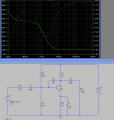
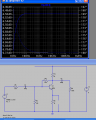
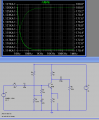
the solid trace is the amplitude of the input impedance and the dashed trace is its phase. as you can see, the input impedance is about 22ohm up until 1khz and goes downhill quickly thereafter.

coupled with the (relatively) high output impedance from the prior stage, you have a significant attenuation of the input signal: a 20khz 100mv input signal loses about 94mv of it on the output impedance of the prior stage and only 6mv of it gets amplified by this stage - not a good thing.

not to mention the wild swing in the phase - that means varying degrees of group delays at different frequencies.
 

Attachments

millwood

Joined Dec 31, 1969
0
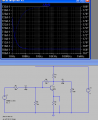
here is the frequency response of the last stage.

as you can see, it is extremely "wild": from 10db at 20hz to 30db at 2khz and then back down to 17db at 20khz.

if you were to do a -3db frequency response, as we typically do, it would be from 1.5khz - 5khz - barely acceptable for an old telephone booster, but nothing to write home about.
 

Attachments

millwood

Joined Dec 31, 1969
0
remember about that capacitor (C4 in my schematic) between the collector and base of the output transistor? the last 30 years of audio are about various innovative and often elaborative ways to reduce that capacitor to as low of a value as you can.

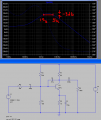
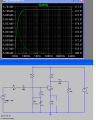
why? here is a plot of the frequency response with C4 set to 0.1uf. Compare it with the prior chart where C4=0.01uf.

unless there are some very disturbing physical or psychological reasons, you do NOT want to listen to an amplifier with this kind of frequency response.
 

Attachments

millwood

Joined Dec 31, 1969
0
this is to illustrate that designing an amp is a lot more than just getting its dc working points right.

Again, I strongly suggest that you pick up a book by Self or Sloan on the subject matter and after that, you will have a lot more appreciation for the issues engineers have to deal with to produce even a half respectable product.

it also shows why so many textbook examples will never be used in the real world, :).
 

millwood

Joined Dec 31, 1969
0
so how do you improve it?

one way would be to address the input impedance issue and then to introduce some negative feedback.

before we do that, let's just make sure that what ever we do, the dc working points for the transistor stay unchanged. right now, the transistor is running at about 40ma bias current. so we want to make sure that our future circuits run at that level as well.

the first change is to introduce some forms of negative feedback. that's done by rewiring the upper resistor from the rail to the transistor's collector. this way, we will be able to increase the value of the bias resistors and maintain better dc stability.

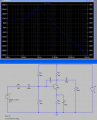
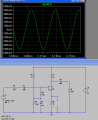
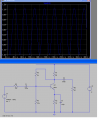
first, the output waveform - it has a swing of 400mv Vp, in reasonably good shape.
2nd, the frequency response - flat to infinity: remember, we are using perfect transistors here.
3rd,the input impedance. at about 700ohm, dominated by beta*R2.

either way to look at it, it is a substantial improvement over the prior version.
 

Attachments

millwood

Joined Dec 31, 1969
0
now, this approach wouldn't work if the supply voltage is very high (for example, 24v or more) - it would require R3 to be small thus hurting your input impedance.

if you are using high rail voltages, you need to revise the bias.

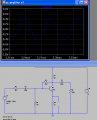
see the attached schematic. R4/R3/C3 form a voltage divider / ripple rejection enhancer, and the bias is fed to the base through R7. the input impedance is approximately R7//(beta*r2). and if beta or r2 is sufficiently high (usually the case), R7 defines the input impedance and you can select R7 freely regardless of supply voltage.

how does this amp perform?

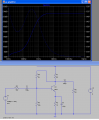
1) waveform: about 500mv Vp. reasonably well defined - no visible defects.
2) frequency response: flat to the yaya land - thanks to the ideal transistor.
3) zin: about 1.1kohm. if we used a higher R2, it would have been considerably higher.

what this exercise shows is that single stage amps don't have to perform poorly, if you are careful at designing them.
 

Attachments

Wendy

Joined Mar 24, 2008
23,796
Hey Bill, thanks for that circuit. I would like to understand the need for all those resistors and the capacitor. Can you explain?

Does the AAC have any similar designs and explains them?

I was reading the BJT section until I got to the audio amp and stopped there because it is exactly what I wanted to do myself. Perhaps I should read the rest of the BJT section first.

And also Bill, what type of microphone does your circuit theoretically use? Coil or electret?
Like I said, it's not a mic, it is representative of the input signal.

My advice, go with the simple one first, then if you want to build on it you can. You may even get to see some interesting accidents (every tech ever to lay wire has tales of weird accidents). Strange glowing lights, odd smells, colored smoke, and more expensive than fireworks. Oh, and did I mention fire? :D I don't think you'll get there with this, but its where you start.

Basically that last schematic I showed is a cumulation of a transistor theory course, with all the bells and whistles as it were. For driving a speaker it isn't really that good, it is a basic high gain amplifier. Remember us talking about Class A (and so on) amps? That is what their for. A lot of inovation has gone on since tubes were invented, and a lot of that tranfered on over to transistors and beyond.

For now, stick with two speakers and a transistor that can bake a while without frying, their cheap, and easy. Oh, and if that transistor gets really hot, and you touch it, the part number will brand into flesh in reverse. Personal experience talking here.

I'll only be here about once a day for a while, work has gotten the better of me. But this is one of the threads I'll stick with.
 

Audioguru

Joined Dec 20, 2007
11,248
Of course the output sine-wave has no visible defects:
1) The transistor has such a high amount of negative feedback that its voltage gain is only 5.
2) The load current is almost nothing.
3) The output level is low.

If an emitter bypass capacitor is added to boost the voltage gain, if the output level is increased to near clipping and if the load current is increased then there will be so much distortion that it hurts.
 

millwood

Joined Dec 31, 1969
0
Of course the output sine-wave has no visible defects:
1) The transistor has such a high amount of negative feedback that its voltage gain is only 5.
2) The load current is almost nothing.
3) The output level is low.

If an emitter bypass capacitor is added to boost the voltage gain, if the output level is increased to near clipping and if the load current is increased then there will be so much distortion that it hurts.
none of them is foundamental to why the amp didn't work.

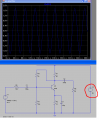
here is a slight revision to the amp. it has a gain of 15x, capable of driving a 64ohm headphone to ear bleeding levels, and output 1.5v vp, with minimal distortion and can work under vastly different supply rails - the dc working points are pretty much immune to supply voltage. and the frequency response is flat to infinity - again, ideal transistor.

yet, it has that emitter capacitor too.

all because of the introduction of negative feedback: the upper divider resistor is wired to the collector of the output device.

the original design failed, foundmentally because it has no feedback, and is an open loop amplifier.

Obviously, you can make lots of changes to this version still. But it is on the right track, thanks to the feedback.
 

Attachments

millwood

Joined Dec 31, 1969
0
here is the output waveform for 36v rail. and compare it vs. the 8v rail case and you can hardly see any difference.

negative feedback is a great thing, if used properly and wisely.
 

Attachments

Top