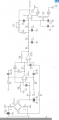
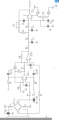
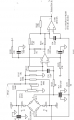
Hello everyone, I have a question about the operation of the circuit.
I know that the Wheatston bridge is a sensor but how pressure measurment is obtained.
Thank you for your answers.
In a balanced state the bridge output is zero volts. If we change the resistance in one leg the balance is upset resulting in a voltage out. So I can have for example three 350 Ohm resistors and a 350 Ohm strain gauge. The strain gauge resistance is 350 Ohms making a balanced bridge but as I apply a strain (pressure force) on the strain gauge the bridge becomes unbalanced with an output proportional to the amount of strain. I suggest you read this or similar to understand Wheatstone Bridge Theory of Operation.
Tje bridge circuit, as already described, has the four resistors being devices known as strain gages, which means that their resistance increases as the conductors are stretched and decreases as they are compressed. These resistors are bonded to a diaphram in a housing so that as some fluid pressure increases the diaphram flexes, which causes two if the resistors to stretch and the diagonally opposite pair to be compressed . This unbalances the bridge, causing a difference in the two voltages at the side corners. Normally that voltage would be fed to a circuit called an instrument amplifier. But the circuit shown is not an instrument amplifier, it is instead a differential input amplifier. The over-al performance is similar but the operation is different from an actual instrument amplifier.
The voltages at the two sides of the bridge are (in theory) equal when the pressure is zero and they change a small amount as the bridge becomes unbalanced. The amplifier only amplifies this small difference voltage, providing an analog voltage in proportion to the pressure deforming the diaphram.
Tje bridge circuit, as already described, has the four resistors being devices known as strain gages, which means that their resistance increases as the conductors are stretched and decreases as they are compressed. These resistors are bonded to a diaphram in a housing so that as some fluid pressure increases the diaphram flexes, which causes two if the resistors to stretch and the diagonally opposite pair to be compressed . This unbalances the bridge, causing a difference in the two voltages at the side corners. Normally that voltage would be fed to a circuit called an instrument amplifier. But the circuit shown is not an instrument amplifier, it is instead a differential input amplifier. The over-al performance is similar but the operation is different from an actual instrument amplifier.
The voltages at the two sides of the bridge are (in theory) equal when the pressure is zero and they change a small amount as the bridge becomes unbalanced. The amplifier only amplifies this small difference voltage, providing an analog voltage in proportion to the pressure deforming the diaphram.
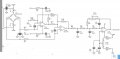
Thank you for replying, but I have a question about the following circuit where the same sensor is used but the measured quantity is flow
Thanks again.
That bridge arrangement could be used for any quantity which can alter a resistance - weight, temperature, RF power, pressure, etc. The changing resistance is used in one, or possibly two) arms of the bridge.
Measuring flow with a pressure sensor is often done. The simple method is measuring the pressure drop, (Differential pressure) across a calibrated orifice. This can be quite accurate but generally has a lower span that is usable. In addition the orifice method depends on the fluid having a consistent viscosity. For gas flow measurements there is a special class of orofices called "critical venturi flow meters" that have special properties making them more accurate than other types. So that is how flow measurement is done with a strain gage pressure sensor.

 Facebook
 Google
 GitHub
 Linkedin