Signal boost by antenna gain ?

Thread Starter

Externet

Joined Nov 29, 2005
2,624
Hi.
An antenna with no gain produces a 5μV level receiving a signal.

Tx------------------------------>nogainANT

Replacing the antenna with a 10X gain antenna (20dB) should produce a 50μV reception of that same signal ?

Tx------------------------------>10X gainANT

Feeding that 50μV signal to another 20dB gain antenna (10X); is the effective radiated signal of that second antenna 500μV ?
 

crutschow

Joined Mar 14, 2008
38,321
QUOTE="Externet, post: 1979131, member: 4569"]
Replacing the antenna with a 10X gain antenna (20dB) should produce a 50μV reception of that same signal ?
[/QUOTE]You used a deciBel (gasp) :eek:.
But the answer is yes.
Feeding that 50μV signal to another 20dB gain antenna (10X); is the effective radiated signal of that second antenna 500μV ?
Antennas radiate power, not voltage, and the power out would equal the power in.
A radiated signal of 500µV makes no technical sense.
 

LowQCab

Joined Nov 6, 2012
5,101
"Reception-Gain", and "Transmission-Gain", are virtually the same thing, just with different directions.

"Reception-Antennas" are "not quite as fussy"
about the Dimensional-Details of a given Antenna-Design,
but "Transmitting-Antennas" tend to be substantially "more-fussy" about all the Construction-Details.

All Antennas achieve Gain-Improvements by being constructed in a manner
that makes them MORE-DIRECTIONAL in some way.


There are standard methods of building Standard, Commonly-Known-Antenna-Designs that
are "expected" to have certain performance-characteristics,
and levels of Gain and Directionality, ( the Directionality may be advantageous or Not ).

Virtually ALL Antenna-Designs will exhibit Improved- Gain, and Improved-Directional-Characterization,
when installed at Higher-Distances-above Ground-Level,
with almost no-limit to the performance-improvements that can be observed.

All Antenna-designs will demonstrate Very Significant Improvements in Efficiency as they are
placed higher than ~2-Wavelengths above the Ground,
and, "progressively-Less-Significant" improvements will be seen
when exceeding more than ~4-Wavelengths off the Ground.
This effect can be easily seen by observing the Antenna's-Impedance, and SWR-Ratio,
changes, as the Antenna's Height is changed.

The Antennas Impedance and SWR can actually be "Tuned" to an "Ideal-State" by
altering the Antenna's Height off of the Ground.


All Antenna-designs are a long-series of compromises,
it depends on what You expect regarding performance-characteristics.

All Antennas have a "Polarization-Pattern".
There can be Vertical, or Horizontal, Polarizations, and even "Circular-Polarizations",
in Clock-Wise, and Counter-Clock-Wise Polarities,
such as found in "Helical-Antennas" which are commonly used on Satellites, and Quad-Copters.

Most if not all Commercial-FM-Radio, Transmitting-Antennas are Polarized both Vertically and Horizontally.
This is done to improve Reception in Cars and Trucks,
which usually need a Vertical-Polarization for best Reception with the usual 1/4-Wave-Whip-Antenna.
But, "Ground-Noise" is substantially reduced with Horizontal-Polarization, so it is used for everything else.

Circular-Polarized Antennas can have completely "Global-Directionality",
or "Pin-Point-Directionality", like the ones commonly used on Satellites.

And, the Circular-Polarization virtually eliminates "Multipathing" Signal-Distortions / Reflections.
.
.
.
 
Last edited:

Danko

Joined Nov 22, 2017
2,135
Feeding that 50μV signal to another 20dB gain antenna (10X); is the effective radiated signal of that second antenna 500μV ?
Independent of gain, power Ps=Pr*Es*Er, where Es and Er are efficiencies of antennas.
------------------------
Decibels relative to isotropic (dBi) is a unit of measurement that describes
how much power an antenna transmits in a single direction
when compared to an isotropic radiator, which transmits in all directions at once.
Gain in dBiMeaning
-10 dBiOne tenth or 10 % (loss)
-6 dBiOne quarter or 25 % (loss)
-3 dBiOne half or 50% (loss)
0 dBiSame or 100% (no gain/loss)
+1 dBi12% higher or x 1.12
+2 dBi58% higher or x 1.58
+3 dBi100% higher or double
+6 dBi4x higher or quadruple
+9 dBi8x higher
+10 dBi10x higher
+13 dBi20x higher
+20 dBi100x higher
https://antennatestlab.com/antenna-education-tutorials/what-is-antenna-gain-dbi-scale
-----------------------
See https://www.antenna-theory.com/basics/main.php about such parameters, as:
Frequency, Frequency Bands, Radiation Pattern, Field Regions, Directivity, Antenna Efficiency, Antenna Gain, Beamwidths and Sidelobes, Antenna Impedance, Bandwidth, Polarization, Effective Aperture, Friis Transmission Equation, Antenna Temperature, Why do Antennas Radiate?
 
Last edited:

Thread Starter

Externet

Joined Nov 29, 2005
2,624
Thank you, gentlemen.
Voltage Gain being (Vout/Vin) as in a 50μV outputted of a 5μV signal inputted because the antenna gain is 10X at certain aiming direction.
[if you prefer it expressed in decibels, then multiply its log x 20.]

Using other wording :
If a -say 50μV- signal is fed to an antenna with 10X gain at certain direction; will its propagation field reach farther than using a 0X (no gain) antenna ?
 
Last edited:

nsaspook

Joined Aug 27, 2009
16,251
Thank you, gentlemen.
Voltage Gain being (Vout/Vin) as in a 50μV outputted of a 5μV signal inputted because the antenna gain is 10X at certain aiming direction.
[if you prefer it expressed in decibels, then multiply its log x 20.]

Using other wording :
If a -say 50μV- signal is fed to an antenna with 10X gain at certain direction; will its propagation field reach farther than using a 0X (no gain) antenna ?
The propagation field reach is infinity in classical physics spaced vacuum. What changes is only the level of energy (propagating in the impedance of free space, in a dispersive manner) at X vector in that space remote from the energy source as antenna Directivity is changed or modified.

"The terms "power gain" and "directive gain" are both deprecated by IEEE"

https://ieeexplore.ieee.org/document/286098
Definitions of terms in the field of antennas are provided.
Scope:
It is assumed in this standard that an antenna is a passive linear reciprocal device. Thus, where a definition implies the use of an antenna in a transmitting situation, its use in a receiving situation is also implicit, unless specifically stated otherwise. When an antenna or group of antennas is combined with circuit elements that are active, nonlinear, or nonreciprocal, the combination is regarded as a system that includes an antenna. Examples of such cases are an adaptive antenna system and a signal-processing antenna system; the complete conical-scanning, monopulse, and compound interferometer systems also fall in this category. For terms that are quantitative, it is understood that frequency must be specified. For those in which phase or polarization is a significant part of the definition, a coherent source of power is implied. Whenever a term is commonly used in other fields but has specialized significance in the field of antennas, this is noted in the title. When applying terms pertaining to radiation characteristics, such as gain, polarization, beamwidth, etc., to multiple-beam antennas, each port shall be considered to be that of a separate antenna with a single main beam. For polarization diversity systems that may include active devices, these terms apply to each polarization state for which the antenna is adjusted. Throughout this standard, where phasors are used, or are implied, the time convention shall be taken to be exp(jwt).
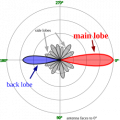
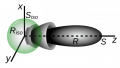
https://en.wikipedia.org/wiki/Directivity
1745241775368.png

1745241680390.png
All things being equal (or close to equal with things like radiation efficiency), the total radiated power into free space doesn't change with antenna Directivity changes.
 
Last edited:
Top