Thank you for replying me.
I already known about antenna fundamentals and its radiation patterns like gain, radiation power, bandwidth and polarization. I have also had a basic understanding of impedance matching to increase antenna efficiency.
Up to now, I have learnt about some radiation source such as dipole and microstrip patch. But I wanna use another fancy antenna design for my project, and I found fractal geometry intriguing.
I have tried to simulate it and the result quite good. But I struggle with explaining the theory behind that structure.
Well, fractal antennas vary in important ways from conventional arrays and while they superficially resemble arrays, they aren't actually.
Consider a conventional LPDA which is somewhat like the Sierpinski antenna—both have log-periodic behavior, both consist of multiple elements that seem to be scaled versions of each other. So, on the surface you might think an LPDA and Sierpinski are somehow fundamentally the same.
But, look at how the two antennas are fed, and at the radiation patterns.
Well, fractal antennas vary in important ways from conventional arrays and while they superficially resemble arrays, they aren't actually.
Consider a conventional LPDA which is somewhat like the Sierpinski antenna—both have log-periodic behavior, both consist of multiple elements that seem to be scaled versions of each other. So, on the surface you might think an LPDA and Sierpinski are somehow fundamentally the same.
But, look at how the two antennas are fed, and at the radiation patterns.
Yes, this is a part in my project in this term. I need to design an antenna that have conical beam radiation, moderate gain and high efficiency as well. Additionally, I was required to use microstrip and compact it in PCB.
In terms of microstrip antennas, I have designed a Sierpinski structure by creating slots on the origin triangle patch. So, does it relate to slot antennas? Thank you.
Yes, this is a part in my project in this term. I need to design an antenna that have conical beam radiation, moderate gain and high efficiency as well. Additionally, I was required to use microstrip and compact it in PCB.
In terms of microstrip antennas, I have designed a Sierpinski structure by creating slots on the origin triangle patch. So, does it relate to slot antennas? Thank you.
I studied antenna design a long time ago but don't remember much except the basics, and fractal antenna designs were not that prevalent then.
From what I understand today, the fractal antenna design can be very complicated with various shapes and also multiple layers. I believe you would have to consult with some written literature to get a really good grasp of this.
Size, especially length and spacing and also the substrate, strongly influences inductance and capacitance . More than one size and/or spacing would imply a filter that has more than one resonate frequency. The way it is fed is also a consideration.
That would be the really basic idea, but you might find more information at ResearchGate although that may be a totally pay for everything site, unfortunately. In any case, you need a really good reference on this.
I studied antenna design a long time ago but don't remember much except the basics, and fractal antenna designs were not that prevalent then.
From what I understand today, the fractal antenna design can be very complicated with various shapes and also multiple layers. I believe you would have to consult with some written literature to get a really good grasp of this.
Size, especially length and spacing and also the substrate, strongly influences inductance and capacitance . More than one size and/or spacing would imply a filter that has more than one resonate frequency. The way it is fed is also a consideration.
That would be the really basic idea, but you might find more information at ResearchGate although that may be a totally pay for everything site, unfortunately. In any case, you need a really good reference on this.
Hmm I get it. I admit that it is hard to figure out how it works.
By the way, if it's the case, should I replace my Sierpinski antenna simulation to what? My objectives is conical beam radiation and moderate gain around 4-5 dBi. The gain maybe solved by a conventional array, but what about conical radiation? Can I have some recommendation about it?
Antenna designers are always looking to come up with new ideas to push the envelope for antennas, using a smaller volume while striving for every higher bandwidth and antenna gain. One proposed method of increasing bandwidth (or shrinking antenna size) is via the use of fractal geometry, which gives rise to fractal antennas.
While some researchers claim that fractals have superior performance, some experts claim the contrary.
In 2003, Steven R. Best wrote in A Comparison of the Resonant Properties of Small Space-Filling Fractal Antennas, “that antenna geometry alone, fractal or otherwise, does not uniquely determine the electromagnetic properties of the small antenna.” However, in 2008 Constantine A. Balanis‘s research concluded that fractal antennas performed relatively similarly to the electrically small antennas they were compared against. More recently, in 2011, authors of Small Antenna HandbookRobert C. Hansen and Robert E. Collin reviewed many papers on fractal antennas. The pair concluded that they offer no advantage over fat dipoles, loaded dipoles, or simple loops, and that “nonfractals are always better.”
Hmm I get it. I admit that it is hard to figure out how it works.
By the way, if it's the case, should I replace my Sierpinski antenna simulation to what? My objectives is conical beam radiation and moderate gain around 4-5 dBi. The gain maybe solved by a conventional array, but what about conical radiation? Can I have some recommendation about it?
I am sorry but I only designed a few antennae in my time and most of them more standard types. I made a really good CB antenna way back when CB was a big thing around here, put it on the roof, and got much farther out with transmissions. As to fractal antennae, I have not designed one yet, but I think you have the right idea, there is Sierpinski, and another type I can't remember the name of right now that would fit your application.
Maybe you can get a book on this because there is going to be a lot of information you'll need. You can find one online and if you do not want to buy it, you can ask your local library to get you a copy for a loaner. If they can get one, you can study the book for free.
The only simulator I know of is the CST Microwave Studio, and I am not even sure that would be good enough for what you are doing. You'd have to look into that and maybe you can get a student version or something.
Sorry I can't help much more with this right now.
These antennae certainly are interesting though. The ability to work well at several frequencies, and in a small package. We are lucky to have them or we might still have little fold up antennae sticking up from our cell phones today
The only simulator I know of is the CST Microwave Studio, and I am not even sure that would be good enough for what you are doing. You'd have to look into that and maybe you can get a student version or something.
CST Studio and ANSYS HFSS both have powerful farfield simulation tools and parametric modeling (and scripting) capabilities, so those would be options (though you have to be careful with meshing something like that).
These antennae certainly are interesting though. The ability to work well at several frequencies, and in a small package. We are lucky to have them or we might still have little fold up antennae sticking up from our cell phones today.
The vast majority of cell phones use pifa or microstrip patch antennas. I don't know of any (I'm sure there are a few) modern handset manufacturer which are using fractal antennas. Fractal antennas were the rage maybe 10 years ago but they seem to have mainly faded off the mainstream.
Slightly off-topic, it would be interesting to see how a fractal would work in metasurface applications, but I don't know quite enough about that particular research area enough at this point to be able to hazard any guesses. I just know "macroscopic periodic structures = neat properties."
Slightly off-topic, it would be interesting to see how a fractal would work in metasurface applications, but I don't know quite enough about that particular research area enough at this point to be able to hazard any guesses. I just know "macroscopic periodic structures = neat properties."
Thank all of you who considered my thread. I'm now converting my approach to triangular microstrip patch and compare it with Sierpinski. I'm in my progress of cut-and-try to in simulation. I thought triangular patch was more approachable than triangular fractal.
Thank all of you who considered my thread. I'm now converting my approach to triangular microstrip patch and compare it with Sierpinski. I'm in my progress of cut-and-try to in simulation. I thought triangular patch was more approachable than triangular fractal.
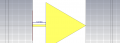
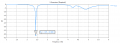
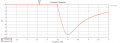
Hi everyone. I have a problem with my triangular patch result. These two designs are distinguished by the feed position. While the blue resonated at my desired frequencies 2.4GHz, the red one seemed strange. Can anyone explain what happened to me? P/s: In the case of the blue, how can I widen bandwidth without changing resonated frequency 2.42 GHz. Thank you for your help!
Hi everyone. I have a problem with my triangular patch result. These two designs are distinguished by the feed position. While the blue resonated at my desired frequencies 2.4GHz, the red one seemed strange. Can anyone explain what happened to me? View attachment 346264View attachment 346265View attachment 346266View attachment 346267P/s: In the case of the blue, how can I widen bandwidth without changing resonated frequency 2.42 GHz. Thank you for your help!
It might help you to look at the Smith chart here to get an idea of what's going on. My initial thought is that you have two very different impedances here. One exhibits a sudden impedance change, while the other is a gradual transition (which is why it looks a lot wider band). That's going to change the (apparent) resonance point significantly, because you have different inductive/capacitive loads that the feedline sees. To get the same center frequency between the two, I'd say that the second patch you have (the one whose point comes out of the feedline) you may need to make a bit bigger (I'd try 1.5x bigger to start out with and see if that shifts it to the left enough or too much).
I'd have to read up a bit more on this particular structure and do a little experimenting myself to give better advice on how to increase bandwidth of the first patch, but one thing I'd try is to taper the feedline somewhat at the connection point (so your feedline would end up looking a bit trapezoidal). You'd likely have to re-tune the patch itself, most likely (changing a dimension or similar) to keep the center frequency the same, but tapering generally allows the impedance to vary less drastically, and thus widen, somewhat, the effective bandwidth of something.
Hi everyone. I have a problem with my triangular patch result. These two designs are distinguished by the feed position. While the blue resonated at my desired frequencies 2.4GHz, the red one seemed strange. Can anyone explain what happened to me? View attachment 346264View attachment 346265View attachment 346266View attachment 346267P/s: In the case of the blue, how can I widen bandwidth without changing resonated frequency 2.42 GHz. Thank you for your help!
Sorry I cannot help more here I can give a little general information that's about it. You really need a good book for this I think.
Anyway, wider bandwidth is associated with the inductance (and capacitance) and inductance is associated mostly with physical length. Capacitance is associated mostly with physical width.
Since when you lower the inductance you widen the bandwidth, to keep the resonant frequency the same you have to increase the capacitance.
This means you want to shorten any paths that connect nodes, while decreasing the distance that is between paths, keeping the LC factor constant.
Another way is to parallel more than one inductor, and parallel more than one capacitor again to keep the LC factor the same.
This may or may not shed some light on your problem, but as I said you really need a good book on this. I have a book on the more regular antennas somewhere and even that book is pretty large.
Basic classical EM theory hasn't changed since 1945. Our technology has gotten much much better in doing the same thing or doing things in practical applications that could only be theorized back then. Some types were likely almost impossible to theorise back then because of the lack of computer power to mathematically explore the complex configurations we have today.
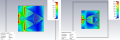
Apologies for the interruption, but I would greatly appreciate some clarification regarding the field distribution in an antenna.
I’m currently encountering some difficulty in identifying the cause of the electric field distribution shown in the two images below. As you can see, the field appears rather unusual, with a significant portion concentrated around the feedline—this contrasts with the expected distribution, where the field should be primarily focused on the triangular patch.
I would be truly grateful for any insights or feedback. Thank you very much.

 Facebook
 Google
 GitHub
 Linkedin

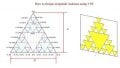 Hi everyone. I need to research about design formula of Sierpinski antenna and theory about it. Is it works as an array antenna or another?