Shouldn't op-amp feedback be physically impossible?

nsaspook

Joined Aug 27, 2009
16,328
Once again not understanding my point. Of course it's possible because it does happen. I just don't understand how. That's why I'm here asking you all. Because it seems like it shouldn't. But you all are not answering my question. Apparently you don't even understand what my question is.
I tried to give a mechanical analogy but it's a hill only you can climb. The OPAMP is obviously not impossible and the physical force principles they operate with have been used in mechanical devices long before modern electronics.
https://control.com/textbook/pneumatic-instrumentation/analogy-to-opamp-circuits/
 
Last edited:

Thread Starter

LonelyLad

Joined Sep 17, 2024
29
Ok. You are correct.
The op amp feedback mechanism is physically impossible.
You win. Now go away and sleep well.
Once again not understanding my point. Of course it's possible because it does happen. I just don't understand how. That's why I'm here asking you all. Because it seems like it shouldn't. But you all are not answering my question. Apparently you don't even understand what my question is.
 

crutschow

Joined Mar 14, 2008
38,515
As you can see from the top arrow with the X beside it (signifying that it should be incorrect), whatever voltage there is will not travel back up to a point closer to the voltage source (VIN in this case). Instead, the scenario with the two bottom arrows will happen. The voltage goes towards the ground.
Yes, it actually goes below ground (for a positive Vin).
That's why it's called "negative feedback".
A slight positive voltage at the (-) input generates a negative voltage at the op amp output (thus it's called the negative input).
So the current current going through R1 to the (-) input from Vin is exactly balanced by the current going out of through R2 to the op amp output, so as to keep the (-) input voltage essentially equal to the (+) input (here connected to ground) due to the high open-loop gain of the op amp.

Doesn't that make sense?
How can the input impedance be so high if it's just a single transistor and then ground? Is all that impedance just from the transistor?
There's a bunch of transistor after the input to provide the high gain, so the input transistor operates at a very low current making the input base current typically in the nanoamp region.
If the op amp has a FET input, then the input current is essentially zero, and the impedance very high.
 

boostbuck

Joined Oct 5, 2017
1,043
Again:
.... whatever voltage there is will not travel back up to a point closer to the voltage source .... Instead, ...the voltage goes towards the ground.
Voltages per se don't travel anywhere - current flow in a circuit develops voltages across resistances per ohms law.

I think it would help your understanding if you could try and visualise the current flows that cause the various voltage values around an op amp. The inputs are of such high impedance that current flow is nominally negligible which answers your query above.
 

WBahn

Joined Mar 31, 2012
32,854
Again:

View attachment 331906

As you can see from the top arrow with the X beside it (signifying that it should be incorrect), whatever voltage there is will not travel back up to a point closer to the voltage source (VIN in this case). Instead, the scenario with the two bottom arrows will happen. The voltage goes towards the ground.

I understand that this diagram does not depict a +V (and optionally -V) pin on the op amp itself but my point still applies. If my understanding of negative voltage on an op amp is correct then maybe this circuit makes a little bit more sense but nobody's clarifying anything
Your arrows demonstrate that you don't understand how an opamp works, but perhaps they reveal where some of your misunderstanding comes from.

As we have been trying to tell you, the power for the output does NOT come from the input. You show a current flowing from the inverting input to the output. That's not what happens. The inputs of an opamp are specifically designed so that virtually no current flows either into or out of them. In most opamp designs, there is a very small bias current that has to flow, Even on the half-century old 741, the bias currents are a fraction of a microamp, so it is usually reasonable to consider that no current flow into or out of either of the inputs.

The opamp, because it has so much gain (the old 741 typically had a gain of about 200,000), that if the voltage difference between the two inputs is more than about 100 µA µV, the output will rail (go as close to the supply voltage as it can get). So when we employ negative feedback, the circuitry around the opamp results in the voltage difference between the two inputs being very, very small.

So, with that in mind, think about what happens in the circuit you have above if the supply voltages are ±15 V, R2 is 10 kΩ, R1 is 5 kΩ, and Vin is -2 V. If the circuit is behaving correctly, the voltage at the inverting input will be almost identical to the voltage that the non-inverting input, which you have hard tied to 0 V. That means that R1 has -2 V on the left and 0 V on the right, which results in 0.4 mA flowing right-to-left through it. Since virtually no current flows in or out of the inputs, the current has to be flowing right-to-left through R2, from the output back through R1 to the input. That 0.4 mA through R2 means that the right side is 4 V higher than the left side, which is at 0 V, making the output of the opamp at +4 V.

If the gain is 200,000, to get that +4 V requires that the actual voltage at the inverting input must be -0.000020 V, so pretty close to 0 V. If noise or something else perturbs the output of the opamp so that it's voltage goes up (say to 4.1 V), that will raise the voltage at the inverting input, which reduces the differential voltage between the inputs, which drives the opamp output back down. The opposite happens if the perturbation causes the output to go down to, say, 3.9 V. The voltage at the inverting input now goes down (becomes more negative), which increases the differential voltage and drives the output of the opamp to go back up. THIS is the negative feedback mechanism at play.

You should go through and do a similar walkthrough for the case when Vin is +2 V.

EDIT: Fix typo.
 
Last edited:

MrAl

Joined Jun 17, 2014
13,707
View attachment 331865

Basically this. It's not like an (ordinary) op-amp has some sort of internal voltage source it can use to loop voltage back around into an input. It's just a bunch of transistors.

To help explain this a bit more, let's substitute an op amp for this circuit which presents roughly the same problem that I'm trying to describe:

View attachment 331869

Obviously in this circuit the voltage wouldn't just loop back around after passing through the first resistor. It will apply itself to both the resistor and the diode in the same direction: towards ground.

Op-amp feedback seems to be the same way, yet it works. Why is this? Is there something in an op-amp that I am not aware of? This seems to defy the basic way a circuit is supposed to work.
Hello there,

The op amp is not a passive device like a diode. Even though it has devices inside that do not themselves product power, they do end up modulating the power source (the voltage supply source) and that modulation appears on the output of the op amp. That means it can be viewed as a sort of special kind of power supply that takes the +Vcc input and provides some of that at the output.
Since the output goes down as the inverting input goes up, and the output goes up as the invert as the inverting input goes down, PART of the output can be fed back to the inverting input to form negative feedback.

It is interesting that there are a few caveats to this. For one, the output impedance affects the effectiveness of the feedback and at times there will actually be feedforward that goes from the inverting input directly to the output, which of course would not get inverted. It's usually only for a very short time though that usually (but not always) ends up being insignificant, so it does not get talked about as often as the feedback itself does. This is a reminder that the output of the op amp is very dynamic and so is not always very low; it partly depends on that precious feedback in order to get to that very low value we normally think of.
 

MisterBill2

Joined Jan 23, 2018
27,537
Consider that to the majority of us are involved with useful design considerations and functions, the operation of a non-powered op-amp is not part of the discussion or consideration. The one actual concern is protection of the device in the event that signals are present while the device is non-powered.
Thus the whole discussion to answer an uninformed challenge and argument has been a waste of time and internet bandwidth.
 
Last edited:

MrChips

Joined Oct 2, 2009
34,817
If TS is still willing to learn about op amps, yes an op amp is just a configuration of transistors.

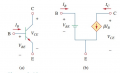
Here is the circuit model of a transistor.

1726669098379.png

Base current comes in at the base and goes out the emitter.
The base current does not contribute to the collector current besides the fact that the collector current Ic is modulated by the base current multiplied by the current gain beta.

In other words, the collector current comes from another current source, not from the base current.
 

WBahn

Joined Mar 31, 2012
32,854
Of course. I think it's the first I've ever seen you make -- at least with regard to units. Thus, my comment.
While I am generally very good on units, I have certainly made mistakes before. They normally, like this one, are just typo blunders where my fingers and thoughts aren't in sync. In this case, I had just looked up the bias current of the 741, so my brain flubbed the units when I made the switch. I remember specifically thinking 0.1 mV and deciding to move to µV, and then typed the wrong damn thing without realizing it. It was also an example of we see what we expect to see. I proofread the post and my brain read it as 100 µV because that's what my brain "knew" I had written.
 

StefanZe

Joined Nov 6, 2019
212
The voltage goes from Vin to Vout. It's not going to travel back to the inverting input. On the contary, the voltage will take that path with R2 to get to Vout.
The current flows from a high potential to a low potential.
Voltage does not flow or take paths or travels. It is just the difference in electric potential between two points.
Normally you use one fixed point (ground) and reference all other points to this fixed point (ground)
So Vin is just the potential difference between the input and ground and Vout the potential difference betwwen output und ground.
Because of the patricularties of an opamp the voltage between + and - in this circuit is 0V.
So the connection R1-R2-Opamp- has a ground potential.
Current flows from Vin (if positiv else change current directions) to this connection and current flows from this connection to Vout.

The feedback is not current. It is the voltage on - (and this voltage depends on Vin and Vout)

In mathematical words:

If you use Kirchhoff's current law on the connection of OPAMP - , R1 und R2 you have
I1+I2+Iopamp- = 0

Iopamp- is very small and therefore negligible

So yes the current flows from Vin to Vout.
Every current needs a voltage to flow through a resistor so there needs to be a voltage according to U=R*I.

Now lets talk about the opamp.
The opamp will amplify every small voltage between + and - and will ouput the amplified voltage.
If there is a feedback between the output and the negative input auf the opamp will try to minimize the voltage differnence between + and -. The only way to do this for the opamp is to change it's output voltage.

If the voltage difference between + and - is 0V there is a virtual ground at the - input (because + is connected to ground and there is no voltage difference between the + and -)

So I1= -I2 (Kirchhoff's current law)
V1=R1*I1 and V2=R2*I2 (Ohm's law)

Now add the virtual ground and Kirchhoff's voltage law
so V1=Vin and V2 = Vout

if you combine all this equations you get

Vout = -Vin *R2/R1.
 

LvW

Joined Jun 13, 2013
2,029
Yes, that's my point. The op-amp does not produce voltage by itself. Thus feedback that goes against the direction of the source's voltage should be impossible. It uses voltage supplied to it from an external sources (which is at pins 4 and 7 in this example). I don't think you understand where I'm going with this.
May I jump into the discussion with a clarification?
We should clearly distinguish between two kind of voltages:
* Signal voltage applied to the opamps input terminals and deliverd by the output node,
* DC supply voltages.

And yes - we can say that "the op-amp does not produce voltage by itself"
Perhaps it is more correct to say that the opamp transfers a DC voltage (deliverd by an external source) into a signal voltage at the output node (as a result of an applied smaller signal voltage at its input nodes).
But this is an old story because that`s what each amplifying device does.
 
Top