Shouldn't op-amp feedback be physically impossible?

WBahn

Joined Mar 31, 2012
32,852
An OP amp just controls the voltage from a voltage source that comes out at the output, no different from a transistor. It's not like a battery or rectified transformer output where it has a "positive" and "negative" end and produces its own voltage between these.

A power supply has its own power source. It uses internal transformers. It doesn't directly use the power from an outlet. It's the receiving induction coil that supplies the power, and it gets the energy to do that from the power outlet.

That's the problem. Voltage comes from the voltage source and in such an example as this:

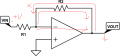
View attachment 331895

The voltage goes from Vin to Vout. It's not going to travel back to the inverting input. On the contary, the voltage will take that path with R2 to get to Vout.
What happens if you unplug a power supply?

It doesn't supply power!

Why not?

Because the power it supplies come from another power source. That might be batteries. It might be a wall outlet. It might be a solar cell. It might be a car's alternator. It might be a hamster on a treadmill. It takes externally supplied power and uses that to provide power to something connected to it's output.

An opamp does EXACTLY the same thing!

The power at the output of an opamp does NOT come from the input voltage signal.

This is like saying that the water that comes out of a faucet comes from your hand because your hand turns the valve. No, your hand is a signal the provides an input to the faucet, but the faucet gets water from an external water source and provides some of it to the output of the faucet, with the amount it outputs being controlled by your hand.

Look at the pinout for an opamp!
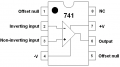
1726620377628.png

You see the signals that we put in our schematics, namely pins 2, 3, and 6. But this device requires POWER to be supplied to pints 4 and 7, otherwise it is just like unplugging the power supply or disconnecting the hose going to the faucet.
 

schmitt trigger

Joined Jul 12, 2010
2,090
Are you a troll?
First, You first postulate a non-sensical argument and circuitry.
People here assume that this is because you’re someone who is aware of his lack of understanding he and is sincerely looking to educate himself. They attempt to steer you into the right path.

Not only do you refuse to accept their answers, but you double down on your absurd arguments. Refute any attempt to correct your incoherences.
This is a textbook definition of trolling.
 

crutschow

Joined Mar 14, 2008
38,513
Are you a troll?
First, You first postulate a non-sensical argument and circuitry.
People here assume that this is because you’re someone who is aware of his lack of understanding he and is sincerely looking to educate himself. They attempt to steer you into the right path.

Not only do you refuse to accept their answers, but you double down on your absurd arguments. Refute any attempt to correct your incoherences.
This is a textbook definition of trolling.
Or an example of the all too common "stubborn ignorance".
 

MisterBill2

Joined Jan 23, 2018
27,530
Please provide an equivalent expression that shows that the following diagrams should be concidered equal ?


View attachment 331878

View attachment 331885
Actually, a ZERO GAIN opamp would perform like the TS was asserting. Usually, a zero-gain op-amp is in that category classed as "Defective". OR, it may simply not have any supply voltage present. Without any power supply connected, certainly the performance will be different.
 
Last edited:

Veracohr

Joined Jan 3, 2011
783
You cannot say a point in any circuit is positive or negative without a reference. And that reference can be changed at will.
Yes, and you can throw out all the "what ifs" you want about whatever theoretical reference points you like, but the circuit drawing in the original post showed a widely-used common/ground symbol which is a generally agreed-upon reference point. So what point are you trying to make? That anything can be anything if you just look at it the right way? Why not just see an inverting amplifier with grounded positive input and assume that ground is the reference and that the hoof sounds you hear are not zebras?
 

MisterBill2

Joined Jan 23, 2018
27,530
An OP amp just controls the voltage from a voltage source that comes out at the output, no different from a transistor. It's not like a battery or rectified transformer output where it has a "positive" and "negative" end and produces its own voltage between these.

A power supply has its own power source. It uses internal transformers. It doesn't directly use the power from an outlet. It's the receiving induction coil that supplies the power, and it gets the energy to do that from the power outlet.

That's the problem. Voltage comes from the voltage source and in such an example as this:

View attachment 331895

The voltage goes from Vin to Vout. It's not going to travel back to the inverting input. On the contary, the voltage will take that path with R2 to get to Vout.
Unfortunately for this discussion , the power supply connections are not shown. An op-amp with no correct power source connected does not follow the rules. Perhaps THAT is the condition the TS is considering.
The operation of a non-powered opamp was not covered in our previous discussions. Perhaps THAT is what the TS is thinking about.
 

WBahn

Joined Mar 31, 2012
32,852
Unfortunately for this discussion , the power supply connections are not shown. An op-amp with no correct power source connected does not follow the rules. Perhaps THAT is the condition the TS is considering.
The operation of a non-powered opamp was not covered in our previous discussions. Perhaps THAT is what the TS is thinking about.
It WAS covered:

What to you mean that it doesn't produce voltage on it's own?

It is a voltage-controlled voltage source.

Do you know what an adjustable bench power supply is? If not, it's a box that has some circuitry in it and you plug it into a power source (the wall) and you turn a knob to set the output voltage.

Now imagine replacing that knob with some additional circuitry that, using a voltage applies to two inputs, has the same effect as turning the knob. Apply a larger input voltage, the output voltage goes up. Apply a negative (differential) voltage, and the output voltage becomes negative. Apply zero voltage between the two input pins, and the supply produces zero output voltage. You now have a voltage-controlled voltage source.

An opamp is nothing different. You plug it into power (the Vcc and GND pins) and you apply a voltage differential between the two input pins, and that sets the output voltage. But opamps have LOTS of gain. You put in a voltage difference of 1 µV, and you get a 1 V output voltage. Put in 10 µV and you get a 10 V output voltage. That a gain of one million. Old opamps had gains in the 100,000 range and new opamps might have gains in the 10 million or even more range.

The feedback does not happen within the opamp -- it's the external circuitry that takes the output voltage and, usually after doing some kind of processing on it, changed one or both of the input voltages, which then changes the output voltage, and one and on.
 

Thread Starter

LonelyLad

Joined Sep 17, 2024
29
What happens if you unplug a power supply?

It doesn't supply power!

Why not?

Because the power it supplies come from another power source. That might be batteries. It might be a wall outlet. It might be a solar cell. It might be a car's alternator. It might be a hamster on a treadmill. It takes externally supplied power and uses that to provide power to something connected to it's output.

An opamp does EXACTLY the same thing!

The power at the output of an opamp does NOT come from the input voltage signal.

This is like saying that the water that comes out of a faucet comes from your hand because your hand turns the valve. No, your hand is a signal the provides an input to the faucet, but the faucet gets water from an external water source and provides some of it to the output of the faucet, with the amount it outputs being controlled by your hand.

Look at the pinout for an opamp!

View attachment 331898

You see the signals that we put in our schematics, namely pins 2, 3, and 6. But this device requires POWER to be supplied to pints 4 and 7, otherwise it is just like unplugging the power supply or disconnecting the hose going to the faucet.
Yes, that's my point. The op-amp does not produce voltage by itself. Thus feedback that goes against the direction of the source's voltage should be impossible. It uses voltage supplied to it from an external sources (which is at pins 4 and 7 in this example). I don't think you understand where I'm going with this.
 

nsaspook

Joined Aug 27, 2009
16,326
Yes, that's my point. The op-amp does not produce voltage by itself. Thus feedback that goes against the direction of the source's voltage should be impossible. It uses voltage supplied to it from an external sources (which is at pins 4 and 7 in this example). I don't think you understand where I'm going with this.
The OPAMP is the electronic equivalent (in the analogy) of a old school mechanical teeter toddler. The output is the difference between inputs. Gravity is only directed down but the angle (analogy of voltage) from level (zero or some reference) is the balance of forces at the center. A person moving inward or outward changes the ratio of one input to the other to balance the beam. The net amount of moving for balance (NULL net force between inputs) is the OPAMP output.
1726623442024.png
 
Last edited:

BobTPH

Joined Jun 5, 2013
11,516
but the circuit drawing in the original post showed a widely-used common/ground symbol which is a generally agreed-upon reference point
As I have said twice now.

Assuming the negative supply to the opamp the same as your ground, and the input is always positive, you are absolutely correct.

The circuit will not produce the inversion of the input with respect to that ground. No one here has made any claim that contradicts that. You continue to argue with something only you yourself is saying.

What I explained is how you can still use a single supply opamp as an inverting amplifier. That does work, I do know from experience as well as from theory.

Have a nice day. I cannot help you.
 

WBahn

Joined Mar 31, 2012
32,852
Yes, that's my point. The op-amp does not produce voltage by itself. Thus feedback that goes against the direction of the source's voltage should be impossible. It uses voltage supplied to it from an external sources (which is at pins 4 and 7 in this example). I don't think you understand where I'm going with this.
That's because where you are going is pretty evidently nonsensical.

That fact is that opamps work. So any claim that you make that it is impossible for opamps to work reveals a flaw in your understanding of how they work, not a flaw in the opamps.

Feedback does NOT "go against the direction of the source's voltage".

You don't understand how they work.

Just saying over and over that what they do is impossible does not accomplish anything, except highlight your unwillingness to acknowledge that it is YOUR understanding of either how they work, or what is and isn't possible, that is the problem.
 

Thread Starter

LonelyLad

Joined Sep 17, 2024
29
Of course not.
It doesn't.
Why do you think it does?
What is "source"?
None of us do.
Again:

1726623874267.png

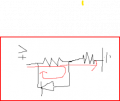
As you can see from the top arrow with the X beside it (signifying that it should be incorrect), whatever voltage there is will not travel back up to a point closer to the voltage source (VIN in this case). Instead, the scenario with the two bottom arrows will happen. The voltage goes towards the ground.

I understand that this diagram does not depict a +V (and optionally -V) pin on the op amp itself but my point still applies. If my understanding of negative voltage on an op amp is correct then maybe this circuit makes a little bit more sense but nobody's clarifying anything
 
Last edited:

Thread Starter

LonelyLad

Joined Sep 17, 2024
29
Are you a troll?
First, You first postulate a non-sensical argument and circuitry.
People here assume that this is because you’re someone who is aware of his lack of understanding he and is sincerely looking to educate himself. They attempt to steer you into the right path.

Not only do you refuse to accept their answers, but you double down on your absurd arguments. Refute any attempt to correct your incoherences.
This is a textbook definition of trolling.
"I don't understand what you're talking about! I'm going to accuse you of being a troll because I can't read!"

-scmitt trigger, 2024.

Do I need to repeat myself again? How simply to you want me to write this to you before you understand what I'm getting at? Look at my post above if you are still confused by what I mean (#33). Everyone here is talking about how there's no +v and -v on the op amp in the illustration. One of them is insisting that an op amp is a power source that produces its own voltage. Maybe you all just don't get what I'm saying.
 

nsaspook

Joined Aug 27, 2009
16,326
"I don't understand what you're talking about! I'm going to accuse you of being a troll because I can't read!"

-scmitt trigger, 2024.

Do I need to repeat myself again? How simply to you want me to write this to you before you understand what I'm getting at? Look at my post above if you are still confused by what I mean (#33). Everyone here is talking about how there's no +v and -v on the op amp in the illustration. One of them is insisting that an op amp is a power source that produces its own voltage. Maybe you all just don't get what I'm saying.
Sure, we're all wrong and don't get why it's impossible.
1726624956132.png
Let's think about that.
 

sparky 1

Joined Nov 3, 2018
1,218
op amp equivalent.png
The arrows are conventional current they are drawn backwards in order to preserve contributions to electrical science.
In op amps the positive and negative refers to the potential difference above or below a common reference point usually zero.


The diode circuit above and the op amp below will never be equivalent. Including other differences.
Diagram A ≠ Diagram B. therefore irrelevant in showing feedback is impossible.
(It is possible to compare the difference between a 3 port circulator and a 2 port Isolator
it has been shown they are not the same by math expression and with their optical counterparts
Start quantifying and stop drawing arrows, the simulator gives )

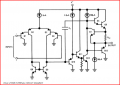
LM358 internal view.png

Which direction will an electron travel without diode junction ? Electron current leaves vacancies as the free electrons move. see video.
When you are asked to show or prove you must use laws and math to quantify
When you theorize in electrical science it is necessary to use mathematical expressions correctly.
The ability to memorize an equation and solve text book questions rather than understanding the mathematics of electrical science
and applying those laws with the discipline of mastering the science, grasping an analogy is a mode of thinking which avoids quantifying.
 
Last edited:

Thread Starter

LonelyLad

Joined Sep 17, 2024
29
Sure, we're all wrong and don't get why it's impossible.
View attachment 331907
Let's think about that.
Once again not understanding my point. Of course it's possible because it does happen. I just don't understand how. That's why I'm here asking you all. Because it seems like it shouldn't. But you all are not answering my question. Apparently you don't even understand what my question is.
 

Thread Starter

LonelyLad

Joined Sep 17, 2024
29
≠≠≠
View attachment 331905
The diode circuit above and the op amp below will never share an equivalent expression.
Diagram A ≠ Diagram B
(It is possible to compare the difference between a 3 port circulator and a 2 port Isolator
it was shown they are not the same by math expression and with their optical counterparts
and you can draw all the arrows you want but that proves nothing.)
View attachment 331904
Okay, thank you. We're getting somewhere. Feedback on a 358 is possible because the input goes straight to ground. The output isn't going to return to itself in the circuitry. I'm glad someone could help me here.

One thing though: How can the input impedance be so high if it's just a single transistor and then ground? Is all that impedance just from the transistor?
 
Top