Shouldn't op-amp feedback be physically impossible?

Thread Starter

LonelyLad

Joined Sep 17, 2024
29
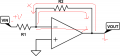
feedbackdrawing.png

Basically this. It's not like an (ordinary) op-amp has some sort of internal voltage source it can use to loop voltage back around into an input. It's just a bunch of transistors.

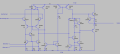
To help explain this a bit more, let's substitute an op amp for this circuit which presents roughly the same problem that I'm trying to describe:
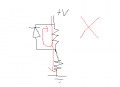
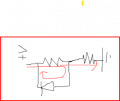
whirlpoolcircuit.png

Obviously in this circuit the voltage wouldn't just loop back around after passing through the first resistor. It will apply itself to both the resistor and the diode in the same direction: towards ground.

Op-amp feedback seems to be the same way, yet it works. Why is this? Is there something in an op-amp that I am not aware of? This seems to defy the basic way a circuit is supposed to work.
 

crutschow

Joined Mar 14, 2008
38,322
Basically this. It's not like an (ordinary) op-amp has some sort of internal voltage source it can use to loop voltage back around into an input. It's just a bunch of transistors.
Why do you think it's not an (ordinary) op amp?
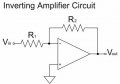
It is indeed one, and that's a very basic and common inverting op amp configuration with gain equal to -R2 / R1.
Op-amp feedback seems to be the same way, yet it works. Why is this?
It's not the same way.
The op amp has internal transistor that have a high gain for any voltage between the two inputs, and generate output current which can provide the feedback current (as well as load current).
 

dl324

Joined Mar 30, 2015
18,220
Welcome to AAC!
Op-amp feedback seems to be the same way, yet it works. Why is this? Is there something in an op-amp that I am not aware of? This seems to defy the basic way a circuit is supposed to work.
I'm not sure what your question is.

Since the schematic you provide has no part numbers, if we assume it's an opamp, the zero input differential theorem states that the voltage at the non-inverting terminal will be the same as the inverting terminal.

If we assume that +V is indeed a positive voltage, that will cause the current in R1 to be V/R1 amps. Since in an ideal opamp, no current flows into or out of the inputs, the current in R2 would be the same as in R1. That would make the voltage drop across R2 to be R2 * V/R1. That would make Vout = -V * (R2/R1). Which is how the formula we memorized for the gain of an inverting opamp was derived.

If +V was a negative voltage, the math still works. The currents are just in the opposite direction.
 
Last edited:

Thread Starter

LonelyLad

Joined Sep 17, 2024
29
Why do you think it's not an (ordinary) op amp?
It is indeed one, and that's a very basic and common inverting op amp configuration with gain equal to -R2 / R1.
It's not the same way.
The op amp has internal transistor that have a high gain for any voltage between the two inputs, and generate output current which can provide the feedback current (as well as load current).
I'm saying that an ordinary op amp does not produce voltage on its own. It works with voltage from an external source.

What do you mean by generating current?
 

dl324

Joined Mar 30, 2015
18,220
I'm saying that an ordinary op amp does not produce voltage on its own. It works with voltage from an external source.
Aside from photovoltaic components, there aren't many that work without a source of power... Even photovoltaic components need a source of power...
 

Thread Starter

LonelyLad

Joined Sep 17, 2024
29
Welcome to AAC!
I'm not sure what your question is.

Since the schematic you provide has no part numbers, if we assume it's an opamp, the zero input differential theorem states that the voltage at the non-inverting terminal will be the same as the inverting terminal.

If we assume that +V is indeed a positive voltage, that will cause the current in R1 to be V/R1 amps. Since in an ideal opamp, no current flows into or out of the inputs, the current in R2 would be the same as in R1. That would make the voltage drop across R2 to be R2 * V/R1. That would make Vout = -V * (R2/R1). Which is how the formula we memorized for the gain of an inverting opamp was derived.

If +V was a negative voltage, the math still works. The currents are just in the opposite direction.
I'm asking how an op amp can feed back can output a voltage (or current, or whatever the output is) from an area of lower potential that's closer to ground (meaning the output) back to an area of higher potential (the input, which is closer to +V). I mean, voltage doesn't work like that I don't think. As a mechanical analogy, this would be like gravity somehow pushing something back up a hill rather than down it.
 

BobTPH

Joined Jun 5, 2013
11,463
This drawing seems to say that with a positive voltage input you expect a positive output. But the circuit is an inverting amplifier, so the output will be negative & requires a negative supply.
Finally, you have said something comprehensible.

You are correct that an opamp that has no negative supply cannot put out a negative voltage with respect to its negative side supply.

But any voltage measurement has to have a reference. Choose that reference as 1/2 the supply voltage. Call it ground. And connect the non-inverting input to this new ground.

Now measure all voltages with respect to that ground. Your amp can now put out positive and negative voltages.

This may sound to you like a trick, but it is not. All vintages are relative. You cannot say a point in any circuit is positive or negative without a reference. And that reference can be changed at will.
 

WBahn

Joined Mar 31, 2012
32,706
I'm saying that an ordinary op amp does not produce voltage on its own. It works with voltage from an external source.

What do you mean by generating current?
What to you mean that it doesn't produce voltage on it's own?

It is a voltage-controlled voltage source.

Do you know what an adjustable bench power supply is? If not, it's a box that has some circuitry in it and you plug it into a power source (the wall) and you turn a knob to set the output voltage.

Now imagine replacing that knob with some additional circuitry that, using a voltage applies to two inputs, has the same effect as turning the knob. Apply a larger input voltage, the output voltage goes up. Apply a negative (differential) voltage, and the output voltage becomes negative. Apply zero voltage between the two input pins, and the supply produces zero output voltage. You now have a voltage-controlled voltage source.

An opamp is nothing different. You plug it into power (the Vcc and GND pins) and you apply a voltage differential between the two input pins, and that sets the output voltage. But opamps have LOTS of gain. You put in a voltage difference of 1 µV, and you get a 1 V output voltage. Put in 10 µV and you get a 10 V output voltage. That a gain of one million. Old opamps had gains in the 100,000 range and new opamps might have gains in the 10 million or even more range.

The feedback does not happen within the opamp -- it's the external circuitry that takes the output voltage and, usually after doing some kind of processing on it, changed one or both of the input voltages, which then changes the output voltage, and one and on.
 

MrChips

Joined Oct 2, 2009
34,628
You are missing out on op amp fundamentals.

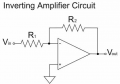
Have a look at this circuit.

1726616195858.png

The non-inverting input is at 0V.

Because of negative feedback, the inverting input is also at 0 V.
Here is the reason why this is the case.
The voltage gain of the op amp is typically 100,000.
If the inverting input drops below 0 V, the output of the op amp would hit the positive supply rail.
If the inverting input rises above 0 V, the output of the op amp would hit the negative supply rail.

Vin does not contribute to the output voltage.
Here is the reason why this is the case.
An ideal op amp has infinite input resistance. No current flows into the input of the op amp.
Since the voltage at the inverting input is 0 V, we can calculate the current I1 flowing through R1.
I1 = Vin / R1

Similarly, we can calculate the current I2 flowing through R2.
I2 = Vout / R2

But remember, no current flows into the input of the op amp. So, where do I1 and I2 go?
I1 and I2 are both flowing into the input, but I just said no current is flowing into the input.
Hence
I1 + I2 = 0
I2 must be equal to -I1.
Hence Vout / R2 = - Vin / R1
Vout / Vin = -R2 / R1

And there is your voltage gain formula for this inverting amplifier circuit.
 

WBahn

Joined Mar 31, 2012
32,706
I'm asking how an op amp can feed back can output a voltage (or current, or whatever the output is) from an area of lower potential that's closer to ground (meaning the output) back to an area of higher potential (the input, which is closer to +V). I mean, voltage doesn't work like that I don't think. As a mechanical analogy, this would be like gravity somehow pushing something back up a hill rather than down it.
We have all kinds of mechanical feedback mechanisms. One classic example is the flyball governor to control engine speed. The engine turns a shaft that has a couple of weights on lever arms attached to it. As the shaft turns, the arms move outward and, because of the lever, upward. The faster it spins, the higher the arms move. But the arms are connected to the engine throttle in such a way that the arms moving up reduces the throttle while the arms moving down increases the throttle. The engine thus feed speed output back to the throttle input by way of this flyball governor such that will run at a constant speed. Increasing or decreasing the load on the engine results in speed changes, but the speed changed result in a changed throttle position that compensates for it.
 

Thread Starter

LonelyLad

Joined Sep 17, 2024
29
What to you mean that it doesn't produce voltage on it's own?

It is a voltage-controlled voltage source.

Do you know what an adjustable bench power supply is? If not, it's a box that has some circuitry in it and you plug it into a power source (the wall) and you turn a knob to set the output voltage.

Now imagine replacing that knob with some additional circuitry that, using a voltage applies to two inputs, has the same effect as turning the knob. Apply a larger input voltage, the output voltage goes up. Apply a negative (differential) voltage, and the output voltage becomes negative. Apply zero voltage between the two input pins, and the supply produces zero output voltage. You now have a voltage-controlled voltage source.

An opamp is nothing different. You plug it into power (the Vcc and GND pins) and you apply a voltage differential between the two input pins, and that sets the output voltage. But opamps have LOTS of gain. You put in a voltage difference of 1 µV, and you get a 1 V output voltage. Put in 10 µV and you get a 10 V output voltage. That a gain of one million. Old opamps had gains in the 100,000 range and new opamps might have gains in the 10 million or even more range.

The feedback does not happen within the opamp -- it's the external circuitry that takes the output voltage and, usually after doing some kind of processing on it, changed one or both of the input voltages, which then changes the output voltage, and one and on.
An OP amp just controls the voltage from a voltage source that comes out at the output, no different from a transistor. It's not like a battery or rectified transformer output where it has a "positive" and "negative" end and produces its own voltage between these.

A power supply has its own power source. It uses internal transformers. It doesn't directly use the power from an outlet. It's the receiving induction coil that supplies the power, and it gets the energy to do that from the power outlet.

That's the problem. Voltage comes from the voltage source and in such an example as this:

1726618708159.png

The voltage goes from Vin to Vout. It's not going to travel back to the inverting input. On the contary, the voltage will take that path with R2 to get to Vout.
 

BobTPH

Joined Jun 5, 2013
11,463
We agree that an opamp cannot put out a voltage outside its supply range. Did you read my post #15 which explains why it can still handle bipolar signals? Did you understand it?
 
Top