Should I use a regulator or DC/DC convertor?

Thread Starter

richard3194

Joined Oct 18, 2011
193
Hi. My transistor radio requires 18V DC. I have a DC power supply that is rated 18V at 800mA. When I connect the PSU to my radio, the measured voltage is about 25.5V. So, the radio cannot be drawing that much current. Well, I want to feed the radio with 18V. What should I place between the PSU & the radio, a voltage regulator board ( I mean no transformer, i.e 3 pin regulator) , or a DC/DC convertor board (I mean SMPS with transformer)? I've been trying to source a suitable product, but not sorted things out yet. Thanks.
 
Last edited:

Thread Starter

richard3194

Joined Oct 18, 2011
193
In theory then it looks liike I have two choices: A switching regulator, (probably a series regulator) & a DC/DC convertor based on switching (and SMPS topology, like say boost-buck). That's my understanding. The simplest arrangement & the cheapest (I guess) being the regulator. I was seeking to find, purchase a regulator board, but that did not prove very fruitful. I don't know why.
 

MisterBill2

Joined Jan 23, 2018
27,186
How much current does your radio require?? My guess is that it is not much. So using a linear regulator will not waste a lot of power.
D.C. gave the best advice in post #2.
AND remember to use the 0.1 mfd bypass capacitors on both the regulator input and output.
 

Thread Starter

richard3194

Joined Oct 18, 2011
193
My original notion was to buy a regulator, ready-built or as a kit. But, I think employing a 3 terminal regulator is so minimalistic, that no one bothers offering a regulator as a kit or otherwise. Different with a DC/DC convertor, where boards/kits are common-place. I'll get a 3 terminal regulator and place it (with any heat sink and filier capacitors) on a small piece of veroboard. Thanks.
 

MrChips

Joined Oct 2, 2009
34,628
Linear voltage regulators drop the voltage down from a high voltage to a lower voltage. The linear regulator has to dissipate the extra power as heat. For example, if the power supply output is 25 V and the radio requires 18 V, then the regulator has to dissipate (25 V - 18 V) x current in amps = power in watts.

If the radio requires 0.5 A @ 18 V, then the regulator has to dissipate 7 V x 0.5 A = 3.5 W

You want the power supply to be not too much higher than the load voltage while the regulator needs a minimum headroom of 2-3 V unless it is a LDO (low drop-out) regulator.
 

atferrari

Joined Jan 6, 2004
5,001
Hi. My transistor radio requires 18V DC. I have a DC power supply that is rated 18V at 800mA. When I connect the PSU to my radio, the measured voltage is about 25.5V. So, the radio cannot be drawing that much current. Well, I want to feed the radio with 18V. What should I place between the PSU & the radio, a voltage regulator board ( I mean no transformer, i.e 3 pin regulator) , or a DC/DC convertor board (I mean SMPS with transformer)? I've been trying to source a suitable product, but not sorted things out yet. Thanks.
You are saying that your DC PSU's output is 18V and when connected to the radio it goes up to 25V?
 

MisterBill2

Joined Jan 23, 2018
27,186
NO, That is not what the TS is saying!! It is an UNREGULATED DC supply the that loads down to 18 volts at the rated current of 800mA. That is how the non-regulated supplies work and how they are rated. Really rather "Hokey" to use a polite term. But they have been doing that for at least 50 years, rating the voltage at some current.
 

Thread Starter

richard3194

Joined Oct 18, 2011
193
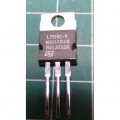
I think I'll be buying MC7818CTG. I see that the data sheet gives the circuit of what is called "Standard Application", which simply consists of the regulator & filter capacitors at the input & output. That should be good enough for my needs, as has been noted already above.
 
Last edited:

MisterBill2

Joined Jan 23, 2018
27,186
Certainly using a resistor to drop the voltage will provide a voltage reduction that totally depends on the current draw.
Using a resistor to provide some of the voltage drop to reduce the heat in a regulator creates a serious demand for capacitance shunting on the input side, to avoid oscillation in the regulator IC. I learned that quite early in my career. That is, both the 0.1MFD capacitors and the 100 MFD capacitors for the input power.
 

Papabravo

Joined Feb 24, 2006
22,058
Wow, that’a a lot of capacitance.
Not really. 20,000 to 50,000 µfd is a lot for ordinary capacitors. 1 F and above is typical for super capacitors.
ETA: You didn't think MFD stood for Mega Farad did you? THAT would be an enormous capacitor.
 

MisterBill2

Joined Jan 23, 2018
27,186
When a series resistor is used to drop the voltage for a variable load, such as a radio, a capacitor is required to hold the voltage sort of steady as the load rapidly varies, such as the audio from a radio. 100MFD might be adequate, depending on how much current the radio requires.
 

BobTPH

Joined Jun 5, 2013
11,463
Not really. 20,000 to 50,000 µfd is a lot for ordinary capacitors. 1 F and above is typical for super capacitors.
ETA: You didn't think MFD stood for Mega Farad did you? THAT would be an enormous capacitor.
Capital M is Mega as a prefix. 50 years ago people used mfd for uF. That is not considered correct now, as the use of prefixes has become standard.
 

MisterBill2

Joined Jan 23, 2018
27,186
OK, I used a confusing prefix. I will try to spell it out in the future.
A lot of things have changed during my career, that was one of the smaller changes.
 
Top