Should I design a 'Connector Test Board'?

Thread Starter

airplane100000

Joined Aug 2, 2016
73
In my recent design and PCB work I often need to design around a variety of wire-to-board connectors. The large assortment of similar brands, sizes, and footprints has caused quite a few difficulties, including:

  • Confusion arising from brand names vs. common names (Molex being called JST, etc..)
  • Conflating between the very large product lines by connector manufacturers (such as the massive JST catalogue)
  • Unable to determine pitch, and only succeeding when trying to mate with various plugs
  • Struggling to determine the best connector for my design
  • Dealing with counterfeits while trying to find originals

I imagine it may be useful to have a connector sample/demonstration board, with a large array of connectors soldered to it, perhaps mounted in a nice 3D printed frame. One could then visualize each of the various connectors with ease, and attempt to mate to them to test matching. One board could be male and a companion board could be female.

Does anybody else agree that this may be useful?
If so, which connectors would you like to see included on the board?

If people see this as useful, I may design it and make it open-source.

Thanks for any input
 
Many years ago we had a continuity tester that was plugged into a mainframe. The tester was first connected to a known good system and all points of connection were tested. The test results were then downloaded onto a cassette tape, same as the ones you used to put into a tape player in your car. That record was maintained in a file cabinet. When we had a new mainframe we'd make the appropriate connections, program the tester from the tape and then run it. The biggest problem was testing for short circuits. Since any one wire out of a hundred or so wires could be shorted to something else, more than just knowing A to A was good, B to B was good up to "n" number of wire connections, you had to know if A to B was a connection (bad condition) A to C, A to D, A-E, A-F and on and on. THEN B to C, B-D etc. Then C, Then D and so on and so on. Testing just 10 wires means over 100 checks. And that's just 10 wires. It's not practical for any large scale system, let alone a system that can be used to test dozens if not more different connectors and connections.

Like dl324 said
Not really. There are too many connector variations to make it practical/useful.
It's not practical. And I'd like to add, extremely complex.
 

Thread Starter

airplane100000

Joined Aug 2, 2016
73
It's not practical for any large scale system, let alone a system that can be used to test dozens if not more different connectors and connections.

Like dl324 said

It's not practical. And I'd like to add, extremely complex.
Thanks for the reply, but my idea here was not to check electrical connectivity, rather to have a visual catalogue of common connectors and check for mating with on hand cables.
 

SamR

Joined Mar 19, 2019
5,494
I do well with an ANENG cable tester/detector/injector set and a DMM. Injector/detector for long runs, DMM for short runs, and the tester portion for RG connector type cables. I have seen a few scratch-built Dongle type D shells with LEDs to check port connections as well. Kind of a multiport logic probe... Also handy to have is a set of connector pin keys to swap out the connector pins. As far as actual connectivity, a Molex catalog and 6" & metric stainless steel pocket rule or 6" & metric caliper also very useful.
 

MisterBill2

Joined Jan 23, 2018
27,639
The value of any tester scheme depends on how much time it saves doing an accurate test. If you only tested one type of cable, one per day, a tester would be a benefit. But if there are no common cables that are tested frequently, a dedictaed tester will not be much of a benefit.
I have a wonderful hand-held tester that checks DATA cables with the 8-position (RJ45) connectors, and also the four and six pin modular connectorized cables. THAT tester is handy! I got it because some fool damaged one of the 8-pin connectors so it was not usable.
It took me nearly 15 minutes to repair that damaged connector! It was quite messed up!!
 
OK, that is right! It is the proliferation of different types of "similar" connectors that has become a problem. !!

I don't see that a sample PCB will be much of a solution, unless it serves to guide in reducing that proliferation.

The primary question now is if the designer has any choice as to which connector to select!!!

My unfortunate experience has been that the more different choices WILL CERTAINLY LEAD to a given choice being unavailable at the worst possible time. THAT is the bitter reality of how the world works.

My apology for not being in favor of non-interchangable, but otherwise equal, or equivalent, connectors.
 

Thread Starter

airplane100000

Joined Aug 2, 2016
73
You might design a simple board with rows of pins at different pitches. This is usually the first consideration in identifying connector types.
Well my issue has not been purely pin spacing on the board. For instance, I ordered a camera module from AliExpress with a pre-attached cable with a female JST connector at the end. The exact connector type/pitch was not specified, and I couldn't determine if the pitch was 1 or 1.25mm with a caliper. I had to order a bunch of JST male connectors of various pitches to try and mate with it until I found the correct one. I thought a board with a small section of 20 common male JST connectors on it (as well as other connectors) could have made this much easier.
 
I couldn't determine if the pitch was 1 or 1.25mm with a caliper.
That's exactly why I made the suggestion – the pitch of a connector is the first step in determing what connector it could be. If you have a loose connector you're trying to match (i.e., a pcb mount connector) having rows of holes with different pitches can help narrow it down quickly.

JST connectors are very common, but they are certainly not the only brand of connectors you may encounter. Let's say you make a pcb with every different type of JST connector.... but wait. You can't have every connector type × every number of pins. The would be impossible or at least impractical.

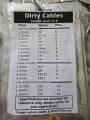
You might take a look at Dirty Cables Dirty Connector Sample Pack for some ideas. Unfortunately it's no longer available. It includes many common connector types, with male and female connectors of each type in individual transparent envelopes.

Something like that – a library of loose connectors of the types you have encountered – might be more useful than a pcb that becomes obsolete when a new connector is encountered.

20260619_105818.jpg

20260619_105644.jpg
 

Thread Starter

airplane100000

Joined Aug 2, 2016
73
Something like that – a library of loose connectors of the types you have encountered – might be more useful than a pcb that becomes obsolete when a new connector is encountered.
It's not so clear to me how a simple row of holes would help me determine the pitch of a female JST that's already attached to a cable. Anyhow, That sample collection is fairly close to what I had in mind. Although my thought was that having them nicely soldered and labeled on a board would be neater. My idea was to only use 2 pin-count connectors of the various common brands and types. I could probably fit 100 on a single board.

That said, if nobody else finds this useful, perhaps I will only discover it is useless after making it.

Any final verdict?
 

Jon Chandler

Joined Jun 12, 2008
1,607
It's not so clear to me how a simple row of holes would help me determine the pitch of a female JST that's already attached to a cable.
Admittedly, it doesn't help much with female connectors.

Using 2 pin connectors may not be optimal. For example, two pin 0.2" pitch (5.08mm) terminal block will more-or-less fit a hole pattern designed for 5mm terminal blocks, but even a 3 or 4 pin terminal block won't. With close pitches, an error over 2 pins may not be obvious.

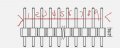
A tip to measure pin spacing with a digital caliper

1. Tare (zero) the caliper while measuring the dimension of one pin.

2. Measure across extreme length of pins from end to end.

3. Divide by the number of spaces between the pins --> pitch.

Taring out the pin diameter compensates for the extra pin width in the measurement.

Screenshot_20260619_220028_Gallery.jpg
 
Top