Series RLC oscillation

Thread Starter

KonstantinosAn

Joined Sep 12, 2020
7
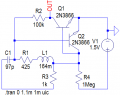
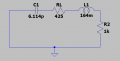
I have constructed an RLC circuit as shown below
1599933284758.png
The values of the capacitor and inductor cannot change and are specifically chosen to match the needs of my project.
RL is the resistance of the inductor
R2 is the resistance of the RLC circuit
I need to be able to track the resonance frequency of my circuit at almost every time so i was thinking of trying to oscillate the circuit
This circuit is part of a sensor practically so i cant use a generator to feed it with a sine wave and try to find resonance frequency this way
So i need to transform this circuit so it can self-oscillate (continuously - in a theoritical world) and in this way i will be able to find the frequency i am after
I am pretty new to the concept of oscillation so any help will be much appreciated
Thanks in advance
 

DickCappels

Joined Aug 21, 2008
10,661
Can you please detail the circuitry represented by R2? Will what you have shown so far necessarily need to be referenced to ground?
 

Thread Starter

KonstantinosAn

Joined Sep 12, 2020
7
R2 is just the resistance of the RLC ciruit and its value can change (i chose 1k just to have sharper response and thus find the resonance frequency easier)
Also no the elements can also not be referenced to ground
The only things that cant change are the capacitance the inductunce and the resistance RL
 

Papabravo

Joined Feb 24, 2006
22,082
Without some kind of source you will be hard pressed to observe much of anything. The series resonant frequency is approximately 159 kHz. I think it is pretty unlikely that you will find a useful source that can couple RF energy into the circuit since that band is for fixed base operators and maritime mobile. Building an effective radiator at that frequency will also have challenges. Let us know what you find
 

Papabravo

Joined Feb 24, 2006
22,082
Can you please detail the circuitry represented by R2? Will what you have shown so far necessarily need to be referenced to ground?
You cannot use LTspice to simulate ANYTHING without at least one ground node. You can use a floating ground with a high impedance to node 0, the actual ground. Again I think you will have a herd time observing anything.
 

Thread Starter

KonstantinosAn

Joined Sep 12, 2020
7
Without some kind of source you will be hard pressed to observe much of anything. The series resonant frequency is approximately 159 kHz. I think it is pretty unlikely that you will find a useful source that can couple RF energy into the circuit since that band is for fixed base operators and maritime mobile. Building an effective radiator at that frequency will also have challenges. Let us know what you find
The only source i can use is a battery.
The thing is if i charge the capacitor and then the capacitor is discharging should this provide oscillations?
And if thats the case do i need to feedback this circuit so it keeps oscillating?
Thats the questions in my head that need an answer
 

Papabravo

Joined Feb 24, 2006
22,082
The battery is no good because the capacitor will block ALL DC current flow
In order for something to oscillate you need to at least satisfy the Barkhausen Criteria -- google it.
In short you need a loop gain of 1 or a bit more and a phase shift of n*360° where n ∈ [0, 1, ... , ∞)

Back in the dawn of electronics time you could build a crystal set with a germanium diode, an air wound coil, and an air variable capacitor. There was enough energy from nearby 50,000 Watt AM Clear Channel radio stations to drive a pair of high-impedance headphones.
 

Thread Starter

KonstantinosAn

Joined Sep 12, 2020
7
The battery is no good because the capacitor will block ALL DC current flow
In order for something to oscillate you need to at least satisfy the Barkhausen Criteria -- google it.
In short you need a loop gain of 1 or a bit more and a phase shift of n*360° where n ∈ [0, 1, ... , ∞)
Ok i get that. So generally speaking if we dont pay that much attension on the values that i have to work with if there a circuit that can act as a feedback to an rlc circuit in order to make it oscillate for a good period of time ?
 

Papabravo

Joined Feb 24, 2006
22,082
I suppose, but why don't you try telling use what you are trying to do so we can suggest one of more productive avenues of inquiry.
 

Thread Starter

KonstantinosAn

Joined Sep 12, 2020
7
Ok so lets take it from scratch.
My project is about building a sensor for covid-19 based on capacitance. So i calculated the capacitance of the interdigital capacitor i want to use and based on the range of frequencies i need (10kHz - 1MHz) i chose the value of the inductance.
Using ACE2 on the capacitor will change the total capacitance because there was an increase in the total dielectric constant. When ACE2 captures Covid-19 the total dielectric constant changes again. So because the capacitance is changing the resonance frequency of my RLC circuit is also changing.
In sort terms after i use the ACE2 on the capasitor and calculate the resonance frequency i want to be able to detect any further changes of the resonance frequency in order to now if a room is infected or not.
 

Thread Starter

KonstantinosAn

Joined Sep 12, 2020
7
Is it what you trying to find?
View attachment 217019
first of all can you give me a brief explanation about how is this circuit operating
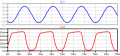
secondly that is the result i want a "continuously" oscillating circuit... the thing is that i measured the frequency of the output i am getting and it wasnt close to what i was expecting
i calculated that the resonance frequency given the values of the capacitor and the inductor would be around 159KHz
In your desing i am getting a sine wave with frequency of around 89KHz
I though that getting an rlc circuit to oscillate would make it oscillate with the resonance frequency... am i wrong?
 

Papabravo

Joined Feb 24, 2006
22,082
The transistors introduce additional parasitic capacitors, from base to emitter, base to collector and from collector to emitter.
 

Thread Starter

KonstantinosAn

Joined Sep 12, 2020
7
yeah apart from that this circuit works only for the initial value of the capacitor. If i change this to simulate the oscillations with ACE2 the oscillation decay over time and there is no amplification
 
Top