Thank you for the video. I have replaced my capacitor with the exact same one and now the output voltage is able to go up to 33V. It seems to have solved the voltage dropping to 9V. I have also borrowed an oscilloscope, but am not entirely sure what to look for.
hi J,
So to summarise.
You are using a 12Vdc wall wart.?
What Vout voltage range do you get.?, with the 47k pot.
What typical load currents.?
Details of the caps used.?
E
hi J,
So to summarise.
You are using a 12Vdc wall wart.?
What Vout voltage range do you get.?, with the 47k pot.
What typical load currents.?
Details of the caps used.?
E
Hi Eric,
I have tested on 5V and 9V from the wall wart.
Both of them, I am getting Vout range of 1.3 - 35V at 47K Ohms.
How do i obtain the load current? I'm currently using 1K resistor as load.
The output capacitor i've replaced is the same 35V 100uF electrolytic.
hi,
To calculate the Load current= Vout/ Rload eg: 30Vout/1000R = 0.03Amps
If you increase the capacity of the Vout cap it will improve the smoothing, add another 100uF 35v in parallel.
E
hi,
To calculate the Load current= Vout/ Rload eg: 30Vout/1000R = 0.03Amps
If you increase the capacity of the Vout cap it will improve the smoothing, add another 100uF 35v in parallel.
E
I have added the capacitor in parallel, my Vout is now reaching 42V when pot is set at 47K at 5V voltage in. Could it be that when my old output capacitor blew up, it messed up other components as well?
First the capacitors:
I finally actually read the ap note at my first link at 28 and it covers the concerns quite well.
Capacitors can be one of the biggest problems with switchers. When ESR is important, as it is for the coupling capacitor and the output cap, and you want/need to use aluminum electrolytic types it is often advantageous to use either substantially more capacitance than required by the charge vs. ripple issue and/or use caps rated for higher voltage and/or use multiple caps in parallel. Adding ceramic capacitors in parallel can improve the high frequency performance, unfortunately through-hole ceramic caps tend to be quite expensive. Solid electrolyte (aluminum-polymer) caps are an excellent choice, though rather expensive. Their ESR and ripple current rating (the two really go together) are typically much better than even really good conventional electrolytics. Solid tantalum capacitors also perform very well but care is required to select types rated for high ripple. Some don't like fast-rising voltage and have a nasty tendency to fail short-circuit. They are also expensive.
Panasonic, Nichicon, United Chemicon and Rubycon make good quality capacitors (Rubycon used to be known for some of the worst electrolytics on the market, but now make some very good ones). Kemet and AVX don't offer conventional Al caps but are good for tantalum. I recommend staying away from "house brand" caps. Farnell is the only major vendor I know of that has a house-brand line.
As the ap note mentioned above details, the output capacitor and the coupling capacitor both need to be of high quality.
Input power supply: The current limiting behavior of most switchmode wallwarts is likely to be quite soft and unpredictable. The best thing to do is just check the voltage any time you see inexplicable behavior.
Excessive output voltage: This is most likely due to a problem in the feedback resistor. Any time you get odd behavior like that it is best to test with a fixed resistor instead of the pot. Pots are somewhat delicate and can wear out. High resistance between the element and the wiper can arise. When using a pot as a variable resistor, as opposed to using it as a voltage divider, always connect the unused terminal to the wiper. On a breadboard, try to do it by connecting with a separate wire to the source or destination. In both cases, the objective is to try to make sure that the end-to-end resistance of the pot remains in-circuit even if something goes wrong with the wiper or its connection. If the feedback resistors goes open, the switcher runs open-loop (unregulated). With a boost converter this can lead to grossly excessive output voltage, frequently resulting in something failing catastrophically.
If the feedback circuit goes open, the FB pin of the IC will usually drop to 0V. This can be confirmed by measurement. Probing the feedback pin is perilous in a working switcher. Noise injection can make a well-behaved switcher go berserk and of course shorting it to anything is bad news. Volt meters are usually unsuitable due to the long unshielded leads. An oscilloscope is the best instrument to use.
Input power supply: The current limiting behavior of most switchmode wallwarts is likely to be quite soft and unpredictable. The best thing to do is just check the voltage any time you see inexplicable behavior.
Excessive output voltage: This is most likely due to a problem in the feedback resistor. Any time you get odd behavior like that it is best to test with a fixed resistor instead of the pot. Pots are somewhat delicate and can wear out. High resistance between the element and the wiper can arise. When using a pot as a variable resistor, as opposed to using it as a voltage divider, always connect the unused terminal to the wiper. On a breadboard, try to do it by connecting with a separate wire to the source or destination. In both cases, the objective is to try to make sure that the end-to-end resistance of the pot remains in-circuit even if something goes wrong with the wiper or its connection. If the feedback resistors goes open, the switcher runs open-loop (unregulated). With a boost converter this can lead to grossly excessive output voltage, frequently resulting in something failing catastrophically.
If the feedback circuit goes open, the FB pin of the IC will usually drop to 0V. This can be confirmed by measurement. Probing the feedback pin is perilous in a working switcher. Noise injection can make a well-behaved switcher go berserk and of course shorting it to anything is bad news. Volt meters are usually unsuitable due to the long unshielded leads. An oscilloscope is the best instrument to use.
The first pin of my pot is connected R2, wiper is connected to the FB pin, and the third pin is connected to ground. Is it wrong?
I have tried adding a wire from pin 1 to wiper, by doing that, i was not able to vary the voltage, it was stuck at 1.3V.
When i connected the wiper to pin 3, then pin 3 to ground , the voltage output was stuck at 38V.
I'm sorry, from earlier sim schematics I thought you were using the pot as a variable resistor making up part of the total resistance between the output and the FB pin. It is OK with this controller to use it as you are, except I would put a fixed resistor between the bottom and ground to limit the maximum output voltage. Without such a resistor you could set the output voltage to something extremely high.
It is interesting that the circuit max'es out at 38 volts. This may be due to internal circuitry to protect the switch from excessive voltage (rated at 35 V). I haven't read the data sheet carefully - it may be mentioned.
hi J,
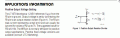
Look at this clip from the d/s it shows the resistive divider chain for the Vout.
Vref is 1.245Volts
Note the recommended R2 value of 6k2
E View attachment 148178
Yes, this explains how i can get 1.3V when the pot is at 0R and 12V when the pot is set to 42K, because the remaining resistance on the pot acts as R2, in this case 5K . Which when calculated using the given formula is 12V.
My solution : Add 5.6K resistor as R2, this way, even when my pot is at 47K, I will be getting 12V Vout instead of the unregulated voltage.
Sounds good?
I'm sorry, from earlier sim schematics I thought you were using the pot as a variable resistor making up part of the total resistance between the output and the FB pin. It is OK with this controller to use it as you are, except I would put a fixed resistor between the bottom and ground to limit the maximum output voltage. Without such a resistor you could set the output voltage to something extremely high.
It is interesting that the circuit max'es out at 38 volts. This may be due to internal circuitry to protect the switch from excessive voltage (rated at 35 V). I haven't read the data sheet carefully - it may be mentioned.
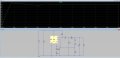
You are right, the datasheet did mention about the rated voltage of 35V. I have tested with a sim on LTSpice, adding a 5.6K resistor between the bottom to ground will give me 12V output when my pot is set to 47K.
As i have acquired a oscilloscope, i connected my probes to the load resistor. I am not very well-versed in oscilloscope, however with the "measure" tab, I can see the Vpp(noise?) , Vmax, Vavg. What should I be doing to obtain data that shows how well my device works?
hi John,
Post 56 circuit looks OK.
What current loads are expecting across the full Vout range.?.
If you are considering using a USB voltage supply source, take care not to exceed the USB rating.
That Amazon variable power resistor seems an 'over kill' to me.
Be aware the 25W power rating of the pot, may only apply to the maximum resistance of the 1k track.
Do a few calculations at different pot settings, Vout and load currents, post your results
E
hi John,
Post 56 circuit looks OK.
What current loads are expecting across the full Vout range.?.
If you are considering using a USB voltage supply source, take care not to exceed the USB rating.
That Amazon variable power resistor seems an 'over kill' to me.
Be aware the 25W power rating of the pot, may only apply to the maximum resistance of the 1k track.
Do a few calculations at different pot settings, Vout and load currents, post your results
E
Apologies for the late reply, been away. I'm testing it across 0.1Amp to 2Amp. I am currently testing it over different loads, and will get back to you when i'm done.
Thank you
J
EDIT: This is the Power Out when the pot is at 47K. I'm not sure how can i measure the input current, my multimeter does not fit into the power pin of the IC.

 Facebook
 Google
 GitHub
 Linkedin


 It seems to have solved the voltage dropping to 9V. I have also borrowed an oscilloscope, but am not entirely sure what to look for.