Sensing when generator is running

DC_Kid

Joined Feb 25, 2008
1,242
That's why if you go contact type of sensor (clamping onto the actual gen mains) the stuff you put there has to accomodate 60Hz and 40Hz. Using a 60Hz rated device on 40Hz won't be good, but 50Hz is euro spec and easy to find, so device rated 50Hz will be ok on 60Hz supply and likely survive ok on 40Hz supply. You could also just clamp on a voltage divider (if the gen CT is tied to util CT/earth (I suspect it is), because I assume that's where the x-420 GND will be). Divide it down and bridge rectify it then clamp it with a regulator (use correct fusing). A step-down provides some isolation, which is a good thing.

The gen apparently has some measured voltage on it's mains while in exercise. You can use that to detect if it's running. Then add in a current sensor. If the gen has load then you know it's running and the xfer switch did it's job.

To know if say there was a util fail and the xfer switch failed, just use backend logic, like "yep, got alert for it's running, but no load sensed, and right now it's not exercise hour". There's no reason for the gen to run outside of exercise hour unless there was a util fail, etc.

It only needs two sensors to know all the states.

As a side note, contacless V detection is not hard, you can simply open one of these and accomodate it to sense V on gen mains. It has all the guts to act as a switch.
https://www.fluke.com/en-us/learn/blog/electrical/non-contact-voltage-detector-basics
 
Last edited:

MisterBill2

Joined Jan 23, 2018
27,519
The problem is that the thread starter wants to know when the genset does an exercise routine. During exercise routines the transfer switch does absolutely nothing. No signals are sent to the transfer switch. Nothing changes at the transfer switch. So back to the genset we go. :)

The transfer switch as pictured in one of my earlier post only has 4 wires going to and from. Aside from mains or genset power. You have 240 VAC mains power as sensed on the utility side of the transfer switch sent to the genset used to detect mains utility failure and the 12 VDC which is only a pulse to toggle the transfer switch. That's it. The typical transfer pulse is a 12 VDC pulse having a 2 ~ 3 second duration. That design precludes having constant duty solenoid coils getting warm.

End results is there is nothing in the transfer box doing anything during exercise routines so nothing, no signals, in the transfer box are of any value during genset exercise routines.

Ron
The purpose of sensing generator output at that (generator) side of the transfer relay is to verify that the generator is spinning, which means that the engine has started. Verifying the connection to the transfer switch is a "free" added benefit.
Evidently some of folks don't understand what I say. Or something.
Also, the main reason to connect at that point is that the transfer switch is in a more convenient location to connect to.
 

Reloadron

Joined Jan 15, 2015
7,889
The purpose of sensing generator output at that (generator) side of the transfer relay is to verify that the generator is spinning, which means that the engine has started. Verifying the connection to the transfer switch is a "free" added benefit.
Evidently some of folks don't understand what I say. Or something.
Also, the main reason to connect at that point is that the transfer switch is in a more convenient location to connect to.
Look I get all that. Now I have the same generator in my back yard, I posted images of mine at thread start. Prior to the newer generator I had an older one, all similar. When any of these generators are in an exercise mode absolutely nothing changes at the transfer switch, absolutely nothing. While in exercise mode the stator receives no excitation, there is no output. I don't care what anyone thinks regarding the transfer switch, the fact well covered is during exercise cycles nothing at all changes or happens in the transfer box. Yes, the transfer switch is conveniently located but it is also useless for detecting a run mode when in exercise. Now if you don't get that have at it with suggestions about the transfer switch as I am done explaining how that works and when it works.

How did I come to know this wealth of useless information? Years ago when I met my wife she was caring for her totally invalid mother. Over the years mom's condition became worse and more and more electronic gizmos appeared. There was an oxygen concentrator, a vent machine, a suction machine and the list goes on. Loss of mains power would cause a disaster. I went out and bought a 4.0 KW Coleman Powermate as a backup get over. When we were doing major renovations I figured a nice fully automatic system would be a nice solution for whole house. Bought a 13 KW Generac which was a great deal on a floor model. Life went on and every Sunday morning the thing started up and did an exercise routine. I never gave it much thought. Then came the day a large storm hit. I rely on sump pumps. They are critical. Pouring down rain and the power goes out. Generator starts just fine, generator transfers just fine, only one problem, no electricity. Sump is starting to overflow. OK desperate I drag out that old Coleman, added fresh gasoline and it fired up on the second pull. Learning curve at work here. Just because these units start and run exercise means nothing when you actually need emergency power. Now about once a month I kill mains power and let the genset actually run and deliver power. Over the years I became real familiar with the same model the thread starter has.

The thread starter does indeed make mention of seeing some voltage in exercise mode. My best guess here is there may be some residual voltage across the stator out as a result of residual magnetism in the excitation field. My guess is with even a few mA load that will be gone. You have a 16 KW genset and no excitation you get nothing. Now I based my suggestions on the same unit the thread starter has. I have read and understand the owners manual as well as the service manuals. That includes the genset and the automatic switch panel. Some suggestions will work and some won't for the reasons I pointed out. Now personally if anyone wants to get something of value from the exercise panel, have at it. I suggest someone who wants to help read the manuals. This is a link to all the supporting documentation, Good as it gets.

Ron
 

MisterBill2

Joined Jan 23, 2018
27,519
Certainly it is indeed possible that it is only residual magnetism. Thus it will make sense to check and see if it will deliver a small amount of power so that the engine operation can be verified. If not a transformer, then some high value resistors and capacitors. The goal is sensing that a voltage appears when an exercise effort is initiated, and so high accuracy is not vital. If some voltage is suddenly present then it is clear that the generator is spinning, which means that the engine started. And now we understand that starting the engine was what the TS was hoping to verify, because not starting was the problem before.
 
Last edited:

MisterBill2

Joined Jan 23, 2018
27,519
Why do I need to own one of those when the TS has reported what the one they have is doing, which was generating some voltage while spinning in the exercise mode. And that voltage was able to be measured at the generator side contacts of the transfer switch. And the transfer switch is located in an area that is much more convenient.
The big question now is if that "some voltage" during the exercise sequence is adequate to operate a relay directly.
 

MisterBill2

Joined Jan 23, 2018
27,519
How many folks who own a "Generac generator" of any model have measured the voltage during the exercise mode. And how many "Generac" service people have actually serviced them. Usually it is a local service contractor, not an actual employee.
Back in post #1 the TS mentions a lower voltage produced in the "exercise mode", and then in a later post tells us that it was a different voltage.
So my thinking is that the TS has actually measured that voltage a few times. Why should I doubt that??
 

strantor

Joined Oct 3, 2010
6,875
So my thinking is that the TS has actually measured that voltage a few times. Why should I doubt that??
Because it doesn't make sense. It would be irresponsible of a generator manufacturer to sell a product that, in an intentional mode of operation, delivers off-spec power that can be damaging to devices connected to it.
 

Reloadron

Joined Jan 15, 2015
7,889
Certainly it is indeed possible that it is only residual magnetism. Thus it will make sense to check and see if it will deliver a small amount of power so that the engine operation can be verified. If not a transformer, then some high value resistors and capacitors. The goal is sensing that a voltage appears when an exercise effort is initiated, and so high accuracy is not vital. If some voltage is suddenly present then it is clear that the generator is spinning, which means that the engine started. And now we understand that starting the engine was what the TS was hoping to verify, because not starting was the problem before.
Well I'll tell you what. Then you just go right ahead and explain to the thread starter exactly how they can go about doing what they want to do. The voltages the thread starter posted make no sense at all. Go right ahead and measure that voltage. Not to say the thread starter did not see something but in AC measurements how many times have we thought we saw a voltage only to discover the tiny mV on the meter face? I never saw the measurements and sorry I don't see them as true and correct. So you just go ahead and take lead on this and cover using another relay in the transfer switch box. I am done. It's been nice and fun though.

One side note on something I got incorrect. The exercise feature uses a quiet mode when selected. I saw this as a two speed mode and actually it's 3 speeds. On start the generator will ramp up to 3600 RPM. After about 7 seconds that speed will drop to about 2400 RPM and about 40 seconds later it will drop to about 1950 RPM where it will remain till the cycle is complete. This feature can be omitted allowing the genset to just run at 3600 RPM for the entire cycle.

Ron
 

Reloadron

Joined Jan 15, 2015
7,889
Hey, Ron, hows it going? You didn't notice, I guess that bill is an expert and your only a fanatic.
Things are good. Wife has slowed down a bit. I got to NY in July to meet with friends on the beach and plan Florida maybe in Dec.

Yeah, life ain't always easy being low on the totem pole but hell being retired the only person I need to please is me. :)

Ron
 

Tonyr1084

Joined Sep 24, 2015
9,744
Y'know, I was just at the Salt Lake Home Show in Sandy Utah. Saw a Generac dealer and asked him about the older models and when they exercise if they produce any voltage at all. He said (to the effect) 'the older units don't generate any power when exercising. The new models have a bluetooth feature (or maybe he said a Wi-Fi feature by which you can check the status and receive notices when it's exercising'. He also said (to the effect) that at the transfer switch the new units produce full voltage but the older ones didn't.

So the older units do not produce any voltage. HOWEVER, that doesn't mean you can't read some parasitic voltage. I recall a test rig that had a bad ground. It was introducing some 60VAC 60Hz into a grounded unit. This unexpected ground path was blowing out a very sensitive sensor. Nobody could figure it out until I happened to touch the power strip, an exposed rivet while I had my hand on the unit under test and felt a distinct charge. Just how much current was being introduced - I haven't a clue. So the voltage the TS is reading could be some cross talk between parallel lines. It may be useful, it might not be. I'd suspect not.
 

MisterBill2

Joined Jan 23, 2018
27,519
Well I'll tell you what. Then you just go right ahead and explain to the thread starter exactly how they can go about doing what they want to do. The voltages the thread starter posted make no sense at all. Go right ahead and measure that voltage. Not to say the thread starter did not see something but in AC measurements how many times have we thought we saw a voltage only to discover the tiny mV on the meter face? I never saw the measurements and sorry I don't see them as true and correct. So you just go ahead and take lead on this and cover using another relay in the transfer switch box. I am done. It's been nice and fun though.

One side note on something I got incorrect. The exercise feature uses a quiet mode when selected. I saw this as a two speed mode and actually it's 3 speeds. On start the generator will ramp up to 3600 RPM. After about 7 seconds that speed will drop to about 2400 RPM and about 40 seconds later it will drop to about 1950 RPM where it will remain till the cycle is complete. This feature can be omitted allowing the genset to just run at 3600 RPM for the entire cycle.

Ron
OK, it was my guess that the thread starter was competent to make a measurement that was correct.
AND, I am thinking that, given that the transfer relay does not operate during the exercise, it is not "Generating any power", no matter what voltage is actually generated.
So it seems that perhaps we should ask the TS to connect a load to the generator output terminals for the next exercise, and see if there is enough voltage to power a 25 watt incandescent light for a while. My impression is that the TS is able to take a voltage reading accurately.
 

Reloadron

Joined Jan 15, 2015
7,889
Alrighty, today is exercise day so I decided to see what I actually get. This is a new transfer panel.

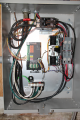
Transfer Overview.png

The mechanicals are the same but they came up with a cute little module eliminating a few relays. Tiny fuses verse the larger cartridge fuses of older units and rather than 4 control lines they added a 5th labeled T1.

I used my old Fluke 87 III for measuring set for AC voltage. Prior to the genset starting I was just seeing random garbage of low milli volts bouncing around.

However when the genset started there was a voltage on the genset outputs. It was bouncing around between about 115 to 125 VAC over a few seconds. Just seemed like random garbage but it is about what the thread starter saw. Can it be used? Well if I were to try it I would likely just hang an opto-coupler out there made for AC and try it. They do make opto-couplers for mains voltage AC. Just keep in mind that random voltage will become a hard 240 VAC when the genset is actually running in a mains outage situation. Will it work reliably? Beats the hell outta me lieutenant. It would be cheap enough to find out. So this was my morning basement sojourn. I did not loading what I saw so I have no clue and I did not drag a scope out to look at it. What I saw was all over the map and not stable but it was there. The transfer switch does have a constant 12 VDC available.

Thank you Tony for some good info from a Generac Rep. That got me motivated enough to look at the new (4 years old) system). This system does have the option for WiFi but I guess the thread starter's system doesn't have that option. Hell if it did the thread starter could likely log everything.

Ron
 

Reloadron

Joined Jan 15, 2015
7,889
So it seems that perhaps we should ask the TS to connect a load to the generator output terminals for the next exercise, and see if there is enough voltage to power a 25 watt incandescent light for a while. My impression is that the TS is able to take a voltage reading accurately.
Makes sense to me. If it lights a 25 watt incandescent lamp it will drive an opto-coupler.

Ron
 

MisterBill2

Joined Jan 23, 2018
27,519
Alrighty, today is exercise day so I decided to see what I actually get. This is a new transfer panel.

View attachment 305044

The mechanicals are the same but they came up with a cute little module eliminating a few relays. Tiny fuses verse the larger cartridge fuses of older units and rather than 4 control lines they added a 5th labeled T1.

I used my old Fluke 87 III for measuring set for AC voltage. Prior to the genset starting I was just seeing random garbage of low milli volts bouncing around.

However when the genset started there was a voltage on the genset outputs. It was bouncing around between about 115 to 125 VAC over a few seconds. Just seemed like random garbage but it is about what the thread starter saw. Can it be used? Well if I were to try it I would likely just hang an opto-coupler out there made for AC and try it. They do make opto-couplers for mains voltage AC. Just keep in mind that random voltage will become a hard 240 VAC when the genset is actually running in a mains outage situation. Will it work reliably? Beats the hell outta me lieutenant. It would be cheap enough to find out. So this was my morning basement sojourn. I did not loading what I saw so I have no clue and I did not drag a scope out to look at it. What I saw was all over the map and not stable but it was there. The transfer switch does have a constant 12 VDC available.

Thank you Tony for some good info from a Generac Rep. That got me motivated enough to look at the new (4 years old) system). This system does have the option for WiFi but I guess the thread starter's system doesn't have that option. Hell if it did the thread starter could likely log everything.

Ron
OK, if the voltage gets up to even 100 volts then certainly with a suitably rated diode, or diode bridge, it can charge a capacitor through a resistor that will limit the current when the voltage is 240 volts. So th e charged capacitor, suitably limited by a zener diode, can operate a suitable opto-isolator, or maybe even an SSR. So the generator spinning can be verified in this box. Possibly not for the entire time of the exercise, but we did not get that information yet.
But, to simply verify that the generator spun up, can be verified in this box. Like I suggested before.
An even simpler scheme will be to use a neon bulb with a series resistor as the light source for a photo-sensor, either a photo-transistor or a photo-resistive device. That could have an adequate isolation distance and be easier to acquire, possibly.
 
Last edited:

DC_Kid

Joined Feb 25, 2008
1,242
Well if I were to try it I would likely just hang an opto-coupler out there made for AC and try it
A $5 step-down transformer with a fuse is probably better/easier as a test.
120v to say 6vac (50Hz rated, you might try 60Hz but if the gen can provide decent power at low rpm 40Hz then you might cook the step-down primary), place primary on gen main and CT. You can then add a load resistor on the 6v side, and then see if gen voltage remains stable.

Small loads likely won't do much, but a big load will likely load down the gen voltage (when in exercise mode).

He said (to the effect) 'the older units don't generate any power when exercising.
There's some confusion going on.

Making power is not the same as making volts. So let's clear that out.
Volts with Amps is power.
Volts w/o amps is nothing but volts.

There should be no "residual magnetism", unless the rotor itself has become slightly magnetized from wiping through magnetic field. If that's the case, it can likely also provide some power.

I guess one good test is to clamp on a step-down 50Hz transformer (120v to say 6v, gen main to CT) with a 100ohm resistor on 6v side, and then measure gen volts when it's running at low rpm's. If the volts remain stable then you know for sure the gen can make power even when running in exercise mode.

40Hz does appear to fit normal gen rotor equations, which puts the 2pole gen rotor at 2400rpm for 40Hz when running exercise, and 3600rpm at 60Hz. This appears to be backed by actual tests the OP did.

If you want contactless volt sense (no gen power needed), floating gate FET in proximity to gen mains.
 
Last edited:

DC_Kid

Joined Feb 25, 2008
1,242
The thread starter does indeed make mention of seeing some voltage in exercise mode. My best guess here is there may be some residual voltage across the stator out as a result of residual magnetism in the excitation field. My guess is with even a few mA load that will be gone. You have a 16 KW genset and no excitation you get nothing.
That's true, for gens that have active controls for excitation.
What about gens that are self excited based on regulated RPM's?

What type of gen config does Generac actually use?
 
Top