Sensing when generator is running

Reloadron

Joined Jan 15, 2015
7,889
That change over mechanism looks quite interesting. two solenoids to force a switch to change.
I think that I would use a gear-motor driven cam to drive a snap action lever to move contacts similar to those in a 50 amp motor starter. Fast make, fast break, and a lower power drive mechanism, with the motion from a cocked spring mechanism.
My current change over scheme has six high current toggle switches and is totally manual.
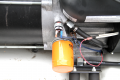
The way the magic works is a 12 volt DC pulse of about 2 ~ 3 seconds is sent to the contactor solenoids. In addition to mechanical lockout if you look close you can see the electrical lockout micro switches. That affords a safety factor making it pretty much foolproof. Additionally only a pulse is needed to switch from Mains Power Utility to Genset power. Just about all generator/utility transfer switches work this way. Also visible in my images is a small yellow square and it has a hole in the center. You can insert a tool in and manually cob the transfer over. They have that covered.

Ron
 
Last edited:

Reloadron

Joined Jan 15, 2015
7,889
Thanks for pointing this out. I found it now in post #70 although I think we've not yet had that confirmed by the thread starter and even then, surely if the alternator is spinning there will be a voltage being generated, albeit not connected to the output? If not, which would presumably require some kind of clutch arrangement, this would be more expensive than a circuit breaker?
Not quite. During an exercise routine the genset spins just fine. What does not happen is there is excitation provided to the rotor. No excitation means no output. Keep in mind this is aimed at the thread starter's genset. Typically a 60 Hz genset rotates at 3,600 RPM and a 50 Hz rotates at 3,000 RPM. Unless the genset is diesel fueled then the rotational speed is halved as a pole is added. Things look like this:

The two factors relate as per the following formula: Generator Frequency (f) = Number of revolutions per minute of the engine (N) * Number of magnetic poles (P) / 120. In other words, f = N*P/120. Or, P = 120*f/N.

Anyway here nor there the idea being when these Generac Generators run an exercise routine no excitation is provided to the rotor so no voltage is generated on the stator output side.

Ron
 

DC_Kid

Joined Feb 25, 2008
1,242
The x-420 also integrates with Maxim DS18B20

It's a 1wire comm chip, needs Vdd and GND, but you can just plop that in under the gen housing and detect temp under the housing. It has to heat up in there when running.

During an exercise routine the genset spins just fine. What does not happen is there is excitation provided to the rotor.
+1
Modern day automotive alternators run the same way. ECM controls (regulates) the excitation to maintain voltage across varying load.
 
Last edited:

Reloadron

Joined Jan 15, 2015
7,889
In post #70, from that load center switch, there should be auto sense control signal wire that goes to the gen outside. I suspect a low AC voltage is present. One could sense that voltage (or lack of) at the gen to know if util failed.
Actually if you look at my post #70 image on the left side you will see 2 fuses (one missing) running to a terminal strip. Only 4 wires are used. N1 and N2 are 240 VAC picked off the mains. Those go to the genset. The remaining two terminals are 12 VDC for switching the transfer switch from the genset. All the "thinking" is done in the genset.

Using temperature for anything? I would use a common hose clamp and clamp a Type K thermocouple to one exhaust header. It will get hot real fast. Personally I would just use the oil pressure switch. The oil filters on these units is front and center for easy change access. The switch is NO till start and then goes NC. If all the thread starter wants is engine running take it off the pressure switch and leave a small delay because that switch has enough oil pressure when just cranking to close. From here it can get as simple or complex as anyone wants. Combine the oil pressure switch with for example a ZMPT AC Voltage module. Like an AND gate. We have oil pressure so engine is running, we have AC voltage so engine is running to power a load. Just write the code for a cheap ESP8266 wireless module and monitor what the genset is doing or send the data to a cloud and check in using a smart phone from anywhere. Roll your own or get a turn key solution off the shelf.

Ron


.
 

DC_Kid

Joined Feb 25, 2008
1,242
Using temperature for anything? I would use a common hose clamp and clamp a Type K thermocouple to one exhaust header. It will get hot real fast. Personally I would just use the oil pressure switch. The oil filters on these units is front and center for easy change access. The switch is NO till start and then goes NC.
TC is ok, but TC wire is not cheap, that has to be run somewhere. Or if you keep sensor electronics under the gen hood, where does that power come from? The x-420 can indeed supply low DC voltage. The more complexity you add, the more costly it is, the more fail points are created.

The Maxim 1wire chip can be located near gen heat source, but not right on the exhaust header. Maybe located 12" away, under the hood is still gonna get nice and warm.

As for the pressure switch, then you are back to contact type of sensing. I was in the realm of contactless/simple/inexpensive.

More than 1 way to do it for sure. Choose a method, find the parts, done.
 

MisterBill2

Joined Jan 23, 2018
27,519
Finally!!! In post #64 we got the explanation, which is that the generators would crank but not start and so run until the batteries ran dead.
so now we have the solution provided: the sensor signal that detects that the engine has started and switches off the starter motor. Locate that signal circuit, and add a battery voltage sensor that senses that the batteries are not dead, and you have the verification that the engine has successfully been started. No new sensor or modifications.
 

Reloadron

Joined Jan 15, 2015
7,889
The problem I want to solve beyond if it's running or not is this - For several years the generators would not auto-start so there was no exercise. They would just crank until the battery died. If the power went out, we had to go over to the site and start them using starter fluid. I want to know that they are exercising weekly. The starting problem was fixed recently and turned out to be the internal fuel regulators. They auto-start now. So now I want to make sure they are starting.
OK and with that in mind. This is what you should be looking at with front panel removed.
Oil Pressure Switch.png

The oil pressure switch is right there above the filter. The switch is normally open but closes as soon as any pressure is developed. The Blue side is Ground and the pink side is +5 Volts. The high side is held high at 5 Volts through an internal pullup. When the engine starts the switch closes going from a logic high 5 Volts down to zero volts. So detect the high to low transition using any of several micro controllers that have WiFi capability or connect a GSM shield. When the 5 Volts drops to zero I would maybe add a 5 second delay so we know the genset is running. Depending on where you want to take this you can even log the starts and stops of the exercise routines.

I have seen actual Generac Service Manuals I found using Google which get much more Indepth than the user manuals the units ship with. They are good to have.

Anyway this is how I would go about it.

Ron
 

ThePanMan

Joined Mar 13, 2020
919
TC is ok, but TC wire is not cheap, that has to be run somewhere.
I still don't see why a thermocouple is so difficult. Or expensive. In high school we built our own TC's from two dissimilar wires. While I don't recall what those two wires were, I suspect copper and nickel wires twisted together. I've wondered about the idea of using a copper pipe with 90% of it plated with silver solder. One wire fastened to the bare copper end while the other end, silver solder plated end, attached with a clamp that can exert equal pressure around the solder without piercing it to the bare copper. Now you have a cheap TC, one that can also conduct exhaust gasses. And believe me - that's going to get real hot real quick. I don't know if it will melt the solder. One would have to experiment with it, but I suspect that might work as a pretty good home made TC. Now imagine a thermopile (many TC's in parallel and in series) could deliver some reasonable amperage and voltage.
 

DC_Kid

Joined Feb 25, 2008
1,242
I did mention, many ways to do it, but you need to choose a strategy first, like cheap & contactless vs not so cheap / more complex / contact type.

Quality TC wire in proper insulation for the application, can be near $2+ per foot. It's not cheap.
If spending $50 vs $5 makes no diff, then by all means, spend more for the better stuff.


billrvolz said:

The problem I want to solve beyond if it's running or not is this - For several years the generators would not auto-start so there was no exercise. They would just crank until the battery died. If the power went out, we had to go over to the site and start them using starter fluid. I want to know that they are exercising weekly. The starting problem was fixed recently and turned out to be the internal fuel regulators. They auto-start now. So now I want to make sure they are starting.


The oil pressure switch is right there above the filter.

Anyway this is how I would go about it.

Ron
Don't need oil pressure switch to know it did not start. I think it was mentioned before, before it runs during start, there will be pressure on the switch, but this alone does not mean it's running. I think that's what @billrvolz was saying.

For the "running or not" question, I like the contactless method of temp measurement, Maxim 1wire digi (which intergrate with x-420), or find a TC module and integrate that with the x-420.

If you want to add a check for "running with load" question, use a pickup coil on one of the gen CCC's.
 

Thread Starter

billrvolz

Joined Jul 20, 2021
34
OP here. I have some updated info. I want to thank everyone for their input. I've found it creative and informative. First let me describe the building:

This is a community building built around an existing pump house that moves water from one tank to another. The controls are inside the pump room. There is a downstairs, a low ceiling mezzanine level with 6.5 foot ceiling used for storage and an upstairs. The pump room in roughly in the middle of the building and it is covered in the mezzanine so it's ceiling does not extend to the top of the mezzanine ceiling - you can crouch on top of it. The controls are powered through a UPS so that will keep going for at least 2 hours in a power outage. And I recently had a socket that the UPS plugs into added that is on the generator so it should never run out of power. The pump room itself is on separate power circuit and not on a generator due the power requirement of the pump motors (and that it was built first).

The generators are outside (of course) and the two transfer switches are located on the opposite side of the building on their respective floor. The power wires from the generator runs in two sets of conduit across the ceiling of the mezzanine and then branches to the transfer switch. There are electrical boxes close to the top of the pump room so running wires from there down inside the pump room is easy and short (20 feet).

I've been reluctant to use a solution that involves anything close to the generator as that would require running conduit and cost me $100's. I'm not sure that it's code to run low voltage in the same conduit as AC (though it was done in this case to bring signal wires from the transfer switch to the generators).

Today was exercise day for the generators. I took the cover off the transfer switches and located the wires coming from the generator. When not running the voltage was 0. The mains was 250. When the generators started their exercise, I measured 182 volts at 40 Hz at the transfer switch. After exercising, I restarted the generators to full power and got 247 volts at 58 HZ. So there is going to be power near the pump room when they are running. This was measured between the two hots so between each hot to neutral will be around 1/2 that or 60 volts.

What I will try is to use one of these for each generator : https://www.amazon.com/dp/B08F7FFQ14?psc=1&ref=ppx_yo2ov_dt_b_product_details

This is a RF transmitter/receiver pair. The transmitter takes 3.7-12 VDC and starts transmitting when power is applied. There is supposed to be 5 vdc somewhere that is present only when the generator is running. I can connect the transmitter to that. i just need to find that signal wire. The receiver is always powered and when it senses the transmitter turn on, it triggers the onboard relay. I can use that to signal the x420 that they are running. They are supposed to be good to 120 feet in open air, but I have 30 feet and 2 concrete block walls and stud wall to go through. If I need to I can locate the receiver in the mezzanine near the generators and run wires down to the pump room (10 feet and one concrete block wall). I also need to make sure that two pairs of them can operate independently of each other while only a few feet apart. I may need to put the transmitter in a weatherproof box outside the generator since the metal generator case may act like a Faraday cage.

If this fails, I'll probably use my original solution. I'm just a volunteer that knows enough about electrical stuff to make me dangerous. Others in the community that might volunteer later likely won't be as informed so I need to keep things modular. My solution is fairly modular except for the voltage divider. I'll let you know how it goes. Thanks
 

Reloadron

Joined Jan 15, 2015
7,889
Finally!!! In post #64 we got the explanation, which is that the generators would crank but not start and so run until the batteries ran dead.
so now we have the solution provided: the sensor signal that detects that the engine has started and switches off the starter motor. Locate that signal circuit, and add a battery voltage sensor that senses that the batteries are not dead, and you have the verification that the engine has successfully been started. No new sensor or modifications.
Have you ever looked inside one of these generators. I mean actually gotten in there and seen one? Some things are much easier said than done. Let's see I wonder if it's the red wire, maybe blue, maybe yellow, maybe, maybe and more maybe. This is why I suggested a service manual. Several boards and a hundred plus wires.

What can be done is look closely at the few circuit boards and terminal strips. There should be a board with two relays on the board. One relay is the start relay and the other is a run relay. When cranking the start relay is energized. Once start happens the start relay drops out and the run relay is energized. The run relay will remain energized for full duration of the run cycle. Matters not exercise or actual run and transfer. These relays are buried in there on a board, well mine are on a board. Less a shop manual good luck. If you can find the start and run relays and observe them during a start/run cycle you can likely work from those relays. Less oil pressure that is as good as it gets.

Additionally gensets like this are aimed more at residential backup than any commercial or industrial applications. They make gensets for the latter but yes, they come with a higher price tag. Hell these days you can have whatever you want just be ready to pay the price. The manuals are called diagnostic repair manuals and also service manuals.

Since when exercising there is no voltage out and no transfer you have no choice other than working from the genset unit itself. The transfer switch is of no value to you.

Ron
 

Reloadron

Joined Jan 15, 2015
7,889
Today was exercise day for the generators. I took the cover off the transfer switches and located the wires coming from the generator. When not running the voltage was 0. The mains was 250. When the generators started their exercise, I measured 182 volts at 40 Hz at the transfer switch. After exercising, I restarted the generators to full power and got 247 volts at 58 HZ. So there is going to be power near the pump room when they are running. This was measured between the two hots so between each hot to neutral will be around 1/2 that or 60 volts.
That makes no sense. Your genset should output about 240 VAC Split Phase power. Each hot leg to neutral will be 120 VAC. The frequency is a result of the genset RPM and is governor controlled. Normally for 60 Hz you would see about 62 Hz unloaded and that is done so when loads are applied and engine RPM dips the frequency should remain around 60 Hz. You mention line to line voltage of 247 and then go on to say 60 volts? No, that can't be right. 247 Volts / 2 = 123.5 volts which is what I would expect.

Ron
 

Thread Starter

billrvolz

Joined Jul 20, 2021
34
That makes no sense. Your genset should output about 240 VAC Split Phase power. Each hot leg to neutral will be 120 VAC. The frequency is a result of the genset RPM and is governor controlled. Normally for 60 Hz you would see about 62 Hz unloaded and that is done so when loads are applied and engine RPM dips the frequency should remain around 60 Hz. You mention line to line voltage of 247 and then go on to say 60 volts? No, that can't be right. 247 Volts / 2 = 123.5 volts which is what I would expect.

Ron
That's what I measured. When in exercise, the generator runs at reduced speed. My newer generator at home does the same thing and I get similar voltages/frequencies there. At the reduced speed during exercise I got 182 VAC @ 40 Hertz. When I manually started the generator it ran at full speed and I got 247 VAC @ 58 Hertz. As I said, that was measured across the two hots. Between each hot and the neutral I'd get 1/2 that or 60 volts when in exercise, 120 volts when running full power.

Looking at a service manual, it looks like I can connect my transmitter to pin 7 on J1 and ground. That pin also connects to the fuel solenoid so that should be energized only when the generator is cranking or running. The service manuals I'm looking at don't show any relays but do show an 'engine run winding" that goes into J1 pin 8. Thanks
 

Reloadron

Joined Jan 15, 2015
7,889
No clue why you are seeing a residual voltage in exercise mode. The generator will start and run up to about 3600 RPM and then drop to a quieter run. The frequency you see of 40 Hz will be a direct function of genset RPM. Two pole generator for 60 Hz it's 3600 RPM and for 50 Hz it's 3000 RPM. I posted the formula back there somewhere. I also saw a Generac chart which actually spelled out the RPM for different gensets in exercise mode. So 40 Hz tells us:

Generator Frequency (f) = Number of revolutions per minute of the engine (N) * Number of magnetic poles (P) / 120. In other words, f = N*P/120.

Normal run looks like this. 60 = 3600 * 2 = 7200 / 120 = 60 so 40 = X * 2 / 120.

Turn things around a little and we get N (RPM) = 120 * Frequency / Poles

Or make it simple since 40 is 2/3 of 60 I get 2400 RPM do 40 = 2400 * 2 = 4800 / 120 = 40 and there is the 40 Hz and your genset is running at 2400 RPM or 2/3 (66.6%) of normal run speed.

Yes, if looking at the fuel solenoid works for you then have at it. :)

Yes, mine does the same thing. This one is about 4 years old. My much older unit just ran exercise at full speed.

Ron
 

DC_Kid

Joined Feb 25, 2008
1,242
Your genset should output about 240 VAC Split Phase power. Each hot leg to neutral will be 120 VAC.
"split phase", but for sure it's a 1ph center-tapped gen.
If you were to scope each leg with CT as common neutral ("ground"), at any given time one scope shows +V while the other shows -V of same amplitude.
 

MisterBill2

Joined Jan 23, 2018
27,519
If the transfer switches are more accessible then that is the place to connect a small transformer to step the 240 down to 24 volts, feeding a rectifier and small IC regulator to provide power for that transmitter when the engine has started and the generators are spinning at some speed. That will allow sending the signal and no long conduit runs, just from the transfer switch box to the transmitter and power supply box next to it. I think post #90 mentioned that the transfer switches are closer to where you want the sense to be. And the voltage out of the transformer will still be enough to feed the regulator to supply 12 volts to the transmitter. No reason to be close to the generator at all. 180 volts in should give 18 volts out to the rectifiers and have enough headroom for the voltage regulator.
An extra benefit is that you will know that not only did the engine start, but the generator made power that connected to the transfer switch. That verifies the generator and the wiring without extra expense.
 

DC_Kid

Joined Feb 25, 2008
1,242
Using step-down xfrmer, why 240vac?, it's a CT, so just 120vac stepdown shall suffice, but it needs to be made into a protected DC power supply so fluctuations on gen side can't reach across and fry an input on the x-420.

However, sensing just voltage from the gen mains is not a full indicator that the xfer switch worked. This is why I promote a pickup coil on a gen main line to detect load. If there is a load on gen main line then we know 1) gen is running, 2) util power fail, 3) gen is making voltage, and 4) xfer switch did not fail.

Pickup coil and a temp sensor (see next post), I think is all that is needed here. Using logic you can detect all the states of the gen relative to weekly run exercise and full util-power fail.

So in essence, maybe $20 in parts and hookup wire interfaced to the x-420 DAC. Super low cost, low complexity, high durability, contactless.

No clue why you are seeing a residual voltage in exercise mode.
Could just be from static charge made from spinning components. Maybe drape a 100K 1/2w resistor across gen mains, see if residual V drops any.
Maybe there is excitation based on rpm of the gen?
 
Last edited:

DC_Kid

Joined Feb 25, 2008
1,242
After reading post #90, I think @MisterBill2 idea of using step down xfmer at the xfer switch location is ideal.

You need a small step-down xfmer made into a DC power supply, or just buy a small (tiny) power supply that is like 120vac to say 5vdc (input and output should be fused). Hang it on one one side of the gen CT (120vac). Output feeds a x-420 analog input. That should be the sensor for "running or not".

One note though on use of small step-down, if the gen truly runs 60Hz (3600rpm) and then drops to 40Hz (<3600rpm), then I would find xfrmer or tiny power supply that is rated at 50Hz.

As for a load sensor, pickup coil around a gen main line. If not wanting to do a manual wrap, you can use a std air-core inductor, but you'll need to place a gen main wire through the center of the pickup, something like this --> https://www.amazon.com/dp/B07N1P6TWL

Up until now I was not aware OP wanted to just buy stuff from online to make it work, I was in realm of making stuff.
 
Last edited:

Reloadron

Joined Jan 15, 2015
7,889
If the transfer switches are more accessible then that is the place to connect a small transformer to step the 240 down to 24 volts, feeding a rectifier and small IC regulator to provide power for that transmitter when the engine has started and the generators are spinning at some speed. That will allow sending the signal and no long conduit runs, just from the transfer switch box to the transmitter and power supply box next to it. I think post #90 mentioned that the transfer switches are closer to where you want the sense to be. And the voltage out of the transformer will still be enough to feed the regulator to supply 12 volts to the transmitter. No reason to be close to the generator at all. 180 volts in should give 18 volts out to the rectifiers and have enough headroom for the voltage regulator.
An extra benefit is that you will know that not only did the engine start, but the generator made power that connected to the transfer switch. That verifies the generator and the wiring without extra expense.
The problem is that the thread starter wants to know when the genset does an exercise routine. During exercise routines the transfer switch does absolutely nothing. No signals are sent to the transfer switch. Nothing changes at the transfer switch. So back to the genset we go. :)

The transfer switch as pictured in one of my earlier post only has 4 wires going to and from. Aside from mains or genset power. You have 240 VAC mains power as sensed on the utility side of the transfer switch sent to the genset used to detect mains utility failure and the 12 VDC which is only a pulse to toggle the transfer switch. That's it. The typical transfer pulse is a 12 VDC pulse having a 2 ~ 3 second duration. That design precludes having constant duty solenoid coils getting warm.

End results is there is nothing in the transfer box doing anything during exercise routines so nothing, no signals, in the transfer box are of any value during genset exercise routines.

Ron
 

Reloadron

Joined Jan 15, 2015
7,889
One note though on use of small step-down, if the gen truly runs 60Hz (3600rpm) and then drops to 40Hz (<3600rpm), then I would find xfrmer or tiny power supply that is rated at 50Hz.
This is only during an exercise routine. The genset will start and run up to 3600 RPM. Within about 2 ~ 3 seconds the governor will drop that speed in the name of being quiet during exercise. This is done using the governor to reduce speed. I covered the why 3600 RPM several times. The genset output frequency is directly tied to rotor rotational speed and the number of poles. The formulas are out there. A 2 pole genset typically running on NG (Natural Gas), Propane gas or even gasoline runs at 3600 RPM for 60 Hz or 3000 RPM for 50 Hz. The exception is large gensets running on diesel fuel are generally 4 pole generators running at 1800 or 1500 RPM simply because of how diesel engines deliver torque at lower RPM speeds. So double the poles and half the RPM. The same math applies with a synchronous AC motor before we include pole slips in the scheme. This is not something I just invented, it's a real life rule, much like ohms law. :)

Ron
 
Top