Sensing the position of a ground wire

Thread Starter

Roxford

Joined Sep 19, 2025
7
In the last three years residential service panels are being installed with the main breaker being able to shut down power if you install a receptacle ground wire from 220 volt receptacle on the neutral bus. The Neutral bus and Ground bus are required to be bonded (joined by fixed electrical path) in the service panel. All the (white) neutral wires go to neutral bus and bare copper to the isolated ground bus.
How is the improper placement of the ground wire sensed by the new main breaker. It works quite well, but I don't understand it.
 

ronsimpson

Joined Oct 7, 2019
4,645
Are you talking about Ground Fault Breakers? I can't remember the other names for this in other countries. There are breakers that know of two types of problems, not known of by old breakers. (Arc Fault Breakers)
1758315059715.png
 

michael8

Joined Jan 11, 2015
472
There are two small transformer cores in the breaker. Call them T1 and T2. Both line and neutral pass through both
transformer cores. An AC waveform is applied to a third winding on T1 and the response is sensed on a third winding on T2.
An output from T2 occurs if there is imbalance between the line and neutral power line currents *OR* there is
a loop around the transfomer cores.

A load side neutral to ground short along with the source connection between the neutral and ground bonding completes the loop for the neutral wire and allows the T1 signal to be sensed at T2.
 

Thread Starter

Roxford

Joined Sep 19, 2025
7
That is the kind of answer I was looking for. BUT if the neutral and ground bars are bonded by regulation, wouldn't that make the Gound fault detection process result in a shut down all the time? Does the position of the bonding screw (upstream/downstream) in the circuit become critical in this circuit. Bonded bus bars are at zero potential. It seems to me that the required bonding would nullify the intended advancement.
 

ronsimpson

Joined Oct 7, 2019
4,645
The Neutral bus and Ground bus are required to be bonded (joined by fixed electrical path) in the service panel. All the (white) neutral wires go to neutral bus and bare copper to the isolated ground bus.
How is the improper placement of the ground wire sensed by the new main breaker. It works quite well, but I don't understand it.

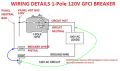
Here is a simple 1 phase breaker.
Earth ground and Neutral are connect together somewhere. Usually at the main panel but newer housed require a disconnect on the outside of the house for the fire department. (for some reason then don't like spraying water on a live house) Now the Ground to Neutral connection is at the disconnect. I have seen it at the meter box, sometimes at the pole. See blue line.

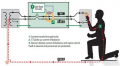
Power flows on Line to the load and returns on Neutral. What the breaker is looking for is current shown by the green line. Example, touching a live wire and water in the sink. The breaker will open when current flow in the wrong place.

In the picture there is a circle in the breaker. That is a differential transformer. It compares current flow in L and N. If there is a difference of more than 5mA the breaker opens.

It does not matter where L and G are connected together as long as it is before the breaker.
Arguably, G and N are the same thing, but N carries current, and G does not. (under normal conditions)
1758374701410.png
1758375217571.png
 
Last edited:

Thread Starter

Roxford

Joined Sep 19, 2025
7
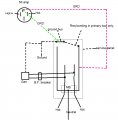
I fully appreciate the detailed responses. In my drawing, the Gen & backfeed breaker are OFF. With the red ground the M.B. will not come on. System functions fine with green ground. No load on receptacle. There are several other GFI in the panel, but I don't think they can influence the behavior of the M.B. I still can't apply the GFI theory to my drawing and understand the observed behavior unless the "required bonding" is not present in the new service panels.breakermystery.jpgbreakermystery.jpg
 

michael8

Joined Jan 11, 2015
472
That is the kind of answer I was looking for. BUT if the neutral and ground bars are bonded by regulation, wouldn't that make the Gound fault detection process result in a shut down all the time? Does the position of the bonding screw (upstream/downstream) in the circuit become critical in this circuit. Bonded bus bars are at zero potential. It seems to me that the required bonding would nullify the intended advancement.
There are two check made by the breaker:
A. the inbalance between the neutral and line currents.
B. the neutral short to ground check.

The way B works is that the breaker injects a signal into T1 and tries to sense it on T2. T1 and T2 are only coupled if
a wire loop links them. The upstream neutral is grounded (somewhere, service likely). The down stream neutral
isn't supposed to be grounded. If the downstream neutral shorts to ground that will complete the loop:

service neutral -> breaker (T1, T2) -> circuit with ground short -> ground -> service netural
 

Thread Starter

Roxford

Joined Sep 19, 2025
7
Please address how bonding between neutral & ground in my drawing does not affect your explanation. The sensing done by the main breaker must be affected by the bonding in my way of looking at the question.
 

michael8

Joined Jan 11, 2015
472
Top