Semiconductor heating

nsaspook

Joined Aug 27, 2009
16,321
I'm guessing that the industry is trying to avoid the switch to other materials, since the cost of developing new equipment and processes for the new materials, and replacing the old technology, would be substantial.
Exactly, the next generation silicon R&D is done but the price is unreal. Just imagine the cost for scrapping that for something new without a 50 year track record of successes IRT performance.
 

cmartinez

Joined Jan 17, 2007
8,760
Exactly, the next generation silicon R&D is done but the price is unreal. Just imagine the cost for scrapping that for something new without a 50 year track record of successes IRT performance.
I know... but eventually the industry will be brought down into a corner, and start producing alternatives, albeit initially at a far greater cost.
Remember how expensive LCD screens used to be compared to CRTs?
 

nsaspook

Joined Aug 27, 2009
16,321
I know... but eventually the industry will be brought down into a corner, and start producing alternatives, albeit initially at a far greater cost.
Remember how expensive LCD screens used to be compared to CRTs?
LCD screen process technology piggybacked existing and mature thin film deposition process semiconductor methods. The trick to lower prices was the economics of scale and improved process equipment not a new device model that's fundamentally different in the applied science. Most people in the industry expect the last pure silicon based chips at 10nm with hybrid exotics to 7nm and below at huge costs that are unnecessary for today's cutting-edge 16nm/14nm processes. After 7nm is where new materials start to be needed.

http://semiengineering.com/10nm-versus-7nm/
 

cmartinez

Joined Jan 17, 2007
8,760
LCD screen process technology piggybacked existing and mature thin film deposition process semiconductor methods. The trick to lower prices was the economics of scale and improved process equipment not a new device model that's fundamentally different in the applied science. Most people in the industry expect the last pure silicon based chips at 10nm with hybrid exotics to 7nm and below at huge costs that are unnecessary for today's cutting-edge 16nm/14nm processes. After 7nm is where new materials start to be needed.

http://semiengineering.com/10nm-versus-7nm/
Interesting... how many years do you think it will take for 7nm to become predominant, and after that, for new material technology to start supplanting silicone?
My guess is that new material technology will first hit mainframes, and migrate downwards from there. We're probably 15-20 years from that point.
 

nsaspook

Joined Aug 27, 2009
16,321
Interesting... how many years do you think it will take for 7nm to become predominant, and after that, for new material technology to start supplanting silicone?
My guess is that new material technology will first hit mainframes, and migrate downwards from there. We're probably 15-20 years from that point.
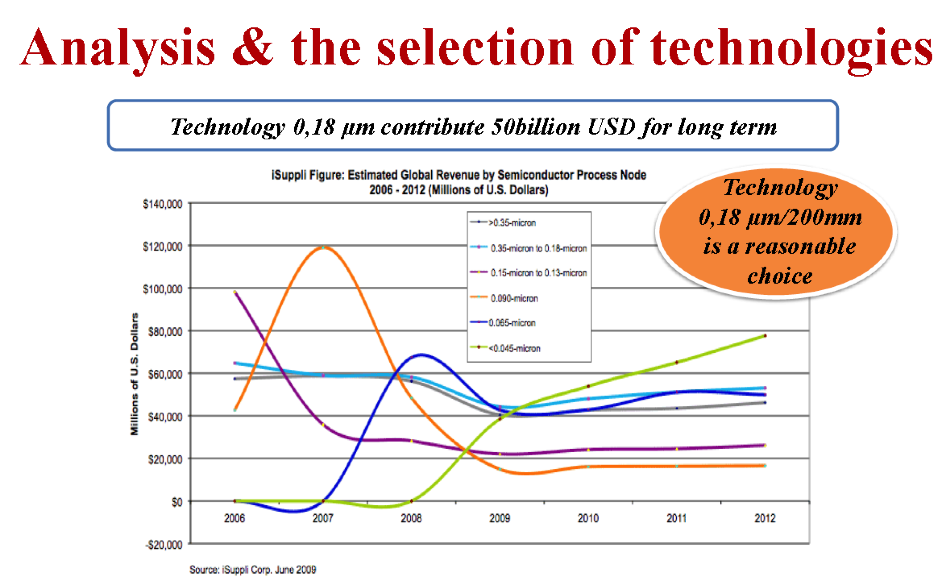
It's hard to say as a large segment of the industry is not even close to cutting-edge on the die size/line width but still make very competitive products with 150-200mm wafers on 20yo hand-me-downs from the top tier manufacturers.


GopherT

Joined Nov 23, 2012
8,009
Interesting... how many years do you think it will take for 7nm to become predominant, and after that, for new material technology to start supplanting silicone?
My guess is that new material technology will first hit mainframes, and migrate downwards from there. We're probably 15-20 years from that point.
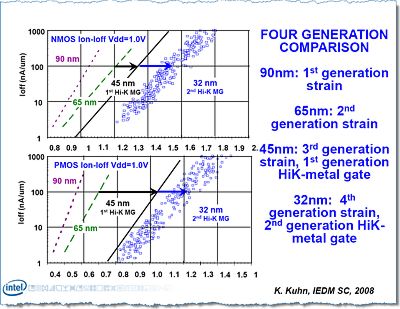
Three technologies are on the horizon. Silicon with some Ge is the easiest to implement (IBM innovation) also called strained silicon. It allows silicon to become a high electron mobility material. Allows higher conductivity in on state (at very low gate voltages) and true off states.

Another high electron mobility material is Silicon carbide. Main advantage is very high temp with no damage. Some mosfets are in the market for high current applications (see digikey). No ICs in production yet. 40 to 100 GHz are estimate operating speeds with reasonable efficiency.

Gallium Nitride (GaN) capable of 100's of GHz. Same material as high brightness LEDs. Most LEDs are just Ga and N layers on a (synthetic) sapphire substrate. ICs and CPUs must be built on GaN - this is very expensive to purify as a single crystal material. If it ever happens, it will be some years off in ICs. international rectifier and one other company are making mosfets from GaN. Unfortunately for them, advances in Si Mosfets are keeping up with GaN advances in the past 4 years since they were launched.
 
Top