Seeking Assistance with Ceramic Fuses.

Thread Starter

Synoptic12

Joined Jan 23, 2026
32
Breaking capacity is different from fusing current.
If you connect it across the mains on a current range, whether it fuses at 600mA or 630mA is the least of your worries. It's far more important to know that it is going to break the circuit rather then strike an arc and start a fire.

Considering that the spec doesn't say whether it is Fast blow time delay, I haven't much confidence in the rating. 600mA is not a standard value, 630mA is.
It is "not" 'Time Delay or Slow' rather "Fast". If that was not clear, it is now. Even if 600mA is 'not standard'; the only 630mA I believe is glass and I have no intention of using glass: "none".
 

Thread Starter

Synoptic12

Joined Jan 23, 2026
32
Not clear to me. The manual doesn't appear to specify.
The Crenova MS8233D 6000-count multimeter uses two built-in fuses for overload protection on its current ranges: a fast-acting fuse (F600mA/250V) for the mA/µA range and a fast-acting ceramic fuse (F10A/250V) for the 10A range.
* * Note on Replacement: It is highly recommended to replace these with high-rupture capacity (HRC) ceramic fuses of the same size and rating, rather than glass fuses, to ensure safety, particularly when measuring higher current.
** Hopefully, that clarifies the issue to hopefully your satisfaction.
 

Thread Starter

Synoptic12

Joined Jan 23, 2026
32
Addendum
For clarification purposes:

Fuse Specifications for Crenova MS8233D:
1.) µA / mA Range: F600mAx250V (Fast-acting)
2.) 10A Range: F10Ax250V (Fast-acting)
Key Details:
A.) Protection Type: The fuses are intended for overload protection, specifically for the µA, mA, and 10A measurement terminals.
B.) Physical Type: While the manual often lists them generally as "fuses," these are typically ceramic or glass tube, fast-blow types commonly found in budget to mid-range multimeters.
C.) Safety Rating: The meter complies with IEC61010-1 CAT III 600V safety standard.

*Note: It is highly recommended to replace these with identical fast-acting (F) rated fuses of the same physical size, voltage, and amperage to ensure the meter continues to protect against overloads.

* No indication of bullet inclusion in formatting. In this respect I have used numerical and letter designations. Hopefully that should suffice.
 
Last edited:

Thread Starter

Synoptic12

Joined Jan 23, 2026
32
Supplement
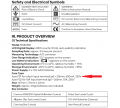
FS1 and FS2 are generally labels for distinct, individual fuses within a single electronic device or circuit, rather than two competing types of fuse technologies (like fast-acting vs. slow-blow). They differ based on their designated location in a circuit, their specific amp/volt ratings, and what component they are designed to protect

The "F" (Fast-Acting) designation means both fuses are designed to open instantly when a fault current occurs to protect the multimeter's internal shunt resistors and the user >i.e. "Multimeters". They are not designed to withstand transient inrush currents (which is what slow-blow fuses are for).
* If I am wrong as to the "F" notating (Fast Acting), please correct me. However, I would only believe that the FS1 and FS2 denoted in the FUSE TYPE: Below may possibly be construed as "Fast".
Again, If that information is incorrect, then you may correct me.
Crenova MS8233D FUSES - Copy.png
 

MisterBill2

Joined Jan 23, 2018
27,785
Several years ago I learned that the fuse does not always protect anything. A visiting tech grabbed a 3 1/2 digit DMM that I had been using to measure DC amps with, and I had not unplugged the leads. The fool set the switch to the 1000 volts AC range and probed between phases of a 460 volt 30 amp feeder. Not only did he burn his hands and the leads and the probes, he also blew up the meter, leaving char marks on the front by the lead connections. It never popped the 30 amp 600 volt fuses, though.
It did cause a lot of excitement, though.
 

Ian0

Joined Aug 7, 2020
13,165
Several years ago I learned that the fuse does not always protect anything. A visiting tech grabbed a 3 1/2 digit DMM that I had been using to measure DC amps with, and I had not unplugged the leads. The fool set the switch to the 1000 volts AC range and probed between phases of a 460 volt 30 amp feeder. Not only did he burn his hands and the leads and the probes, he also blew up the meter, leaving char marks on the front by the lead connections. It never popped the 30 amp 600 volt fuses, though.
It did cause a lot of excitement, though.
I had one like that. With separate sockets for high current and low current measurement? It only had a fuse on the low current socket.
Presumably they thought that the thick piece if wire that formed the shunt could take care of itself. . .
 
Top