Searching for "Voltage Divider + Op Amp Buffer" IC

Thread Starter

Marshall Folkman

Joined Oct 3, 2016
6
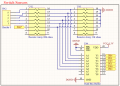
I am currently using the following circuit in my design: (See Attached Image)

I am trying to figure out if anybody makes an IC chip to do this very thing. This is a very common circuit, Yet somehow I can't seem to find a package that accomplishes this very thing in one IC. I am trying to save PCB space and maybe even cost.

Does anybody have any knowledge of a company that sells such devices?

Thanks!

Marshall
 

Attachments

LesJones

Joined Jan 8, 2017
4,511
I don't think that you will find an single IC to do what you want. The resistor packs form a logic level converter that reces 10 volt logic signals to 3.3 volts signals. The IC is a tristate buffer that makes the data available on a data bus when it is required. It is probably enabled by an address decoder. I don't even think that a 10 volt to 3.3 volt level converter would be that common as 10 volts is not a normal logic signal level. (3.3 volts is common.)

Les
 

wayneh

Joined Sep 9, 2010
18,104
It's not any better, but you could use 6 zeners to replace U43. Depending on the current source capacity of the incoming signals, maybe you could even do away with U42.
 

dl324

Joined Mar 30, 2015
18,326
Does anybody have any knowledge of a company that sells such devices?
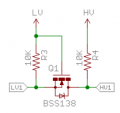
Many companies sell a 4-wide bi-directional level shifter. This is a schematic from Sparkfun:
upload_2017-3-25_8-47-44.png
You can buy them on AliExpress for a fraction of the price at Sparkfun...

The BSS138 is good for voltages less than 20V.

8-wide level shifters are available, but they're much more limited in voltage and I haven't seen one for greater than about 5V.

To save space, you'll have to design your own because these boards are around the size of a postage stamp.
 

dl324

Joined Mar 30, 2015
18,326
I never realized what a level shifter was for.
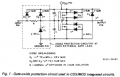
Be aware that CD4050 and CD4049 are in a class of CMOS logic that don't have an input protection diode to VCC.

If you attempt high to low voltage level shifting with gates that have said protection diodes, you will likely destroy the part because too much current forced into a protection diode can cause the device to crowbar the power supply.
 
Last edited:

Thread Starter

Marshall Folkman

Joined Oct 3, 2016
6
Be aware that CD4050 and CD4049 are in a class of CMOS logic that don't have an input protection diode to VCC.

If you attempt high to low voltage level shifting with gates that have said protection diodes, you will likely destroy the part because too much current forced into a protection diode can cause the device to crowbar the power supply.
dl324,

Sorry for the very delayed response, but could you better explain what you mean by this statement? Maybe draw a diagram or something? I am ready to try this approach using the CD4050 IC, but I want to make sure I am conducting automotive grade practices. Thank you!
 

BillB3857

Joined Feb 28, 2009
2,573

Thread Starter

Marshall Folkman

Joined Oct 3, 2016
6
Have you thought of using SIP resistors? They come in a variety of internal connection styles and number of resistors per package.
Here is but one example ....
http://www.mouser.com/ProductDetail/Bourns/4609X-101-472LF/?qs=6yLoizYthp6x52D9SeHB4A==&gclid=EAIaIQobChMIhIjmsoa61gIVArbACh3WMQ9hEAQYASABEgKaafD_BwE

Look at the data sheet shown as a link, and then at the 104 style. You may need to modify circuit slightly to use it, but it shouldn't be too difficult.
BillB3857,

That really is a good idea! My only problem with that would be that I am also trying hard to keep things in SMD form. I'm picky I know.

Marshall
 

Tonyr1084

Joined Sep 24, 2015
9,744
What's the reason why you've used 68KΩ and 33KΩ? I see you're using roughly a 1/3 to 2/3 combination. Is there any reason you can't use a lower resistance? I was looking at the common resistors you get in the 104 series (the 4606-xxx-xxx)? The 4606-181-391 seems to have approximately the same ratio you've set up in your diagram. At 10 volts, you're going to draw 17.5mA of current. Depending on the signal source, is that going to be a problem?

10 / (180 + 390) = 0.01754 amps
 

Thread Starter

Marshall Folkman

Joined Oct 3, 2016
6
What's the reason why you've used 68KΩ and 33KΩ? I see you're using roughly a 1/3 to 2/3 combination. Is there any reason you can't use a lower resistance? I was looking at the common resistors you get in the 104 series (the 4606-xxx-xxx)? The 4606-181-391 seems to have approximately the same ratio you've set up in your diagram. At 10 volts, you're going to draw 17.5mA of current. Depending on the signal source, is that going to be a problem?

10 / (180 + 390) = 0.01754 amps
Tonyr1084,

The problem with this is that it will use more energy, which will in-turn degrade gas-mileage. Just kidding. No this shouldn't be a problem. Thank you for the suggestion!

Marshall
 

Tonyr1084

Joined Sep 24, 2015
9,744
OK. Not sure I understand your exact application but at 68K & 33K (assuming a max of 10 volts) you're running 99 µA of current. To be honest, I don't really see how using 18mA versus 99µA is going to make that much difference in gas mileage; but if this is the constraints you set then I'll accept that for what it is.

Out of curiosity sake, 18 mA at 10 volts is only 180mW (milli watts). That's the equivalent of 0.0000235 HP. Or, 1/42553 of one horse power. Honestly I don't see either requirement having virtually any effect on horse power or gas mileage. That's just a VERY TINY fraction of a single horse power.

Since you mentioned "Automotive Grade" I'm assuming this is a car. (for the sake of argument, lets assume it is) An automotive electrical system typically runs between 13.6 and 14.4 volts. Not sure where you're getting 10 volts from, but again, we don't know your exact application. And it sounds like you don't care to share with us exactly what you're trying to accomplish. So take it or leave it, these are just my opinions, and my opinion and a dollar and a quarter will get you a cup of coffee. (used to be a quarter)
 

GopherT

Joined Nov 23, 2012
8,009
OK. Not sure I understand your exact application but at 68K & 33K (assuming a max of 10 volts) you're running 99 µA of current. To be honest, I don't really see how using 18mA versus 99µA is going to make that much difference in gas mileage; but if this is the constraints you set then I'll accept that for what it is.

Out of curiosity sake, 18 mA at 10 volts is only 180mW (milli watts). That's the equivalent of 0.0000235 HP. Or, 1/42553 of one horse power. Honestly I don't see either requirement having virtually any effect on horse power or gas mileage. That's just a VERY TINY fraction of a single horse power.

Since you mentioned "Automotive Grade" I'm assuming this is a car. (for the sake of argument, lets assume it is) An automotive electrical system typically runs between 13.6 and 14.4 volts. Not sure where you're getting 10 volts from, but again, we don't know your exact application. And it sounds like you don't care to share with us exactly what you're trying to accomplish. So take it or leave it, these are just my opinions, and my opinion and a dollar and a quarter will get you a cup of coffee. (used to be a quarter)

You didn't see the part of the gas mileage comment where he said "just kidding"?
 

Tonyr1084

Joined Sep 24, 2015
9,744
You didn't see the part of the gas mileage comment where he said "just kidding"?
No. Sometimes I read too fast and just assume I know what's being said. My bad. By the time I saw that I had already posted my comment.

Gotta learn to slow down and read complete sentences. The wife complains I do this all the time to her too. She starts talking about her spare tire and before I know it we're discussing designer purses, and I'm still talking about tread wear and balancing. Or maybe it's her fault. I don't know. What were we talking about?
 
Top