Facebook
 Google
 GitHub
 Linkedin

I am creating a new thread, since the original thread's topic is not directly related to the problem I'm trying to solve. I've also taken the liberty of quoting said thread's participants who were kind enough to answer my questions and offered advice, for the purpose of letting them know that the topic being discussed has been moved here.
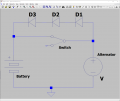
Anyway, the simplest idea so far was proposed by crutschow: Use two or three normal silicon diodes in series with a high current capability so as to take advantage of their inherent voltage drop. Said voltage drop would prevent current produced by the alternator from reaching the battery the switch has been opened, but the diodes would start conducting if the alternator's voltage exceeds that of the battery by the amount of voltage being dropped by the diodes.
This is what I gathered from the way he described his idea:
The diodes I am planning to use are Infineon Technologies' IDWD150E65E7XKSA1, which have the voltage drop curve shown below:
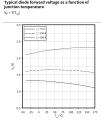
Said diode is rated at 200A, so it should be enough to protect the car's electrical system for the half a second or so that the alternator's voltage surge is expected to last.
Any thoughts or comments?
Now I get it, the response time of the alternator regulation system is slow, when the battery impedance is removed, the voltage soars!
I worked in the automotive electronics industry for 15 years. I can tell you that those products are fully characterized and protected for load dumps and many other abnormal events.
You could also likely use three ≥100A standard (not Schottky) silicon diodes in series to perform the protection function.
You should limit it to at most 0.3C if you care about battery life. You can push it harder if the battery is near being flat but the LA electrochemistry starts to be pretty lossy near 80% Soc so it starts to get hot (warping plates and degrading separators). Regulate the charging voltage to limit current and them limit that voltage to stop gassing.
Recap: I want to install a battery disconnect switch in my car, but I want to protect its operation by making sure that if some idiot (such as me) has the bright idea of disconnecting the battery while the motor is running and the alternator is delivering a considerable amount of current. The protection is needed because under said scenario, the instant the battery gets disconnected, then the alternator would experience a sudden increase in its output voltage due to its internal regulator being too slow to react. If that were to happen, the car's entire electronics (including the alternator's internal diodes themselves) would be fried ... and that would be a rather undesirable outcome ... This can happen because the battery in the car also acts as an overvoltage dampener of sorts. And if said dampener is suddenly removed, it could have very adverse effects under the aforementioned circumstances.Would two (or three) of these diodes do the trick?
Anyway, the simplest idea so far was proposed by crutschow: Use two or three normal silicon diodes in series with a high current capability so as to take advantage of their inherent voltage drop. Said voltage drop would prevent current produced by the alternator from reaching the battery the switch has been opened, but the diodes would start conducting if the alternator's voltage exceeds that of the battery by the amount of voltage being dropped by the diodes.
This is what I gathered from the way he described his idea:
The diodes I am planning to use are Infineon Technologies' IDWD150E65E7XKSA1, which have the voltage drop curve shown below:
Said diode is rated at 200A, so it should be enough to protect the car's electrical system for the half a second or so that the alternator's voltage surge is expected to last.
Any thoughts or comments?
Attachments
-
931 bytes Views: 0