How to accurately and safely read high voltage DC

Thread Starter

samshabz

Joined Jan 18, 2025
9
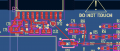
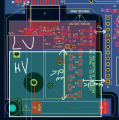
Hi all. This is my circuit to read HVDC (up to 1 kV). It scales it down, with selectable jumpers for different electric vehicles and uses a fuse and varistor for initial safety. The signal gets passed through a simple RC filter, with R being the parallel combination of the resistive divider network, and C being adjustable via jumpers again. The Zener is to clamp it to within the AMC131M01DFMR's range, and also provides some capacitance. The AMC has 1.2 kV working Isolation voltage and its own internal isolated supply. The left, floating side, floats at HV-. It consists of a 24-bit, sigma-delta supply that samples at, last I recall, 4 MHz. I supply the non-isolated side with +3V3 and an 8 MHz clock signal. I followed the design practices of similar AMC modules to ensure the isolated supply is clean. I am using the ESP32S2 MCU (Wemos S2 mini) to interface with it via SPI, with another SPI signal on the same bus. I am not yet sure what rate I will read at, but I only report to the cloud at 1 Hz. On my PCB I have kept clearance above 0.5 mm, which is bigger than the 0.33 mm/kv requirement for air breakdown. I have seen many different numbers for clearance/creepage, some almost a cm. But it's not specified really whether thats between nodes with large potential differences e.g., HV+ and HV-, or between any two components in the entire High Voltage circuit. It would require more space than I can afford to place each component mm's apart. However, I have put 3 mm space between the HVDC zone and the rest of the board (top and bottom layer traces and pour). And many protective warnings. Between the nodes with a large potential difference is >1 cm, unless someone doesnt connect the jumpers correctly - to the selectable resistors - in which case it's about 0.5 mm; im not sure if its reasonable to plan for that. It's a Masters project, so it doesn't have to strictly comply to standards but naturally it should be sufficient. I would like to read as accurately as possible, the resistors are 0.1%, so I think sub 0.5% accuracy is achievable and ideal given the AMC's accuracy. Am I missing anything important or does this look like it will work?
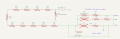
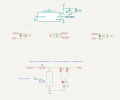
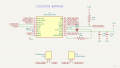
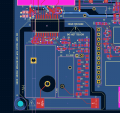
1753121908822.png
1753122575477.png
1753122588290.png

1753122634703.png1753122643257.png
 

Hymie

Joined Mar 30, 2018
1,347
The safe creepage/clearance distance requirements is a complex topic – but based on your circuit description, you have an earthed HV circuit and an earthed low voltage circuit (SELV/ES1), which require Basic insulation/separation between the circuits.

Based on the safety standard for IT equipment (IEC/EN 62368-1), at 1,250V the minimum required creepage distance is 12.5mm.

You may now be thinking that there is no way that your circuit can comply with the above requirement; besides your limited pcb size, the isolation barrier component (IC1) does not have this level of separation.

But all is not lost – since each of your 240kΩ resistors will be reducing the voltage by 120V.
You can now calculate the voltage at the low end of each of the 240kΩ resistors and then the required separation at this location based on this voltage (over the voltage range of interest, the minimum creepage distance requirement is 1.0mm/100V).

As an example, the voltage at the low end of the fifth 240kΩ resistor will be circa 600V, with a minimum creepage distance separation requirement of 6.0mm.

In giving the above solution/advice I have made a number of assumptions about the circuit, most importantly is that the circuit is connected to a real world earth (and that your GND is not just a zero volt reference).

There are other potential solutions which include using a better grade pcb material and/or considering the current that would flow as a result of shorting the insulation.

If you are unable to meet the above separation requirements with a re-design of the pcb layout – post again and I will see if I can advise further.
 

Thread Starter

samshabz

Joined Jan 18, 2025
9
Hi Hymie

Thank you for your detailed reply. I have a few questions if you wouldn't mind to help me wrap my head around this?
1. The isolation barrier of IC1 does not meet the creepage; what is the point of it stating 5kV isolation, and 1.2kV working isolation if it will not comply or work - is it meant to be used in conjunction with something else?
2. With regards to the assumption, this is in an electric vehicle - well it should work in any electric vehicle not a specific one - so typically chassis = HV-, and that is not equal to LV-. So in that sense it's not tied into the actual Earth. I cant say exactly what the difference in potential between those two references are.
3. With respect to the clearance, is this invariant to the drop in potential-i.e. if a node is 800V all other nodes no matter their potential must be 8mm away, or only between nodes which are of that difference in potential. For instance, from the first resistor to the second resistor, the voltage drop is 80 V (800 V to 720 V), must this be rated for the 800 V clearance (8mm) or only the 80V drop (0.8mm). Or does clearance only matter relative to components which have that potential difference, either two nodes both inside the high voltage side with very different potentials, or between the high voltage side and any node in the LV side. I can probably make the spacing work if it is only between nodes which have that drop in potential, otherwise I'm not sure.
4. This is my Masters projects, if it so happens that I cant meet the standard (I will try my best to), is it appropriate to state this must be fixed in commercial use but will work as a model as there will be no air breakdown, and the environment will be kept clean?
 

Hymie

Joined Mar 30, 2018
1,347
In answer to your specific questions:-

  • Many opto-couplers (and similar isolation devices) have an isolation voltage rating in the few kV range, but do not meet the minimum creepage distance requirements (across the barrier) for such voltages. The reason for this is that in many applications the isolation device is required to withstand the circuit mains transient voltages (which can be greater than 2kV).
    It is possible to design a circuit having the kV voltages directly across the isolation device, but additional safeguards would need to be in place.

  • With no real world earth connection, potentially the minimum creeapge distance requirement doubles.

  • The separation requirements only apply across the barrier; where your HV circuit potential is at 800V, you would need a minimum of 8mm between this point and the low voltage circuit. Within the HV circuit, the only requirement is that with any single component (or creepage distance for a given voltage) short circuit – the unit fails safe (does not result in a fire/electric shock hazard etc).

  • An alternative approach in achieving a safe circuit design is to consider the available current after each dropper resistor.
    The safety standard (IEC/EN 62368-1) considers a dc current of up to 2mA safe to touch. Therefore with a 1,000Vdc source, a point connected via a resistance of >0.5MΩ would meet this current requirement.

    However the minimum creepage distance requirement would still apply across this resistance and with a single resistor short circuit the current limit of 2mA still met.
    Therefore with a series chain of 3 resistors (each of 250kΩ) and the creepage distance from the HV source to the low end of the third resistor being at least 10mm, you may have a safe design – there would then be no creepage distance requirements from the low end of the third resistor to the low voltage circuit. Bear in mind that if using surface mount resistors, the creepage distance across each of the 3 resistors would need to be at least 3.33mm.


Other – EVs voltages are at lethal potentials, great care should be taken in your circuit design/construction to avoid the possibility of an electric shock hazard. If someone was to reverse the HV connections on your circuit, the LV part would be at the vehicle battery positive potential. Your final design should include some form of enclosure for the pcb, such that parts at hazardous voltages cannot be touched (you cannot rely on a warning sign).
 

Thread Starter

samshabz

Joined Jan 18, 2025
9
Thank you very much for the help. I have made the relevant changes. My circuit uses 2.4MOhm, with 10 240Kohm resistors. So the current is 0.3333 mA, even if one shorts the circuit will not draw near 2 mA. The resistors are also spaced enough apart such that they will not arc in air. So within the circuit this seems safe.
I have moved the 240kohm resistors in the scaling part to >10 mm away from the low voltage side. Specifically, any node in the high voltage circuit that is also carrying high voltages relative to HV- is >10 mm away from the low voltage side.
The voltages in the HV side which are already scaled down, e.g., sitting at 2V relative to HV-, are not as far away from the LV circuit. Around 5 mm as in picture. Which seems fine according to what you have said. But my worry is as you said about doubling the creepage; is this some sort of assumption that in isolated domains the low voltage side sits at a difference in potential less than or equal to the difference in potential between HV- and HV+? For instance, HV- to HV+ is 800V, therefore LV- to HV- is at worst also 800V lower than HV- (and hence, 1600V between LV- and HV+). Is this what you are trying to say? I dont understand the physics behind this. I can't seem to find any more space to do this either? Do you think it is necessary?

And yes, please do let me know if anything else is off. Thanks a lot!


Picture description: This shows the high voltage zone. The Low voltage part of the high voltage circuit is the red box I made, the green box is the HV part of the HV circuit. all measurements in mm between zones or parts.

1753211063204.png
 

Hymie

Joined Mar 30, 2018
1,347
Looking at the pcb layout, one of the concerns I have is what is a conductive area, and what is not (completely devoid of copper).

It would appear that only the black/dark area of the pcb is devoid of copper, and that otherwise most of the board area is flooded with copper.

If the light blue coloured HV area is conductive material, then you do not have the claimed 10mm to the low voltage circuit – the actual creepage distance will be the distance from the resistor solder pad to the conductive light blue area, plus the distance between this conductive light blue area and the low voltage circuit.
So to have the claimed 10mm separation, the light blue area must not be conductive material.

I know that it is common practice to leave much of pcb areas flooded with copper where they are either at zero volts or earthed, but where isolation is required, this (flooding of the pcb area) is best avoided.
 

Hymie

Joined Mar 30, 2018
1,347
In relation to my comment that where there is no earth connection, the minimum creepage distance requirements double, is based on an older safety standard (IEC/EN 60950-1).
This standard required Basic insulation between a high voltage circuit and an earthed SELV circuit, but where the SELV circuit is unearthed required Reinforced insulation (which doubles the distance).

However the newer IT safety standard (IEC/EN 62368-1) does not mandate such a separation – but rather considers that if the required separation between circuits is present then the insulation is not subject to a short circuit test. Or as in your example, with the 10mm only representing Basic insulation, with the insulation short circuit – the low voltage circuit must remain within 120Vdc or a current flow of <25mA.

Without conducting a test, but by circuit analysis, it is unlikely that if the +HV is shorted to the SELV circuit, that the above voltage/current limit would be met (for the SELV circuit).

One method of meeting the above requirement would be to incorporate a suitable value resistance within the lead that connects the vehicle battery positive to your pcb.
 

Thread Starter

samshabz

Joined Jan 18, 2025
9
Hi Hymie. Sorry for the late reply. This makes sense. I have sent out the board but anyways will try justify this however possible. The exposed components meet PD2 distance, the pour only meets PD1 distance, but is covered by solder mask (no condensation or pollution) so maybe its fine to consider under PD1.
Meeting that short circuit requirement depends where this short circuit occurs, ie im not sure at which node I conduct it. Unless the resistor chain is bypassed in this short event it will draw less than 1 mA. If HV_neg = 800 V wrt LV_neg (not sure how this works ) then the voltage requirement will not be met. I am not sure if it must meet both or one. The HV leads could work, would I place them on both HV_pos and HV_neg to ensure 800 V is maybe only 20 V at board side, and then simply adjust firmware to read in the new range ?
Lastly, do I have to now say that board is not touch accessible (considering no inline resistors on the leads) , and in fact the entire car low-side is not touch accessible because of only meeting basic and not reinforced insulation ? Or do I not have to strictly agree with that requirement? And do the on-board resistors get me out of the requirement?
 

Hymie

Joined Mar 30, 2018
1,347
I’ve attached a truncated version of the creepage table from IEC/EN 62368-1.

The numbers I have been quoting are from the 5th column (based on pollution degree 2 and material group IIIa/IIIb) – this is the default position without knowing the material group and an assumed pollution degree 2.

The table’s first column is the rms voltage; it can be seen that for better material groups the required minimum creepage distance (for a given voltage) is reduced.

I should point out that there is a footnote in the table (note a) in relation to the creepage numbers in column 2 (pollution degree 1) – that the sample must pass the standard’s thermal cycling tests to allow these values to be used.

Nevertheless, if your PCB spacings are compliant with the values in any one of the columns, you could claim the intension to use the appropriate material/tests.

If you still need to invoke the limited current flow, following a short circuit of a creepage distance, it is only one point at a time that this is applied – so you would only need the low end of the first resistor to comply (the others would comply due to the resistance in the path/chain increasing). Bear in mind if the HV input to the PCB did not have at least the minimum required creepage distance to the LV circuit, a short of the creepage distance would be applied at this point (which would then need to comply with the stated safe current limit).
 

Attachments

Thread Starter

samshabz

Joined Jan 18, 2025
9
Hi Hymie, thank you for your time. Finally, how do you justify using this specific standard-amongst the many others available? Since it doesnt specifically also say automotive.
 

panic mode

Joined Oct 10, 2011
4,937
clearances seem to be far too small... specially the bottom layer where HV to HGND is only about 3mm. same goes for HGND to GND. and there are no slits in the board.

another thing is that high voltage attracts dust so it will not take long for HV section to covered with a dust layer. and automotive environment is very harsh + dirty. you may want to consider additional coating.
 

Hymie

Joined Mar 30, 2018
1,347
The title of the standard is: Audio/video, information and communication technology equipment (part 1: safety requirements). Your circuit is not untypical of the type covered by this standard.

It could be argued that you could apply IEC/EN 61010-1 (Safety requirements for measurement, control and laboratory equipment) since your circuit is performing a measurement function.

I have attached the equivalent creepage distance table from IEC/EN 61010-1 for comparison purposes.

Both standards derive their creepage/clearance distance requirements from IEC/EN 60664-1, so it is interesting that there are slight differences in interpretation.
 

Attachments

Hymie

Joined Mar 30, 2018
1,347
As part of your Masters submission, it would definitely be a plus point to show that you have considered safety as part of the design – especially in such a circuit as yours, employing hazardous voltages.

But citing some random guy (on the internet) as the source of your information might appear suspect.

I suggest you search the web to see if you can find a copy of the standard you want to claim to have applied – although copyrighted, you could claim ‘fair usage’ and include relevant parts within your documentation for the project.
 

Thread Starter

samshabz

Joined Jan 18, 2025
9
Thanks Hymie, much appreciated-yes indeed interesting to read all of this. Yes I have been able to find a copy, I will do that ! Thanks, again!
 

Hymie

Joined Mar 30, 2018
1,347
In relation to your Masters project, I have no idea whether the circuit will work (do what you want) – no one has replied in answer to this side of your question.

I would recommend you give serious consideration to boxing the PCB (due to the presents of hazardous voltages) or as a minimum, mount it on an insulating piece of material, so that the powered bare PCB is not sitting directly on some (conductive) desk surface.
In terms of boxing the PCB, you could either source a suitably sized enclosure, or get someone to 3d print bespoke parts.

You could also consider adding a panel meter (such as that below), with the facility to switch the meter input to various circuit points (with appropriate scaling), allowing you to easily demonstrate the correct circuit working.

https://www.ebay.co.uk/itm/162869075175
 

Thread Starter

samshabz

Joined Jan 18, 2025
9
Thanks Hymie. Yes I’ve designed the board to sit within a case that is locally made. I agree I shall consider something like this, I think it will make things easier (and safer) !
 

Hymie

Joined Mar 30, 2018
1,347
Final thoughts on your project:-

The isolation IC you have used is normally employed where reinforced separation is required between say, a mains circuit and a low voltage (SELV) circuit. In this application there is no common connection (across the isolation device) between the mains (Live & Neutral) and SELV circuits. However in your circuit the 0V is common. It is possible that your circuit would work in an application where the 0V is not common – just that in the vehicle application, the HV battery and LV circuits share a common connection to the vehicle chassis.

In view of the common 0V, a simpler circuit would be a string of divider resistors having the required separation distance (from the HV input) and a resistance limiting the current to <2mAdc under normal conditions, and <25mAdc under single fault conditions.

Nonetheless your circuit design shows an understanding of the operation of many electronic components connected together in circuit.
 

Thread Starter

samshabz

Joined Jan 18, 2025
9
Hi Hymie. Thanks again this makes sense. From what I thought, typical EVs don’t share chassis-ground, but this could be wrong. I suppose I will have to hope the IC doesn’t break if that’s the case, since then the isolated reference equals the non-isolated reference side.
Thanks, I do appreciate the encouragement ! I will let you know if it doesn’t work and I need your advice again !
 
Top