How to safely run DC motor at max speed with 2P Li-ion battery + keep voltage constant?

Thread Starter

faisal2234

Joined Feb 13, 2025
6
I have a 2P Li-ion battery pack (two cells in parallel, 3.7V nominal, 4.2V full charge).
I want to connect a DC motor directly to this battery.


What things should I check in the motor model/specs to:


  1. Safely run the motor without damage.
  2. Get maximum speed.
  3. Know the current draw and voltage limits.

Also, I want to keep the voltage constant as the battery discharges, so the motor doesn’t slow down when the battery weakens.
What is the best way to do this (simple circuit idea)?


Thank you!
 

Thread Starter

faisal2234

Joined Feb 13, 2025
6
I don’t want to buy a buck converter or ready-made module.
I want to build the voltage control circuit using normal salvaged components (like resistors, diodes, transistors, etc.) to keep the voltage stable while the battery discharges.


Any suggestions for a simple DIY solution using common parts?
 

meth

Joined May 21, 2016
302
Sorry but to me most of this doesn't make sense.

-Safely and Maximum speed dont go together. You must define at which speed the system is no longer "safe".
-If you want to control the speed you need a driver, you cannot simply connect your motor to the batteries. Google PWM driver
-If you want feedback you need to measure the current going into the motor. This can help you also to remain in the "safe" zone but would also probably include some microcontroller

As for the last part... if you succeed to keep the same pace of the motor with the same load with discharged battery, you will probably win a Nobel prize and have your name somewhere next to Tesla :D

I did not mean to mock you but I hope you understand that if you somehow boost to compensate for the lower voltage you will lose current. Something's gotta give buddy.
 
To maintain the constant speed you need a feedback speed regulation since speed is loading torque dependent.

If the torque is constant you can avoid this feedback speed regulator and just maintain a constant current supplying the motor.

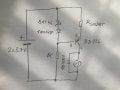
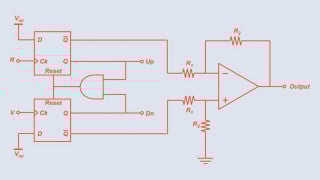
A constant current regulator can be made according this schematic:
IMG_1729.jpeg
The Rshunt is calculated as 0.3/I_motor.
So example in case you want to feed the motor with 50mA you need to use Rshunt about 6 ohm.

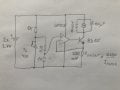
Or more precise with Lm358 op-amp:
IMG_1734.jpeg
 
Last edited:

Alec_t

Joined Sep 17, 2013
15,112
What will the motor be driving? If the motor mechanical load varies, then so must the current if you want to keep the speed constant.
 

Irving

Joined Jan 30, 2016
5,068
As usual, too little information to give a complete and accurate answer. Start with some basics:

1. What motor? Do you have the datasheet?

2. What is it driving? How is it driving it? Is it a constant load? Have you ascertained the mechanical operating conditions?
 

Thread Starter

faisal2234

Joined Feb 13, 2025
6
I am building a small, simple exhaust fan specifically for soldering smoke. I’m not designing something new or fancy—just a basic, functional fan setup. The goal is straightforward: turn on the fan, it runs at its maximum speed, and doesn’t overheat.


I’m using a toy car motor (not CPU fans or CD player motors) because it's easy to get and fits my simple design.


For power, I’m using two Li-ion batteries connected in series (total ~7.4V nominal, 8.4V fully charged) to keep it rechargeable and portable.


After testing, I measured the motor drawing about 2.15A current, and after a few minutes of running, the motor shaft becomes very hot.


I understand that the higher voltage and current are making the motor overheat since these small toy motors are usually designed for lower voltage (around 3V-6V) and lower current.


Goal:


  • Simple ON/OFF operation at full speed
  • No need to control speed
  • Avoid overheating while running from rechargeable batteries
  • Minimal components used


That’s the basic setup. Any advice or simple ideas to keep the motor cool without complicating the design is welcome!
 

MaxHeadRoom

Joined Jul 18, 2013
30,598
I understand that the higher voltage and current are making the motor overheat since these small toy motors are usually designed for lower voltage (around 3V-6V) and lower current.

Any advice or simple ideas to keep the motor cool without complicating the design is welcome!
What is the nature of the fan? Radial or axial?
I would assume the air flow is across the motor?
Depending on the fan type the current goes down as air flow is reduced or restricted.
 

crutschow

Joined Mar 14, 2008
38,418
Not enough info to do a good design.
What is the motor current draw with the fan at the voltage you want to operate at to keep it cool?
 

LowQCab

Joined Nov 6, 2012
5,101
I don’t want to buy a buck converter or ready-made module.
I want to build the voltage control circuit using normal salvaged components (like resistors, diodes, transistors, etc.) to keep the voltage stable while the battery discharges.
Any suggestions for a simple DIY solution using common parts?
.
The biggest problem with this Project is making it Battery-Powered.

Making this fully Regulated with Junk-Drawer-Parts is not even remotely practical.

You might be able to find a ~5-Volt Wall-Wart Power-Supply that could do the job.
.
.
.
 

Irving

Joined Jan 30, 2016
5,068
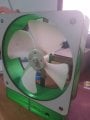
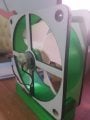
This is an exhaust fan I made I made it with 2 li-ion batteries in parral to make the motor long-term use there is no recharging model in it just a simple 2 li-ion batteries in paral use tocar switch to trun on and off the motor and the motor
Not surprised the motor runs hot, that fan is a massive load for it to turn and it gets almost no cooling from the blades. Do you have any idea how fast the fan actually rotates? Because that motor wants to spin at around 3000 rpm and would normally, in a toy car, have a gear reduction of around 50:1 or more.

At 2A and 4v you are putting 8w of power into the motor and I'd guess maybe 50% of that is lost through heat because the motor is not operating at an efficient speed.
 

MisterBill2

Joined Jan 23, 2018
27,323
I have a 2P Li-ion battery pack (two cells in parallel, 3.7V nominal, 4.2V full charge).
I want to connect a DC motor directly to this battery.


What things should I check in the motor model/specs to:


  1. Safely run the motor without damage.
  2. Get maximum speed.
  3. Know the current draw and voltage limits.

Also, I want to keep the voltage constant as the battery discharges, so the motor doesn’t slow down when the battery weakens.
What is the best way to do this (simple circuit idea)?


Thank you!
There are a few intrinsic contradictions here: First, if you want to run the motor at the maximum safe speed with a fresh battery, it will slow a bit as the battery charge is consumed and the voltage drops. (The reality is that in every direction from a peak, it is down-hill. Second, if you make a direct connection to a battery, the speed will neither be controlled nor constant.

What sort of application do you intend for this motor???
 

crutschow

Joined Mar 14, 2008
38,418
Do you have a variable power supply so you can determine the desired voltage to operate the motor without overheating?
If so, please determine the voltage, and the motor current at that voltage.

I have a simple switching switching design that should efficiently power the motor but, as LQC noted, it likely can't be done with items from your salvaged, junk electronic parts.
Just buy a cheap, switching-regulator and be done with it.
 

MisterBill2

Joined Jan 23, 2018
27,323
The suitable speed control arrangement depends a whole lot on the intended application of the motor.. Powering a conveyor is a lot different from powering a blower, a pump, or a fan. and powering a race car or a motorcycle is different yet.
 

Irving

Joined Jan 30, 2016
5,068
The suitable speed control arrangement depends a whole lot on the intended application of the motor.. Powering a conveyor is a lot different from powering a blower, a pump, or a fan. and powering a race car or a motorcycle is different yet.
The OP already said the application is "soldering fume extraction" and it appears he's made his own (3D printed?) fan and cage as per pictures. But a fan that size probably turns at 500 - 1000rpm, whereas the motor probably wants to be running at 3000rpm for peak efficiency. The poor motor is running under extreme load and is overheating, and is probably not long for this life! A PWM speed control isn't really going to help here, as the mismatch between mechanical load and the motor's achievable output is significant.
 

MisterBill2

Joined Jan 23, 2018
27,323
OK on the fan application, not sure how I missed those color pictures. But the pictures show that the motor is indeed a brush type permanent magnet motor, with a plastic end supporting the brushes. So it is not likely that the motor will outlast the housing and blade parts of the project.
 

MaxHeadRoom

Joined Jul 18, 2013
30,598
So it is an axial fan, and the way it is shown, totally unrestricted, it will be running at maximum current with no air restriction or back pressure.
 
Top