S-Parameters of oscilloscope probe questions (at DC)....

Thread Starter

rdpdo

Joined Nov 2, 2020
17
Hello !

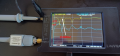
I am trying to measure my probe (1/10 150MHz passive probe) using my LiteVNA, between 10kHz and 1GHz (I have calibrated my LiteVNA for this freq. range). But there are things that puzzle me :
1746037182173.png

  • Why do I get some S21 > -20db at some frequencies.... ? My probe is a passive 1/10 probe, so normally I cannot have any voltage output signal for any freq > 0.1*input_signal because 0.1 is -20db and my probe is passive ... no ??
  • Why S21 is not -20db near DC but minus infinite db ? Normally, as my probe is a passive 1/10, I should get -20db at DC no ??? If I send a DC voltage at input, I should receive a DC -20db voltage at output and not a 0Vdc voltage ....
  • S11 is not an infinite negative value, normally no signal is returned at DC no ??

It seems S21 and S11 are inversed at DC... Any idea ???

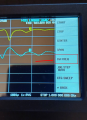
And also, in the "Stimulus" menu, there is an option I don't know how to configure : CW FREQ... perhaps it's because I have not set it correctly ? And also the CENTER Freq ??
1746037213446.png


Thanks you !!
 

ronsimpson

Joined Oct 7, 2019
4,646
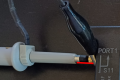
The scope probe ground clip is too long to get a good measurement about 50mhz.
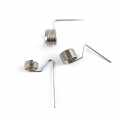
They make a scope probe socket, but you can make one. Make a short connection where the red line is. Your probes came with a spring that goes around the probe ground and connects to a PCB.
1746040210506.png

1746040360955.png
 

0ri0n

Joined Jan 7, 2025
160
It seems S21 and S11 are inversed at DC... Any idea ???
The VNA uses AC coupling at the transmitting and receiving port and can neither transmit DC nor detect any transmission or reflection at DC.

There is a 9M series resistor, in parallel with a small, variable capacitor, close to the tip in your 10:1 probe. Your VNA has, contrary to a scope, only 50 Ohm input impedance. With that kind of resistive divider, forward transmission will be close to zero (very large |S21|) at very low frequencies.
At the same very low frequencies and because of the 9M series resistor, all the power from the generator is reflected back. There is no return loss which makes S11 = 0dB.
 

ronsimpson

Joined Oct 7, 2019
4,646
Interesting point, the probe is built for a 1M 20pF load not a 50 ohm load. I have a preamp for a VNA that had 1M input and 50 ohms on the output.
 

Thread Starter

rdpdo

Joined Nov 2, 2020
17
The VNA uses AC coupling at the transmitting and receiving port and can neither transmit DC nor detect any transmission or reflection at DC.

There is a 9M series resistor, in parallel with a small, variable capacitor, close to the tip in your 10:1 probe. Your VNA has, contrary to a scope, only 50 Ohm input impedance. With that kind of resistive divider, forward transmission will be close to zero (very large |S21|) at very low frequencies.
At the same very low frequencies and because of the 9M series resistor, all the power from the generator is reflected back. There is no return loss which makes S11 = 0dB.
But for the pure DC value, I should get S21=-20db right ? So if I want to add it in my s-parameters for simulation purpose, can I add this point to my file ? I would like to simulate a voltage step through my probe and so if I not misunderstood I need the value at DC for time when step is constant...?
 
Last edited:

0ri0n

Joined Jan 7, 2025
160
But for the pure DC value, I should get S21=-20db right ?
Only if the load is 1MOhm and DC coupled. That applies to a scope but not to a VNA.

Why do you need to work with S-parameters? You could use any SPICE tool for simulation purposes. You could do a transient analysis, AC sweep analysis, look at impedance etc.
 
Top