RLC ciruits with dc source problems

Thread Starter

asdf arfw

Joined Sep 9, 2017
43
I'm wondering, how do I know which method should I use to solve them.
for example if it was a series RLC ciruit and they want me to find v(t) for t>0.
Should I use KVL or KCL to write an equation or I can use both of them depends on what am I trying to find?
 

MrAl

Joined Jun 17, 2014
13,704
Hi,

Nodal analysis uses the fact that the sum of currents into a node equals zero.
For a series circuit, the sum of voltage drops equals zero.

So you decide :)
 

WBahn

Joined Mar 31, 2012
32,839
KCL isn't going to be of much use with a strictly series circuit.

KVL isn't going to be of much use with a strictly parallel circuit.

For series/parallel combinations, which of these two methods is better suited depends on the circuit topology. Experience will teach you what things make one easier to use than the other.

You will also have available other techniques, such as superposition, delta-wye transformations, Thevenin and Norton equivalents, and a few others. Most of these are hopefully already in your tookkit since they are generally taught with purely resistive circuits.

At some point you will get introduced to transform methods, which is an extremely powerful technique.
 

WBahn

Joined Mar 31, 2012
32,839
BTW: For first-order circuits, Thevenin and Norton equivalent circuits with the reactive element as the load are hard to beat. For second order circuits they are very powerful if the L and C can be isolated as the load with few (ideally no) other components.
 

MrAl

Joined Jun 17, 2014
13,704
KCL isn't going to be of much use with a strictly series circuit.

KVL isn't going to be of much use with a strictly parallel circuit.

For series/parallel combinations, which of these two methods is better suited depends on the circuit topology. Experience will teach you what things make one easier to use than the other.

You will also have available other techniques, such as superposition, delta-wye transformations, Thevenin and Norton equivalents, and a few others. Most of these are hopefully already in your tookkit since they are generally taught with purely resistive circuits.

At some point you will get introduced to transform methods, which is an extremely powerful technique.
Hi,

Dont know how much difference this makes to you but one of my circuit analysis programs always uses KCL. It's the heart of nodal analysis.
 

WBahn

Joined Mar 31, 2012
32,839
Most simulators are essentially KCL based because they track the node voltages and branch currents between all nodes with only a single component in each branch. But that doesn't change that KCL is of little use to hand analysis of strictly series circuits.
 

MrAl

Joined Jun 17, 2014
13,704
Most simulators are essentially KCL based because they track the node voltages and branch currents between all nodes with only a single component in each branch. But that doesn't change that KCL is of little use to hand analysis of strictly series circuits.
Hi,

Well strictly speaking, "little use" is still some use and that was really the point of my post. I agree however that many people might not want to do that by hand except as an exercise.
 

WBahn

Joined Mar 31, 2012
32,839
Hi,

Well strictly speaking, "little use" is still some use and that was really the point of my post. I agree however that many people might not want to do that by hand except as an exercise.
Keep in mind that the only reason I didn't say "no use" is because I am generally a believer in "never say never".

I'd like to see a reasonable example of where using KCL in a strictly series circuit is of any real value in the context of the TS's question.
 

MrAl

Joined Jun 17, 2014
13,704
Keep in mind that the only reason I didn't say "no use" is because I am generally a believer in "never say never".

I'd like to see a reasonable example of where using KCL in a strictly series circuit is of any real value in the context of the TS's question.
Hello again,

Well it wont help any to do that because you will find a way to reject that too. You will then argue about what is 'real' and what is not real, and we know that's a philosophical question that comes up now and then. So in short, take or or leave it, and since you probably want to leave it, that's fine too. It's always your choice.

So i say it is of value, you say it is not, that's just the way it will have to stay.
 

WBahn

Joined Mar 31, 2012
32,839
You can reply or not -- your choice and no bad feelings either way.

I'm happy to remove the caveat and rephrase the request because I am genuinely interested in seeing a case in which KCL is useful to the manual analysis of a series circuit:

"I'd like to see an example of where using KCL in a strictly series circuit is of any nontrivial value in the context of the TS's question."

The only thing I am putting as "trivial" is using KCL to establish that the same current is flowing in all of the components since KCL requires that whatever current leaves a terminal of one component must enter the terminal of the component it is connected to.
 

MrAl

Joined Jun 17, 2014
13,704
You can reply or not -- your choice and no bad feelings either way.

I'm happy to remove the caveat and rephrase the request because I am genuinely interested in seeing a case in which KCL is useful to the manual analysis of a series circuit:

"I'd like to see an example of where using KCL in a strictly series circuit is of any nontrivial value in the context of the TS's question."

The only thing I am putting as "trivial" is using KCL to establish that the same current is flowing in all of the components since KCL requires that whatever current leaves a terminal of one component must enter the terminal of the component it is connected to.
Hello again,

That might be one of the best posts i have read of late. Clear, concise, and above all not mocking or name calling. That is really nice to see.
I'll try to get an example posted a little bit later, but i do have to warn that you are using the qualifier, "manual", while i never held myself to that restriction because for one i write my own software and so i look for general ways to handle things that may or may not be so good for a hand drawn set of equations. I rarely have to do that anymore due to my software, so you may not like the example anyway but that will be understandable due to your restriction.
So hopefully a little later or tomorrow morning.

Thanks for the nicely written post :)

Sincerely,
MrAl
 

WBahn

Joined Mar 31, 2012
32,839
I'll try to get an example posted a little bit later, but i do have to warn that you are using the qualifier, "manual", while i never held myself to that restriction because for one i write my own software and so i look for general ways to handle things that may or may not be so good for a hand drawn set of equations.
The "manual" constraint comes from the context of the TS's post. The TS is pretty clearly talking about guidelines for choosing to use KVL or KCL in the analysis of RLC circuits at his level of learning this stuff and it is that post that I was responding to when I said that KCL isn't going to be of much use in the analysis of strictly series circuits. I'm more than willing to admit that I made the assumption that the TS was referring to choosing an analysis technique suitable for his apparent stage of learning and that I was also assuming that he was not considering writing his own simulator as an option on the table when he made his query.

None-the-less, that is the context of the discussion as I see it. If the TS had asked about what analysis techniques to use when writing a simulator, that would have been an entirely different discussion.
 

MrAl

Joined Jun 17, 2014
13,704
The "manual" constraint comes from the context of the TS's post. The TS is pretty clearly talking about guidelines for choosing to use KVL or KCL in the analysis of RLC circuits at his level of learning this stuff and it is that post that I was responding to when I said that KCL isn't going to be of much use in the analysis of strictly series circuits. I'm more than willing to admit that I made the assumption that the TS was referring to choosing an analysis technique suitable for his apparent stage of learning and that I was also assuming that he was not considering writing his own simulator as an option on the table when he made his query.

None-the-less, that is the context of the discussion as I see it. If the TS had asked about what analysis techniques to use when writing a simulator, that would have been an entirely different discussion.
Hi,

Yes i agree there are different ways to do this.
What i was talking about can be done by hand it's not too much of a problem because the resulting equations come out fairly simple.
My main point is that there is no reason to dismiss writing the equations like this but of course there will always be different ways to write equations.

If you wish to discuss the pro's and con's of doing it this way or any other way, perhaps that would be better done in PM's rather than make this thread any more complex.

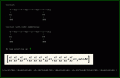
Here's the example i promised. I know not everyone will want to do it this way but i dont make the leap to restrict their mathematical license to a certain technique. If you wish to restrict it that's up to you.
 

Attachments

WBahn

Joined Mar 31, 2012
32,839
Thanks for the example.

So that appears to be brute force application of nodal analysis at all nodes, including nonessential ones. I agree that nodal analysis is just a formalized application of KCL and I definitely agree that brute force application of nodal analysis is at the heart of many (most?) circuit simulators.

For most "hand" work, I think we would agree that this would be cumbersome relative to other approaches.

But, having said that, for people that want a monkey-see, monkey-do one-size-fits-all approach in which they follow the same recipe every time, come up with a large (larger than necessary) set of simultaneous equations, and then plug those equations into a solver, this is a quite viable approach.

I have no fundamental problem with doing so, provided the people doing it understand the underlying basics and have the skills and knowledge to do it by hand. Only then does the use of the approach and the tools to solve the resulting equations stay safely in the realm of tools and not brain-replacement.

But once you DO have the fundamentals well in hand, THEN monkey-see, monkey-do one-size-fits-all recipes serve a very valuable function since systematic approaches tend to reduce errors while also becoming time efficient do to strong familiarity and practice.

Interestingly, as soon as I saw your example it reminded me of an example I did in class one year, off the cuff, just to show that nodal analysis could be applied to a strictly series circuit but that it was not the most efficient way to do it (that was in the context of students having to do all the work by hand -- calculators to crunch numbers only -- to ensure they got down in the weeds with the concepts). I also did an example of a strictly parallel circuit using mesh analysis for the same reason.
 
Top