Resistors and Currents

Thread Starter

Yashiro Isana 1

Joined Apr 12, 2017
12
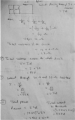
I am confused with the solution I did.
How do I find the current for each resistor when one of the resistors already have current passing through it as per the Question I posted.
And The Total Power in the Circuit
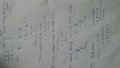
I found out the total voltage in the circuit by adding the resistances given along with the first current given for I could not find the current for the other 2 resistors without knowing the Voltage for the Whole Circuit.
Could someone help me by correcting the mistakes I made.
Tell me and point me out where I went wrong and help me find the Correct solution.
Will be Grateful if someone did. Screenshot_3.png 20170413_202709.jpg
 

WBahn

Joined Mar 31, 2012
32,823
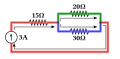
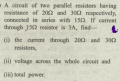
Your circuit drawing is not consistent with the problem statement.

The problem statement really shouldn't have used the term "circuit" because they are not describing a complete circuit, but rather a circuit fragment.

So imagine that current come in from the top, goes through the parallel combination of two resistors, then goes through a third resistor, and then exits the bottom. Somewhere, unseen, a power supply of some kind delivers current to an unseen part of the overall circuit, some of it comes into the top of the circuit fragment that you see, and the current from the bottom of the fragment you see goes back out into rest of the circuit and eventually back to the power supply.

You are asked to find the currents in these three resistors, the total voltage from top to bottom of the fragment you see, and the total power dissipated in just that fragment.
 

dl324

Joined Mar 30, 2015
18,326
Check the voltage used in part i and the information given in the problem statement.

Check the current used in part iii. What current did the problem state was in the series resistor? How did you come up with 9.25A. What does KCL tell you?

EDIT: rotated image for ease in reading:
upload_2017-4-13_8-45-37.png
 
Last edited:

Thread Starter

Yashiro Isana 1

Joined Apr 12, 2017
12
Your circuit drawing is not consistent with the problem statement.

The problem statement really shouldn't have used the term "circuit" because they are not describing a complete circuit, but rather a circuit fragment.

So imagine that current come in from the top, goes through the parallel combination of two resistors, then goes through a third resistor, and then exits the bottom. Somewhere, unseen, a power supply of some kind delivers current to an unseen part of the overall circuit, some of it comes into the top of the circuit fragment that you see, and the current from the bottom of the fragment you see goes back out into rest of the circuit and eventually back to the power supply.

You are asked to find the currents in these three resistors, the total voltage from top to bottom of the fragment you see, and the total power dissipated in just that fragment.
How can I find the total voltage if the currents for the resistors are not available?
 

WBahn

Joined Mar 31, 2012
32,823
How can I find the total voltage if the currents for the resistors are not available?
You calculate them.

First, draw the correct diagram for the circuit fragment you are working with.

You know the current in the 15 Ω resistor, namely 3 A. What if the other two resistors (which are in parallel) were the same value? How much current would flow in each one? How do you determine how the current divides between two parallel paths given the resistances of both paths?
 

Thread Starter

Yashiro Isana 1

Joined Apr 12, 2017
12
What level of study are you? Kirchhoff's Current Law should be one of the first things you learn.
i am confused on which one is the incoming current and outgoing current.
let's say the currents for the two resistors are outgoing as it is going toward the the third resistor.
So the first two are outgoing and what bout the current of the 3rd resistor?
 

dl324

Joined Mar 30, 2015
18,326
i am confused on which one is the incoming current and outgoing current.
let's say the currents for the two resistors are outgoing as it is going toward the the third resistor.
So the first two are outgoing and what bout the current of the 3rd resistor?
What year of study are you? We're going to guide you to a solution using the knowledge you should have; not just provide answers.

If you assume incorrect current directions, you'll get a negative number when you apply KCL.
 
Top