Oh my god, i wanted to jot down my solution to the point where i got stuck and unexpectedly came to the right answer. But it was pretty complicated exercise!
But i really stuck there - https://forum.allaboutcircuits.com/threads/dc-brunch-current-method.205707/. Please, help! There is showed how far i have gone.
These are 2 Voltage Divider configurations where the Voltage across the coil (Rcoil) is the same.
Divider 1 is by R1 and RCoil.
Divider 2 is by R2 and (Rcoil || Rshunt).
You have Rcoil / (Rcoil + R1) = (Rcoil || Rshunt) / [(Rcoil || Rshunt) + R2]
What do you mean "One thread for topic please"? That topic is another question and another problem, you can check it yourself. Why did you closed it? So much work was made to point how far i have gone, like you asked here, and you just closed it.
Oh my god, i wanted to jot down my solution to the point where i got stuck and unexpectedly came to the right answer. But it was pretty complicated exercise! View attachment 343953 View attachment 343954
Any valid approach that leads to the correct solution is valid -- and it's not uncommon for the first successful approach to be far from the "best". So one thing to do when you have found a solution through what seems like a tortuous path, is to go back and see if you can apply what you've learned in arriving at your answer the first time in order to discover a more efficient path.
In this case, one observation that might have led to an easier path is to note that in both configurations the current in the meter is the same (the decade box is adjusted precisely to make this the case). So the focus on what the consequences of that are.
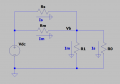
Since the current in the meter is the same, the voltage across it is the same. Let's call it Vm. Since Vm is constant, that means that the voltage across the resistance box is also constant. Let's call it Vb.
The current in the meter, in terms of the current through it and its resistance, is
Vm = Im · Rm
In the first case, the current in the meter is also the current in the decade box, so
Vb = Im · R1
In the second case, the current in the decade box is the sum of meter current and the shunt current
Vb = (Im + Is) · R2
Since these are the same voltage, we have
Im · R1 = (Im + Is) · R2
Since the shunt has the same voltage across it as the meter, the current in it is
Is = Vm / Rs = = Im · (Rm/Rs)
This yields
Im · R1 = (Im + Im · (Rm/Rs)) · R2
The meter current now cancels out of every term, leaving
Here's another way to approach it. In some ways it's easier, depending on how your mind works.
Initially, Rs and Ro are not in the circuit and R1 is set to produce a particular current in the meter, Im. Obviously, this current is the same current as in R1.
This means that
Im = Vb / R1 = Vm / Rm
So
Vb/Vm = R1 / Rm
Now imagine that the shunt resistor is put in place and R0 is put in place and adjusted so that the meter again reads Im. For this to happen, the shunt current must flow through R0 while the meter current is still flowing in R1.
This means that
Is = Vb / R0 = Vm / Rs
So
Vb/Vm = R0 / Rs
Equating the two expressions for Vb/Vm gets us
R1 / Rm = R0 / Rs
which yields
Rm = Rs · (R1/R0)
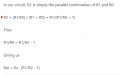
In our circuit, R2 is simply the parallel combination of R1 and R0
from this point i have confused.
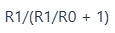
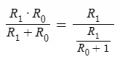
how you got this from this ? If i understand you right, it is equivalent to ? By the way, huge appreciation for such extensive response! As i suggest you scheme plotted on LTSpice. Can you advise some good sources for studying this program?
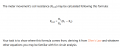
View attachment 344096from this point i have confused.
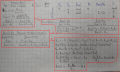
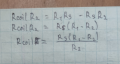
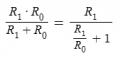
how you got this View attachment 344097from this View attachment 344098? If i understand you right, it is equivalent to View attachment 344099? By the way, huge appreciation for such extensive response! As i suggest you scheme plotted on LTSpice. Can you advise some good sources for studying this program?
You know that your result is wrong because you have, in the denominator of the denominator, R0+1. But the first term is a resistance and the second term is just a number. You can't add things together unless they have compatible units.
Remember what I said in your other thread about tracking units? This is an example of why. If you track your units religiously, then in very short order your mind will rebel at even writing down something like that, because you will unconsciously evaluate dimensional correctness as you go.
So go back and divide the numerator and the denominator by R0 very carefully.
If, on the other hand, you think that the right hand side is what I wrote, just in graphical format, then you need to revisit order of operations. Multiplication and division are performed before addition and subtraction, so
R1/(R1/R0 + 1) = R1/((R1/R0) + 1)
Although not required, this is why extra space surrounds the addition operator while none surrounds the division operator. It is to visually bind R1/R0 tighter than the " + 1".
LTSpice is free and it contains a tutorial to get you started. From there, it is usually adequate to either search its built-in help (which, admittedly, leaves something to be desired) or do a Google search for what you are trying to do at the moment, being sure to include LTSpice as one of the search terms. It is so widely used that there is no shortage of material out there that is easy to find.
do a Google search for what you are trying to do at the moment, being sure to include LTSpice as one of the search terms. It is so widely used that there is no shortage of material out there that is easy to find.
Yeah, i supposed that it has a lot of sources in the internet about this program. But that is the problem, may be i will encounter some low quality source and spend some time to get it and find some better source. I meant may be you already know some good sources as more experienced user, so i wouldn't spend time in vain to seek it by myself.
Yeah, i supposed that it has a lot of sources in the internet about this program. But that is the problem, may be i will encounter some low quality source and spend some time to get it and find some better source. I meant may be you already know some good sources as more experienced user, so i wouldn't spend time in vain to seek it by myself.
This is why I recommend looking for the specific help you need when you need it. Let's say that you want to add a second set of vertical axis to a plot. Do a search for "LTSpice add axis". You'll find several hits on the first page. Pick one. It either answers your question and works or it doesn't. You'll know almost immediately. If it doesn't, pick a different one. I'm not aware of any one site that has everything covered, let alone covered well.

 Facebook
 Google
 GitHub
 Linkedin