Facebook
 Google
 GitHub
 Linkedin

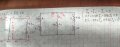
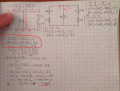
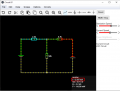
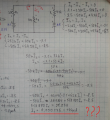
I really can't comprehend how the current should go in the question 6 of https://www.allaboutcircuits.com/worksheets/dc-branch-current-analysis/. I tried do everything like in the textbook article https://www.allaboutcircuits.com/textbook/direct-current/chpt-10/branch-current-method/ but i suppose that i just can't get how the current should go through the nodes. The methods says that if i make wrong direction of the current, that's no problem, it's merely would be sign "-" in the wrong direction current. But looks like it's matter, as i decided in two attempts in the first picture to make the directions arbitrary in case of resistor with 50k resistance. First scheme was my own, before i have seen the answer scheme, second scheme was after. In both cases i did exactly as clauses of the method state. Made the equations, but in both cases i got too big numbers due to 50k resistor and too big amperages in the results. To match the 9.1 and 8.5 volts it should be much less. If my sketches looks messy i can rewrite it in more comprehensible way. So i supposed that something wrong goes with my node current direction. In the second picture i wrote the direction of the currents of the batteries how i think they should pass through the circuit. Red arrows are current of 9.1V battery and pink are of 8.5V. Can they go through each other if they have reversed polarities? As i remember from previous worksheets if their polarities faces against each other, voltage of one battery will oppose to voltage of another. For instance, two batteries of 10 and 8 volts facing against each other: current would go from the 10 V battery through the 8V one and by that pass dropping 8 volts, so after that it would be 2 volts remain. But what going to happen in the case of this scheme? Should the voltages sum up? And as you can see, in the pass of 50k resistor the currents go against each other. And if i am right, i cant understand which one current should dominate, as i suppose it's impossible to exist two different currents in one conductor. And probably the resulting current of dominating one should be the result of subtraction of the less current against it.Am i correct in my current direction assumptions? What i'm doing wrong? Why i cant get reasonable currents by implementing branch current method?
Attachments
-
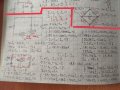 6.3 MB Views: 6
 -
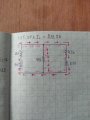 3.3 MB Views: 6
 -
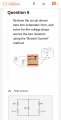 238.6 KB Views: 5