hi A,
I guess you have seen the Vfwd spread ie: 2.8V to 3.8V.?
Its the upper Vfwd limit that could be a problem, not the lower.
Chech the BIN numbers on the d/s
E
hi A,
I guess you have seen the Vfwd spread ie: 2.8V to 3.8V.?
Its the upper Vfwd limit that could be a problem, not the lower.
Chech the BIN numbers on the d/s
E
hi,
The Vfwd is the voltage required across the LED to enable the d/s specified current.
My point is that making changes to the drivers to gain a few tens of mV is not enough.
You could buy a big batch of Blue LED's and test for Vfwd min of 2.9V, but that's a pain.
hi,
The Vfwd is the voltage required across the LED to enable the d/s specified current.
My point is that making changes to the drivers to gain a few tens of mV is not enough.
You could buy a big batch of Blue LED's and test for Vfwd min of 2.9V, but that's a pain.
True, a few mV aren't going to make much of a difference. But, if I boost the supply voltage for the LEDs to 5V and drive them at 3.8V, will that damage them? I can't see an absolute maximum voltage listed and assumed the 3.8V was it - and I can't see any way of ordering one of these anywhere which (LCSC, Mouser, Digikey) which allows you to specify BIN code.
Cheers Eric - I'm not all that concerned about battery life, the 10440 I'm going to use is advertised at 200mAh so assuming a quarter of that, a total 50mA equivalent continuous use (using PWM to cut the duty cycle of the LEDs) for equivalent 5 mins per day, the battery would have to be recharged every 12 days.
Regardless of the Vfw of the actual LED, could I pick a resistor that allows no more than 20mA at the lowest possible Vfw for that part (5V-2.8V=2.2V ; 2.2V/0.02mA = 110R (use 120R)) and then if it ends up having a 3.8Vfw that'll mean (5V-3.8V=1.2V; 1.2V/120R = 10mA), with PWM duty cycle used to set brightness to suit?
hi,
It is most likely that you will get the LED 'brightness' that is acceptable at a lower current than the 20mA stated.
I would suggest you get some the Blue LED's and run a brightness versus current check, in that way if you could get away with say 10mA that will push up the battery life.
Check the Vfwd's as you test, as a confirmation check of their voltages.
As you are pulsing the LED's you could run them higher than the stated 20mA, say 30mA.. check the d/s
E
Yeah, I would expect acceptable brightness well below 20mA - how do I tell from the datasheet what an acceptable maximum current might be? The plots on page 6 of the datasheet range up to 30mA.
As soon as I've kicked the last few tyres (MOSFET selection, diode selection, creating LTSpice models of these and the LED (after learning how to create SPICE models...) I'll be ordering a few assembled PCBs to test - this will include making a mockup to test brightness in-situ.
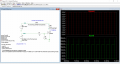
Here is a sim using the model.
I've represented a constant current supply using "Rsim". This provides 20mA constant current for the LED.
I don't know if you intend to incorporate anything like that, but without it you won't have precise control over the current supplied to the LED.
This will translate into a variation of brightness and color intensity.
That's awesome eetech00, thanks! How did you generate the SPICE parameters for that?
I don't plan on implementing constant current - want to limit complexity and cost, intend on making up to 1,000 to test market. For the time being, brightness controlled by PWM and I'll take the punt that the colour will be acceptable throughout the current range. Prototyping will tell!
The only "unknowns" now in the SPICE modelling are the exact MOSFETs, Schottkys and the PFS154, and I figure approximations are good enough for those.

 Facebook
 Google
 GitHub
 Linkedin