Facebook
 Google
 GitHub
 Linkedin
Hello everyone,
I’ve been working on a PCB design for my project, and I would appreciate any feedback or recommendations you can offer. It's a very basic schematic, I'm just doing the prototype for the power circuitry for 4AA batteriee pack now and fixing the overall pcb layout by making the circuit more efficient.
I have gathered all the necessary components and created a basic outline in Altium, I’m very new to PCB design and I'm finding some aspects challenging. I've gained foundational knowledge through an Altium learning course and have some very basic experience in KiCad, but I would appreciate any specific guidance or resources that could help me advance with this Schematic
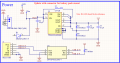
What I want it to do:
I looked online and found this example circuit flow for a PCB with 4 AA batteries. Please let me know what you think.
Example Circuit Flow:
1. 4 AA Batteries in Series (6V)
2. Reverse Polarity Protection
3. Voltage Regulator (Linear or Buck Converter)
4. Decoupling Capacitors
5. Power Switch
6. PCB Power Input.
Here are the descriptions of each step and its purpose.
Voltage Regulation:
If your PCB operates at a specific voltage (e.g., 3.3V, 5V), you will likely need a voltage regulator to step down the voltage from the battery pack. The regulator stabilizes the voltage despite the battery discharge curve, which ensures consistent power delivery to the circuit.
Reverse Polarity Protection:
To prevent damage in case the batteries are inserted incorrectly, a Schottky diode or a P-channel MOSFET can be placed in the circuit to block current if the polarity is reversed.
Decoupling Capacitors:
A capacitor (typically a combination of a larger capacitor like 100 µF and a smaller one like 0.1 µF) is used at the input and output of the voltage regulator to smooth voltage fluctuations and filter noise. These capacitors also help stabilize the output of the regulator.
Power Switch:
A power switch can be placed between the battery pack and the regulator to allow manual control over when the PCB is powered on or off.
So I looked for these materials and came up with an example:
4 AA Battery Holder.
Schottky Diode (1N5819 for reverse polarity protection).
Buck Converter (LM2576 for 5V output).
Capacitors (100 µF and 0.1 µF ceramic)
Power Switch (SPST switch).
(I'm very new to PCB design and would appreciate detailed, step-by-step instructions on how to start. Could you please guide me through the specific steps, as I'm still learning the basics?)
Looking forward to your insights!
Thanks in advance for your help.
I’ve been working on a PCB design for my project, and I would appreciate any feedback or recommendations you can offer. It's a very basic schematic, I'm just doing the prototype for the power circuitry for 4AA batteriee pack now and fixing the overall pcb layout by making the circuit more efficient.
I have gathered all the necessary components and created a basic outline in Altium, I’m very new to PCB design and I'm finding some aspects challenging. I've gained foundational knowledge through an Altium learning course and have some very basic experience in KiCad, but I would appreciate any specific guidance or resources that could help me advance with this Schematic
What I want it to do:
I looked online and found this example circuit flow for a PCB with 4 AA batteries. Please let me know what you think.
Example Circuit Flow:
1. 4 AA Batteries in Series (6V)
2. Reverse Polarity Protection
3. Voltage Regulator (Linear or Buck Converter)
4. Decoupling Capacitors
5. Power Switch
6. PCB Power Input.
Here are the descriptions of each step and its purpose.
Voltage Regulation:
If your PCB operates at a specific voltage (e.g., 3.3V, 5V), you will likely need a voltage regulator to step down the voltage from the battery pack. The regulator stabilizes the voltage despite the battery discharge curve, which ensures consistent power delivery to the circuit.
Reverse Polarity Protection:
To prevent damage in case the batteries are inserted incorrectly, a Schottky diode or a P-channel MOSFET can be placed in the circuit to block current if the polarity is reversed.
Decoupling Capacitors:
A capacitor (typically a combination of a larger capacitor like 100 µF and a smaller one like 0.1 µF) is used at the input and output of the voltage regulator to smooth voltage fluctuations and filter noise. These capacitors also help stabilize the output of the regulator.
Power Switch:
A power switch can be placed between the battery pack and the regulator to allow manual control over when the PCB is powered on or off.
So I looked for these materials and came up with an example:
4 AA Battery Holder.
Schottky Diode (1N5819 for reverse polarity protection).
Buck Converter (LM2576 for 5V output).
Capacitors (100 µF and 0.1 µF ceramic)
Power Switch (SPST switch).
(I'm very new to PCB design and would appreciate detailed, step-by-step instructions on how to start. Could you please guide me through the specific steps, as I'm still learning the basics?)
Looking forward to your insights!
Thanks in advance for your help.