Replacing a selenium rectifier in a jukebox amp

Thread Starter

Nick De Baerdemaeker

Joined Jun 18, 2018
22
I'm at a loss actually...
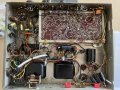
I bought this jukebox and amp "revised" but having recently bought a capacitor kit, and looking at what the amp looks like straight from 1958, I honestly have no clue what I'm doing.

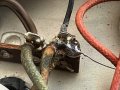
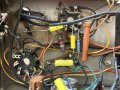
I can confirm so far that the fuses are not blown (the multimeter never says OL), but there is a part that concerns me and looks odd, as if the solder is crumbling. I've decided to go see a professional, although they already told me it's not quite their expertise.

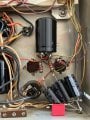
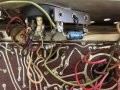
Besides that, the old selenium rectifier was already replaced with the small black one (not by me).
The two capacitors 73474 and 73475 are also disconnected, and were replaced with the big black one on the right.

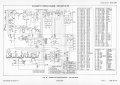
I've added the full schematics
 

Attachments

MisterBill2

Joined Jan 23, 2018
27,528
Looking at the circuit diagram, the bridge rectifier is for the relay supply to pull in the other mains primary winding.
Has the relay burned out as well?
Now we have a clue. So the first step is to see if the 24 volts is being produced. Then check to see if it is at the bridge rectifier. Then see if it gets to the relay that switches that mains voltage to the other transformer. Then verify if that relay pulls in.
Repairing a crumbling solder connection is not that big a deal, because the joint is already in place. Just add heat and a bit more solder. "Crumbly solder joints certainly can stop any current from flowing.
 

MisterBill2

Joined Jan 23, 2018
27,528
I'm at a loss actually...
I bought this jukebox and amp "revised" but having recently bought a capacitor kit, and looking at what the amp looks like straight from 1958, I honestly have no clue what I'm doing.

I can confirm so far that the fuses are not blown (the multimeter never says OL), but there is a part that concerns me and looks odd, as if the solder is crumbling. I've decided to go see a professional, although they already told me it's not quite their expertise.

Besides that, the old selenium rectifier was already replaced with the small black one (not by me).
The two capacitors 73474 and 73475 are also disconnected, and were replaced with the big black one on the right.

I've added the full schematics
REpairing a crumbling solder connection is not that big a deal, because the joint is already in place. Just add heat and a bit more solder. "Crumbly solder joints certainly can stop any current from flowing.
 

Thread Starter

Nick De Baerdemaeker

Joined Jun 18, 2018
22
Thing is that I can't get my head around the capacitors, as Dodgydave says.
The 73474, even though it has four listed from A to D, only three are present on the drawing.
The 73475 are all four present.

It's clear that the previous revision did some tricks, the location where the silvery capacitors 74/75 should be, there's one big cap there, with three others attached including resistors.

I've made a searchable pdf file of the drawing, looking up 34 and 35 should give you the exact locations of each.

Asides from that, I've added the location of the crumbling solder.

I'm open to suggestions, I can of course resolder the crumbly bit but asides from that I'm really unsure, especially compared as to what other rebuilds look like.
 

Attachments

Dodgydave

Joined Jun 22, 2012
11,395
Forget the capacitors for the moment, find the AC voltage to the bridge rectifier first , the transformer may be blown or a broken wire.
 

MisterBill2

Joined Jan 23, 2018
27,528
I'm at a loss actually...
I bought this jukebox and amp "revised" but having recently bought a capacitor kit, and looking at what the amp looks like straight from 1958, I honestly have no clue what I'm doing.

I can confirm so far that the fuses are not blown (the multimeter never says OL), but there is a part that concerns me and looks odd, as if the solder is crumbling. I've decided to go see a professional, although they already told me it's not quite their expertise.

Besides that, the old selenium rectifier was already replaced with the small black one (not by me).
The two capacitors 73474 and 73475 are also disconnected, and were replaced with the big black one on the right.

I've added the full schematics
After examining the whole circuit, what becomes clear is that this is a complex system. The first part will be getting the mechanical portion functional again. That will be tracing all of the controls wiring and making the voltages right. Part of the challenge is that it appears that the turntable for the records is interlocked with the amplifier, so that it will not start spinning until the amplifier is warmed up and ready to play. So you will need to bypass that relay contact until you have the mechanism working.
The amplifier is a separate concern in that it is shown to have a "Cobra" pickup, which is a very different scheme that involves an oscillator and a variable inductance. I do not have an explanation for how it works.
 

Dodgydave

Joined Jun 22, 2012
11,395
After examining the whole circuit, what becomes clear is that this is a complex system. The first part will be getting the mechanical portion functional again. That will be tracing all of the controls wiring and making the voltages right. Part of the challenge is that it appears that the turntable for the records is interlocked with the amplifier, so that it will not start spinning until the amplifier is warmed up and ready to play. So you will need to bypass that relay contact until you have the mechanism working.
The amplifier is a separate concern in that it is shown to have a "Cobra" pickup, which is a very different scheme that involves an oscillator and a variable inductance. I do not have an explanation for how it works.
The cobra pick-up works on the principle of a tuned circuit, the pickup stylus alters it's inductance and varies the frequency of the oscillator , this is fed into an half wave diode or demodulator like an AM radio, the result is the audio, which is then amplified .
As for the relay contacts i would bypass it and wire both transformers together as a temporary measure.
 
Last edited:

MisterBill2

Joined Jan 23, 2018
27,528
The cobra pick-up works on the principle of a tuned circuit, the pickup stylus alters it's inductance and varies the frequency of the oscillator , this is fed into an half wave diode or demodulator like an AM radio, the result is the audio, which is then amplified .
As for the relay contacts i would bypass it and wire both transformers together.
Consider that there is a whole lot going on, and that powering that second transformer takes the system out of standby and into the operation mode, Powering them both constantly will not be a reasonable plan after the system is brought back to working as it should. Consider that the tube filaments are powered by both transformers, so that in standby the tubes are getting only threew volts of heater power, until the play mode is enabled . And consider that the turntable is not enabled until the amplifier is ready to amplify. The system is intended to enable in a specific sequence, not at all like a home system with solid state amplifiers. I did suggest bypassing the contacts to check out the turntable drive, but not as a final change, only as a system service condition.
 
Top