Replace 2 D-size batteries with a Power Adapter

Status
Not open for further replies.

Thread Starter

yourminky

Joined May 31, 2019
33
I have a water heater that uses 2 D batteries to power the igniter which creates several sparks in a series very quickly until the gas lights up. I want to replace the 2 D-size batteries with a simple 3 volt AC power adapter so I don't have to change batteries again. I am thinking the max current draw is 1 amp or less. I have a few 5 volt 1 amp USB phone charger adapters that I could use. I could use a LM317 to regulate the voltage. I could also use 3x IN4001 diodes in series to drop the voltage to 3V. Have anyone tried this before? Can you provide some tips?
 

Audioguru

Joined Dec 20, 2007
11,248
Is the water heater a modern high efficiency type?
My old style gas water heater uses a pilot light flame (natural gas is cheap here) and so does my gas fireplace. No electricity is needed.
 

Thread Starter

yourminky

Joined May 31, 2019
33
Thanks for your replies. What concerns is the 10 or so rapid-fire sparks which draws high current. When the initial current draw is at max which is 1 amp, the voltage drop across the 3x diodes is going to be a lot higher than 0.7 volts each. A larger capacitor may be an answer. Is LM317T (low drop) a better solution?
Regular efficiency heater.
 

djsfantasi

Joined Apr 11, 2010
9,237
Thanks for your replies. What concerns is the 10 or so rapid-fire sparks which draws high current. When the initial current draw is at max which is 1 amp, the voltage drop across the 3x diodes is going to be a lot higher than 0.7 volts each. A larger capacitor may be an answer. Is LM317T (low drop) a better solution?
Regular efficiency heater.
You’re thinking about a resistor. The advantage of using diodes is that their voltage drop is always 0.7V regardless of current draw. Resistors are a linear component. Diodes, no.
 

Thread Starter

yourminky

Joined May 31, 2019
33
You’re thinking about a resistor. The advantage of using diodes is that their voltage drop is always 0.7V regardless of current draw. Resistors are a linear component. Diodes, no.
OK, thanks. I will try the 3x diode method over the weekend and update.
 

crutschow

Joined Mar 14, 2008
38,503
OK, thanks. I will try the 3x diode method over the weekend and update.
You might want to add a small resistive load at the diode output, so the open-circuit voltage doesn't get too high.
1kΩ or so should work.

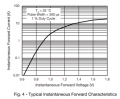
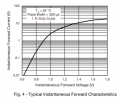
Contrary to djsfantasi's assertion (which is a common one), a diode's forward voltage does change significantly with current, but it's a logarithmic relation, not linear (see data-sheet clip below for the 1N400x series).
That diode has about a 0.9V drop @ 1A.

If that's too much, you might try just two diodes.
The open-circuit voltage with the 1kΩ load resistor to ground should be about 3.7V, which is unlikely to damage the circuit.
I would expect all the components to tolerate at least 5V.

Alternately, use a low-dropout regulator (but I don't think an LM317T is one).
Edit: Here's an example. (The 3.3V fixed output should be fine.)

upload_2019-5-31_12-13-31.png
 

Attachments

Last edited:

djsfantasi

Joined Apr 11, 2010
9,237
You might want to add a small resistive load at the diode output, so the open-circuit voltage doesn't get too high.
1kΩ or so should work.

Contrary to djsfantasi's assertion (which is a common one), a diode's forward voltage does change significantly with current, but it's a logarithmic relation, not linear (see data-sheet clip below for the 1N400x series).
That diode has about a 0.9V drop @ 1A.

If that's too much, you might try just two diodes.
The open-circuit voltage with the 1kΩ load resistor to ground should be about 3.7V, which is unlikely to damage the circuit.
I would expect all the components to tolerate at least 5V.

Alternately, use a low-dropout regulator (but I don't think an LM317T is one).

View attachment 178641
I stand corrected! o_O
 

Thread Starter

yourminky

Joined May 31, 2019
33
I am guessing 1 amp or lower draw, not 100% sure.
Regarding higher voltage drop at max current output, I remembered that from college which was many decades ago. :)
I also remember that without a load the multi-meter would read only 0.3 volt drop per 1N400x diode since the meter has a high input impedance and it would draw very little current thus giving an incorrect reading.
Without a load resistor, the 3x-diode-in-series circuit will give around 4 volts and a few mA current at the very beginning and within a few milliseconds go down to 3 volts and increase the current to a few hundred mA, which is different than a D-size battery which can give a whole Amp or more at the very beginning.
Is the above assumption correct?
Will a 1/4 watt 1k resistor work or I'll need a 1/2 or 1 watt one?
 

Thread Starter

yourminky

Joined May 31, 2019
33
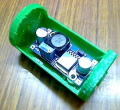
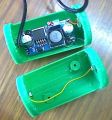
Success! I just finished the project.
I used a 1 amp 5.18 volt old phone charger, 3x 1N4007 diodes from a burnt out CFL. Each diode had 0.61 forwarding voltage per my multi-meter. The output voltage with a 1kohm 1/4 watt load resistor was 3.33 volt. The load resistor or the phone charger never got hot, seemed safe. Voltage did not drop much when the rapid fire igniter spark started. Hot Water Heater is working fine.
Next project is fixing the rechargeable battery for the drill. It has a few bad NiCd cells that need to be replaced.
Thank you for your help.
 

crutschow

Joined Mar 14, 2008
38,503
The output voltage with a 1kohm 1/4 watt load resistor was 3.33 volt. The load resistor or the phone charger never got hot, seemed safe.
3.33V across 1kΩ is just 3.3²/1k = 11mW, which likely causes an undetectable rise in resistor temperature (as least to your finger), so your 1/4W resistor is quite safe. ;)

You might what to keep a couple batteries handy in case the power goes out and you still want hot water.
 

Audioguru

Joined Dec 20, 2007
11,248
Years ago I worked with boardroom conferencing products and the wireless microphones had Ni-Cads that were trickle charged when not used. The Ni-Cads frequently developed short circuits (a common problem) that I could zap away with a charged capacitor.

Battery University.com advises to not continuously trickle charge a Ni-Cad battery. Modern Ni-MH cells made with the Eneloop formula hold a charge for one year and also should not be tickle charged.
 
Status
Not open for further replies.
Top