Because you would still have the transistor... and the relay.
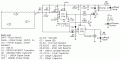
The transistor can do it without the relay. I changed the kind of transistor to something better suited for the application. Q1 was in the same location for all the drawings.
Sorry I didn't get back with you sooner. I've started the process, when I've got it somewhere I'll PM you (but you are welcome to look while I do it). AAC allows me to update the post indefinately, so I'll be modifying the attachment here as I work on it.
If you would be as kind to list the parts I would need for this build, when you get the time, I will buy the parts needed and use that diagram as a "where the bits go guide"
With the exception of the float switch and power supply (not sure about the Sonalert) all these parts are available from Radio Shack. Don't limit yourself however, RS tends to be expensive. If a part is mechanically different, such as the capacitors or Q2, don't sweat it, it will work.
OK, here is the final product. You can use a short version of the protoboard to build it, and save space. The protoboard comes with sticky tape on the bottom to mount it.
Use superglue to tack the wires coming off the board down, being careful not to get any in the holes.
The LEDs can be moved after you've tested it and put it into a box (I assume you are going to do this).
OK, I said physical size isn't important, and it isn't, as long as it fits in the picture. The voltage rating is so high it just isn't important (12VDC compaired to 250VAC), but it has to mechanically fit in the space.
Yeah, I noticed you thought I had two chips, but what I had is 2 chips in one. This is pretty common in electronics nowdays.
Remember, all these parts are available at Radio Shack. Do you have one close to you?
The pot is sold by RS for around $1.99, but BG Micro sells the same parts for $0.15. If you can find them from another source I say go for it. If you download my PaintCAD package you can find part numbers and relative physical dimensions in the bread board folder for the caps.

 Facebook
 Google
 GitHub
 Linkedin