Relay switch to control which 12v source to use...

Thread Starter

revdr.biko

Joined Dec 16, 2019
14
i am not in anyway , shape, or form an engineer.
and thus a bit clueless in this forum.
i am a sailboat captain and would like to pimp out my ride, as it were.
most of the time, the sail boat is at dock and plugged in to 'shore power'.
that is: 120v 30A (sometimes 15A)... i.e. normal power for north america.
their are 2 batteries: starter & house. the house powers all the stuff (lights, radio, electronics...etc)
they both need charging.
as it is now, the load (i.e. 12v boat stuff) drains the house battery and the shore power recharges the battery.
i want to cut out that extra loop while plugged in at shore.
the idea is to install & hook up a transformer (120v to 12v, 20A) to power the boats stuff while at shore.

i've put together an idea but i really don't know if relays can do this kind of thing.

so i'll have two possible 12v power sources and one load (the 12v boat stuff)
house battery would be connected to the NC (normally closed, normally used) lead,
the transformer would be hooked up to the NO (normally open) AND the powered switch.
thus if there is no shore power, then the house battery is connected to the load (12v boat stuff),
but if the shore power is connected, then the transformer generates 12v, which then switches the power source and also becomes the power source.
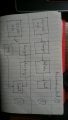
does that make sense?RELAY_SWITCH.png
thank you all for your time.
 

ArakelTheDragon

Joined Nov 18, 2016
1,366
It makes sense and is a feet for a "non-engineer". But it has a lot of calibration and is dangerous at this voltage and current. The batteries must be charged at 14.2V. A transformer can almost directly charge the battery, there is a danger of overheating and setting the transformer on fire if it's not properly chosen. The relay must be able to sustain the high current and voltage. The relay coil must be switch on when the second power source is connected. At the moment I can't draw the circuit.
 

Thread Starter

revdr.biko

Joined Dec 16, 2019
14
it seems i was unclear...
the relay is to cut out the house, and instead use the transformer for lights. not charge the house via the transformer. charging the house would be done with a store bought marine grade charger independent of the transformer.
thus, the transformers only task is to run lights & similar 12v equipment so the house doesn't have to.

and by house i mean 12v deep cell marine battery.
 

ArakelTheDragon

Joined Nov 18, 2016
1,366
It's better to remove the relays and use the battery instead. The battery can charge and supply the load with current at the same time, as long as the load does not drain too much current. In this case you do bot need the transformer and can directly connect the charger that you already have if it has a high enough current.

Edit:
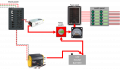
I uploaded a new block diagram
 

Attachments

Last edited:

Thread Starter

revdr.biko

Joined Dec 16, 2019
14
i see.
my concern was that a battery charger is not meant to run lights and other constant loads. i have had problems in the past.

so it seemed a better idea to run constant loads on a transformer and let the battery charge and 'rest' while at shore.

here is a simplified sketch with arrows:
RELAY_SWITCH_SIMPLIFIED.png
 

ArakelTheDragon

Joined Nov 18, 2016
1,366
Whst kind of problems did you have? I uploaded a different block diagram in the previous post. If you want to use relays and a transformer, just add the relays after the battery and after the transformer.
 

Thread Starter

revdr.biko

Joined Dec 16, 2019
14
After the transformer is chosen correctly for constant work, you need a bridge rectifier and a capacitor(battery to filter the voltage).
does one still need a bridge rectifier and a capacitor if the transformer is this:
https://www.amazon.ca/ALITOVE-Transformer-Switching-Converter-Security/dp/B07DN8HH8V

* usual draw for lights is currently around 5 amps max . but this is for a new boat so i'll have to test.
a transformer that is twice what i need sounded like a good idea.
 

Thread Starter

revdr.biko

Joined Dec 16, 2019
14
Your diagram looks good. Use a 120 v AC relay wired to the AC breaker panel. When you have AC, it switches from battery to transformer. Be sure the relay can carry the load and then some.
would it not be more prudent (and safer) to have a 12v DC relay that was down line from transformer & battery? that way battery could charge fully while not having any draw on it, and the 'smart charger' would self regulate, in peace and quiet as there would be no draw.
 
Last edited:

Thread Starter

revdr.biko

Joined Dec 16, 2019
14
What kind of problems did you have?

the battery charger flip/flops between charging states. once the battery is fully charged it turns off... a few minutes later the draw on the battery restarts the charge cycle, and this cycle repeats, constantly. on a few occasions the 'smart' charger got confused and just stopped charging, entered an error mode, & allowed the battery to fully drain.

for my new boat i will get a smarter, 'smart' charger, but i still want to avoid the flip/flops.
 

ArakelTheDragon

Joined Nov 18, 2016
1,366
the battery charger flip/flops between charging states. once the battery is fully charged it turns off... a few minutes later the draw on the battery restarts the charge cycle, and this cycle repeats, constantly. on a few occasions the 'smart' charger got confused and just stopped charging, entered an error mode, & allowed the battery to fully drain.

for my new boat i will get a smarter, 'smart' charger, but i still want to avoid the flip/flops.
If the charger has the ability to set the charging current, you have to charge with a current, slightly less than the drain current. As for the error mode, I don't know how that happened. Even with my 30 dollar solar charger for 100A, I can charge and drain at the same time. I think a solar charger will be better for you.
 

Tonyr1084

Joined Sep 24, 2015
9,744
Your diagram looks good. Use a 120 v AC relay wired to the AC breaker panel. When you have AC, it switches from battery to transformer. Be sure the relay can carry the load and then some.
I fully agree with this. It's what I would have suggested it if nobody had made this recommendation before.
would it not be more prudent (and safer) to have a 12v DC relay that was down line from transformer & battery? that way battery could charge fully while not having any draw on it •••.
I wouldn't think so. The whole point of an automated system is so that when 120 is available the relay clicks in and connects the 12 volts coming from the transformer while at the same time cutting the battery out of the circuit.

I'm not the biggest fan of completely cutting the battery out of the circuit. The reason is because if you let a battery sit a long time without maintaining its charge the internal plates can begin to build up sulfates which will reduce the battery's ability to deliver a charge. While I understand your desire to cut the battery out of the circuit, it's my opinion you would be better served with a charger that can both charge the battery AND run the boat electronics. That way the battery is always maintained and ready at a moments notice. Again, another opinion here, I wouldn't bother switching the deep cycle battery in and out of the circuit. Not with a mechanical switch or with a relay. The ONLY drawback from that is you would not have a way to isolate the battery. Performing maintenance on the battery would require complete electrical shutdown of the entire system. And I assume your starter battery is separate from the circuit.
 

Thread Starter

revdr.biko

Joined Dec 16, 2019
14
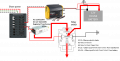
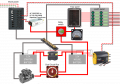
so here is my latest schematic:

if the 120ac is available then it powers the transformer, which in turn throws the relay so that the boat is then powered by the transformer.
the house battery is still maintained via the charger (so always ready and no issue with internal plates) but is not in the loop for any draw on it. (basically in maintained storage)

the beauty of this is that i just unplug (battery magically kicks in) and then go sailing... and i wont forget to throw extra switches.

my new concern is heat... if i let this sit with 120ac on all the time will the relay heat up or even burn out?

at this point i'm just avoiding yet another switch, but on-on switches, with no off in the middle, are expensive and rare.

boat is in rough shape and needs a lot of work... so i'll be at port and working for the better part of the next two years.
when i do head out, i just wanna go and not forget stuff. (mast down and motoring out to a BBQ/swim spot is well within the realm of possibilities)


"i work long and hard to be as lazy as possible." ~meRELAY_SWITCH_wired.png
 

Tonyr1084

Joined Sep 24, 2015
9,744
As you have drawn, it will work. Not sure if you're confusing a 120 VAC relay with a 12 VDC relay, but since the transformer is powering the "house" then it can also power the relay. Shore power energizes the transformer. The transformer energizes the relay. The relay switches the house to the transformer (just as you want it). When you lose shore power the relay drops out and the battery takes over. Since you have a separate battery charger there would be no need to concern yourself with the health of the battery long term.

[edit] make sure that your battery charger doesn't complete a circuit between both battery positives. Each battery should be isolated. Otherwise when you drain one battery you're draining both. Each charging circuit for each battery needs to be 100% isolated one from the other. {end edit}

As for heat, if it's rated for continuous work then it should be fine. If not - using a higher voltage rated relay, say 18 volts (not 24, even though I've successfully used 24 VDC relays on a 12 volt circuit {actually 13.8 VDC}) you should be good. Though I don't know where you're going to easily find an 18 volt control relay. Whatever you chose, make sure you have sufficient data to tell you everything about that relay. How hot it will get, how much voltage it will take to trigger (throw) the armature and how low a voltage it will take for the relay to cut out.

As with everything - make sure the devices you are hooking together will do the job. Not just theoretically, but practically. And when engineering a device such as that on a boat - keep in mind that a failure can be catastrophic to the craft and to life. I'd engineer with either 1 1/2 times over rating or 2 times over rating. That means if a relay will handle 20 amps pick one rated to handle 30 amps or 40 amps. As for heat dissipation of the relay coil - make sure if you're going to have to dissipate 10˚C above ambient make sure you can dissipate AT LEAST twice that. Fire on the water is no joke. Not like you can just run across the street. You're going in the water. First consideration needs to be SAFETY. Second is reliability. You don't want to be out and suddenly find you're without electronics (i.e. ship to shore communication). Third, whatever you design has to do what you want it to do. Every time. And finally, SAFETY.
 

Thread Starter

revdr.biko

Joined Dec 16, 2019
14
As you have drawn, it will work.
awesome.
thanks to everyone!

...Not sure if you're confusing a 120 VAC relay with a 12 VDC relay,...
https://www.amazon.ca/MICTUNING-Fuse-Relay-Switch-Harness/dp/B07CBNBB72/
this one should do the job, but it comes in a 6-pack and i only need one.
i like the built-in fuse.

[edit] make sure that your battery charger doesn't complete a circuit between both battery positives. Each battery should be isolated. Otherwise when you drain one battery you're draining both. Each charging circuit for each battery needs to be 100% isolated one from the other. {end edit}
yeap... well aware, and there's a neat thing i've installed for that on my current boat, and will on the new boat.
https://www.amazon.ca/Blue-Sea-Systems-120A-Battery/dp/B000RZNP5K/
it is in the original drawing of my circuit at the top of this thread.

As for heat, if it's rated for continuous work then it should be fine. If not - using a higher voltage rated relay, say 18 volts (not 24, even though I've successfully used 24 VDC relays on a 12 volt circuit {actually 13.8 VDC}) you should be good. Though I don't know where you're going to easily find an 18 volt control relay. Whatever you chose, make sure you have sufficient data to tell you everything about that relay. How hot it will get, how much voltage it will take to trigger (throw) the armature and how low a voltage it will take for the relay to cut out.
i will contact the seller. good advice.

As with everything - make sure the devices you are hooking together will do the job. Not just theoretically, but practically. And when engineering a device such as that on a boat - keep in mind that a failure can be catastrophic to the craft and to life. I'd engineer with either 1 1/2 times over rating or 2 times over rating. That means if a relay will handle 20 amps pick one rated to handle 30 amps or 40 amps. As for heat dissipation of the relay coil - make sure if you're going to have to dissipate 10˚C above ambient make sure you can dissipate AT LEAST twice that. Fire on the water is no joke. Not like you can just run across the street. You're going in the water. First consideration needs to be SAFETY. Second is reliability. You don't want to be out and suddenly find you're without electronics (i.e. ship to shore communication). Third, whatever you design has to do what you want it to do. Every time. And finally, SAFETY.
yeap... well aware, which i exactly why i'm on this web site.
my first boat draws less than 5 amps with everything on.
it's for sale: Firefly
larger boat will have more things to draw amperage but i'd be incredibly shocked if it approached 10amps. that's why i set things up for 20amp transformer & 30amp relay. but the actuall draw will be tested before transformer & relay are purchased .

in the open state (i.e. not on AC power) the relay should not produce any heat at all as the electromag is off.
so biggest risk would still be at harbor and not at sea.

when a relay fails, does it fail to normally-closed? because that's fine. that's safe.
if it fails and stays open, or locks to normally-open, that's a problem.
 

MisterBill2

Joined Jan 23, 2018
27,504
Another possibility would be to use the "power converter" package used with travel trailers. Those systems switch over to supply the 12 volt accessory items from the AC source when it is available and revert to the 12 volts battery when no AC is provided. An added benefit is that they also charge the battery. And usually they will cost half as much as the similar functions provided for a boat. And they are rather safe, given that they are often installed under a bunk in sleeping quarters. And they do not drain the battery by themselves.

I did not read through all of the in-between posts this morning, so this may possibly have been suggested already.
 

Tonyr1084

Joined Sep 24, 2015
9,744
when a relay fails, does it fail to normally-closed?
IF a relay coil fails it falls to its de-energized state. Meaning the NC will be closed. However, a relay can fail in other ways: The contacts can build up carbon and fail to switch, meaning they switch but do nothing. The other way a relay can fail is the contacts can become welded. They can weld in the NC position OR in the NO position. With welded contacts you lose control of the circuitry. That - at sea - can be a problem.

To a non-nautical guy like me, I can't imagine all the possible dangers. I may even imagine an un-real danger. The point is that nobody here wants you to get hurt. Or for your system to harm others. That's why safety is both the first and last concerns - especially in an area where you can't just pull over and wait for help to arrive.
 

Thread Starter

revdr.biko

Joined Dec 16, 2019
14
ok.
still all good types of fails, and here's why:
fail01: de-energized state, electromag fail. this is the normal state for the boat. all is well.
fail03: weld to NC, again this would be the normal state of the boat. all is well.
fail04: weld to NO position. this is not good but will only happen while at port. the instant i shut of the main and the power goes out i know not to go off gallivanting around at sea with no power, and check things. (will have spares)
fail02: fail to make good contact after switch. this is not good but will only happen while at port. same as fail04.

ammeters prior to relay on each source will indicate state of relay.
 
Top