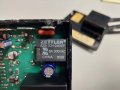
Relay on a Pizza Oven Temperature Controller.

Ian0

Joined Aug 7, 2020
13,097
That looks like a fairly standard size. What does the pcb footprint look like? Common pin centrally at one end, n/c and n/o pins at the other end, and coil pins near the common pin?
 

Tonyr1084

Joined Sep 24, 2015
9,744
How do you know it's a faulty relay? Those things are pretty robust. Not beyond failure, but rare. Have you fully diagnosed the problem? Don't spend money until you know exactly what is in need of fixing. ALSO important is knowing what caused the initial failure in the first place. You could put a new Do-Ma-Flachi in and have it blow out the first time you try to use it.

I don't recall ever seeing a failed relay. In fact, I've found some very old school relays that were still operational.
 

meth

Joined May 21, 2016
298
I dont agree that relays are so hard to go bust, but I agree that you should determine that the relay is faulty in the first place and also examine if there is something that caused that.
From my experience, stuck relay is something that happens... well not OFTEN... but CAN happen (not as hard as the colleague described).
 

Tonyr1084

Joined Sep 24, 2015
9,744
I have seen stuck contacts, but that was on a manually actuated switch. Contact welding is not uncommon, especially when overloaded. Same would be true of a relay. If the contacts are overloaded or not used as per their rating then it is possible to weld contacts. In this case, a commercially produced oven with a relay to control the heating element should be capable of handling at least 133% of the normal expected load. Since the relay is rated for 6 amps at 300 volts AC that would handle 1800 watts (or VA in the correct terminology). My wife's hair dryer is capable of 1800 watts. That's 15A at 120VAC. A relay rated for 6 amps at 300 volts AC would likely be tested at 133% of that rating. That's 1 and 1/3 times more than the anticipated load.

Now, the coil itself could have opened due to poor connections to the pins; that I've seen before in other things. Had a Dremmel tool go bad. When taken apart it was apparent that the failure was due to a very short wire barely making contact with the plug body it was connected into. And since my "wire stretcher" was in the shop for repairs I was not able to extend the wire. However, I was able to solder the wire to the connector and return the tool to usefulness.

I would not suspect a failed relay quite so quickly. Removing it from the board would render the ability to bench test it. But I'd be more suspicious of the controlling circuit that energizes the relay. But without board in hand I can't test anything. It's up to the TS to do the testing.

Again, determine the reason for the failure as well as determining what failed.
 

Tonyr1084

Joined Sep 24, 2015
9,744
Oh, and since you're new to AAC - Welcome to AAC. I just hope the new member hadn't already run out and purchased a replacement relay without revisiting the thread.
 
Top